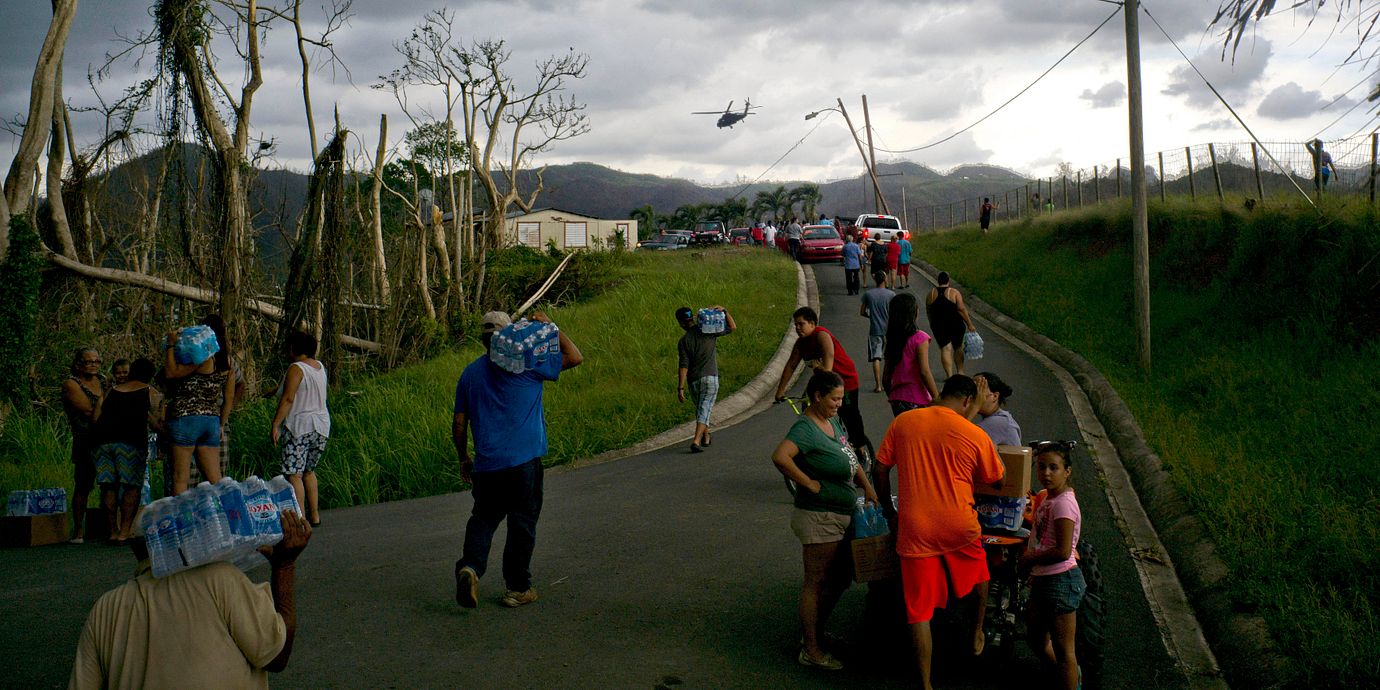
25 hushåll saknar ännu el i Puerto Rico efter Maria
Det har gått omkring elva månader sedan orkanen Maria svepte över Puerto Rico och lämnade stor förödelse efter sig. Sammanlagt 1,4 miljoner hushåll blev strömlösa i ovädret.
Nu – nästan ett år senare – är det bara 25 hushåll kvar som inte har fått strömmen tillbaka, rapporterar CNN och hänvisar till ett Twitterinlägg från det statligt ägda elbolaget AEE.
Maria var den starkaste orkanen att nå amerikanskt territorium på 85 år och resulterade i det största strömavbrottet i USA:s historia. Sammanlagt dog ett 60-tal personer i ovädret, enligt officiella siffror.
bakgrund
Orkanen Maria
Wikipedia (en)
Hurricane Maria is regarded as being the worst natural disaster on record to affect Dominica and Puerto Rico. The tenth-most intense Atlantic hurricane on record and the most intense tropical cyclone worldwide of 2017, Maria was the thirteenth named storm, eighth consecutive hurricane, fourth major hurricane, second Category 5 hurricane, and the deadliest storm of the hyperactive 2017 Atlantic hurricane season. At its peak, the hurricane caused catastrophic damage and numerous fatalities across the northeastern Caribbean, compounding recovery efforts in the areas of the Leeward Islands already struck by Hurricane Irma. Maria was the third consecutive major hurricane to threaten the Leeward Islands in two weeks, after Irma had made landfall in several of the islands two weeks prior and Hurricane Jose passed dangerously close shortly afterward, bringing tropical storm force winds to Barbuda.
Originating from a tropical wave, Maria became a tropical storm on September 16, east of the Lesser Antilles. Highly favorable environmental conditions allowed the storm to undergo explosive intensification as it approached the island arc. The hurricane reached Category 5 strength on September 18 just before making landfall on Dominica, becoming the first Category 5 hurricane on record to strike the island. After weakening slightly due to crossing Dominica, Maria achieved its peak intensity over the eastern Caribbean with maximum sustained winds of 175 mph (280 km/h) and a pressure of 908 mbar (hPa; 26.81 inHg), making it the tenth-most intense Atlantic hurricane on record. On September 20, an eyewall replacement cycle took place, weakening Maria to a high-end Category 4 hurricane by the time it struck Puerto Rico. Interaction with land further weakened the hurricane, though it regained some strength as it moved northeast of The Bahamas. Moving slowly to the north, Maria gradually degraded and weakened to a tropical storm on September 28. Embedded in the westerlies, Maria accelerated toward the east and later east-northeast over the open Atlantic, becoming extratropical on September 30 and dissipating by October 3.
Maria wrought catastrophic damage to the entirety of Dominica, which suffered an island-wide communication blackout. Much of the housing stock and infrastructure were left beyond repair, while the island's lush vegetation had been practically eradicated. The islands of Guadeloupe and Martinique endured widespread flooding, damaged roofs, and uprooted trees. Puerto Rico suffered catastrophic damage and a major humanitarian crisis; most of the island's population suffered from flooding and lack of resources, compounded by the slow relief process. The storm caused the worst electrical blackout in U.S. history and in June 2018, thousands of homes and businesses were still without power. Total losses from the hurricane are estimated at upwards of $91.61 billion (2017 USD), mostly in Puerto Rico, ranking it as the third-costliest tropical cyclone on record.
As of December 9, at least 146 people were confirmed killed by the hurricane: 64 in Puerto Rico, 65 in Dominica, 5 in the Dominican Republic, 4 in the contiguous United States, 3 in Haiti, 2 in Guadeloupe, and 3 in the United States Virgin Islands. The death toll in Puerto Rico may be higher than the official toll, with estimates of the actual loss of life ranging from hundreds to thousands of deaths.
Omni är politiskt obundna och oberoende. Vi strävar efter att ge fler perspektiv på nyheterna. Har du frågor eller synpunkter kring vår rapportering? Kontakta redaktionen