”Hajpen kring hybridbilar kommer att bli kortlivad”
Hybridfordon har blivit populära eftersom de är billigare än helt eldrivna bilar och erbjuder flexibilitet med både el och bensin. Men trots att efterfrågan har ökat och att flera tillverkare satsar på dem, tros trenden bli kortlivad, skriver The Economist.
Strängare regler från USA och EU kommer att begränsa hybridernas marknad, samtidigt som fallande batteripriser och en utökad laddinfrastruktur driver på utvecklingen av helt elektriska bilar.
 The Economist
Why the hype for hybrid cars won’t last
Fully electric vehicles will win the race.
The car industry’s effort to decarbonise revolves around replacing petrol with batteries. A growing number of customers want both. Buyers who cannot afford a fully electric car, or worry about the availability of charging points, are turning to plug-in hybrid electric vehicles (PHEVs), sales of which are rocketing. But the hybrid ride may prove to be short.
Last year global sales of cars running purely on batteries (BEVs) were more than double those of PHEVs. But the gap has been closing. Sales of PHEVs were up by almost 50%, year on year, in the first seven months of 2024, compared with just 8% for BEVs, according to Bernstein, a broker.
This month Volvo backtracked on its commitment to go all-electric by 2030
Carmakers have been cooling on BEVs and warming to hybrids. This month Volvo backtracked on its commitment to go all-electric by 2030. It now says BEVs and PHEVs will together account for 90% of its sales by the end of the decade. Last month Ford announced that it was abandoning plans to make a large fully electric SUV, opting instead for hybrid power. Hyundai is doubling its range of hybrids from seven to 14 models. Volkswagen, too, has pledged to increase investments in hybrids as it rethinks its plans for BEVs.
Consumers are turning to hybrids partly because they are cheap. The big batteries required to run fully electric vehicles make them far more expensive than petrol cars. That is a problem when it comes to selling to the mass market; most buyers “will not pay a premium”, says Jim Farley, the boss of Ford. Plug-in hybrids, by contrast, run on much smaller batteries: they typically have a 20-kilowatt-hour unit, around a third of the size of those in BEVs. As a consequence, PHEVs are only a little more expensive than petrol-powered cars, and cost less to run. Although hybrids can typically travel only around 40 miles on their batteries, the option of using petrol avoids the anxiety many drivers of BEVs have about running out of charge.
For their part, carmakers like hybrids because they are typically as profitable as petrol-powered cars—unlike BEVs, most of which are loss-making. Smaller batteries mean lower production costs. Hybrids also allow legacy carmakers to draw more on their existing expertise and supply chains.
The fashion for hybrids may prove fleeting, however. Rules in California, adopted by 16 other American states, stipulate that by 2035 only 20% of the new vehicles sold by carmakers can be plug-in hybrids; the remainder must be fully electric. The EU plans to slam the brakes on even harder: the bloc will ban the sale of all cars with petrol engines, including hybrids, by 2035.
Those that lose focus on electrification could soon fall behind
Hybrids may already be less competitive by then. Battery prices have been falling, and will fall further as production expands and new chemistries are developed. Carmakers such as Renault have plans to roll out BEV models that cost significantly less than their current offerings, spurred on by Chinese competition. Charging networks are continuing to expand.
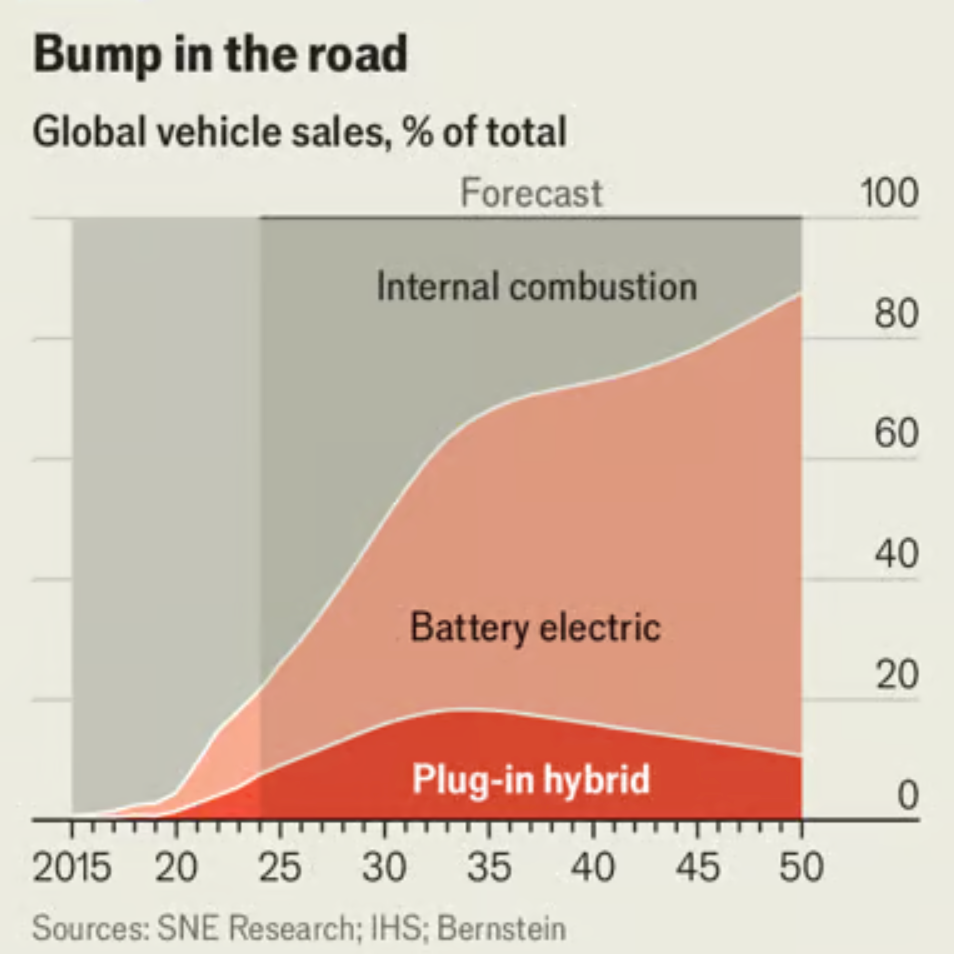
Bernstein predicts that PHEVs will capture a growing share of the car market until 2030, but that sales will then stabilise and eventually decline as those of BEVs speed up (see chart above). Hybrids are “winning now, but BEVs will win eventually”, reckons Patrick Hummel of UBS, a bank. Xavier Smith of AlphaSense, a consultancy, thinks that carmakers’ current obsession with hybrids will prove short-sighted. Those that lose focus on electrification could soon fall behind.
© 2024 The Economist Newspaper Limited. All rights reserved.