Eli Lilly drar ifrån Novo Nordisk i viktkampen: ”Miljoner tabletter redo”
Amerikanska Eli Lilly rycker ifrån danska Novo Nordisk i kampen om viktminskningsmarknaden, skriver The Economist. Trots en sen lansering har Eli Lillys läkemedel Zepbound snabbt tagit ledningen tack vare bättre effekt, lägre pris och snabbare produktion.
– Vi har miljoner tabletter redo, säger Patrik Jonsson, chef för bolagets viktminskningsdivision.
Analytiker förutspår att Eli Lilly kommer kontrollera 47 procent av den över 90 miljarder dollar stora marknaden till 2030.
 The Economist
Eli Lilly looks set to steal Novo Nordisk’s weight-loss crown
Despite a late start, the American firm is bearing down on its Danish rival.
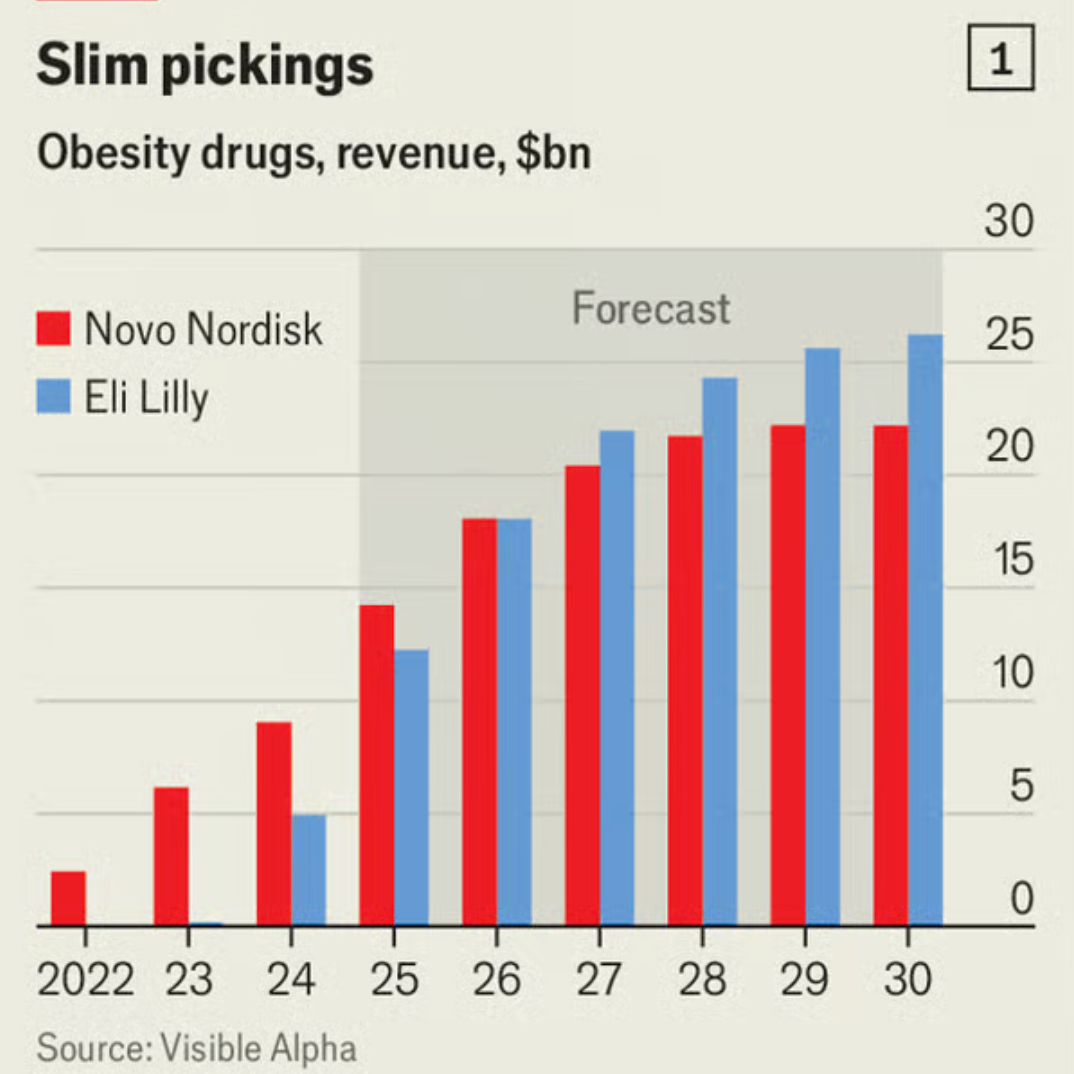
Being first to market with a drug can be crucial. Eli Lilly is proving that being second but better can also pay. Zepbound, the American firm’s weight-loss jab, was approved in its home country in November 2023, more than two years after Wegovy, made by Novo Nordisk, a Danish rival. Yet in 2024 Zepbound yielded $4.9bn in revenue, more than half of Wegovy’s $8.2bn. On May 7th Novo cut its sales forecast for 2025, citing “lower-than-planned” growth in weight-loss drugs. S&P Global, a financial-data firm, expects sales of Lilly’s obesity drugs to overtake Novo’s by 2027 (see chart 1).
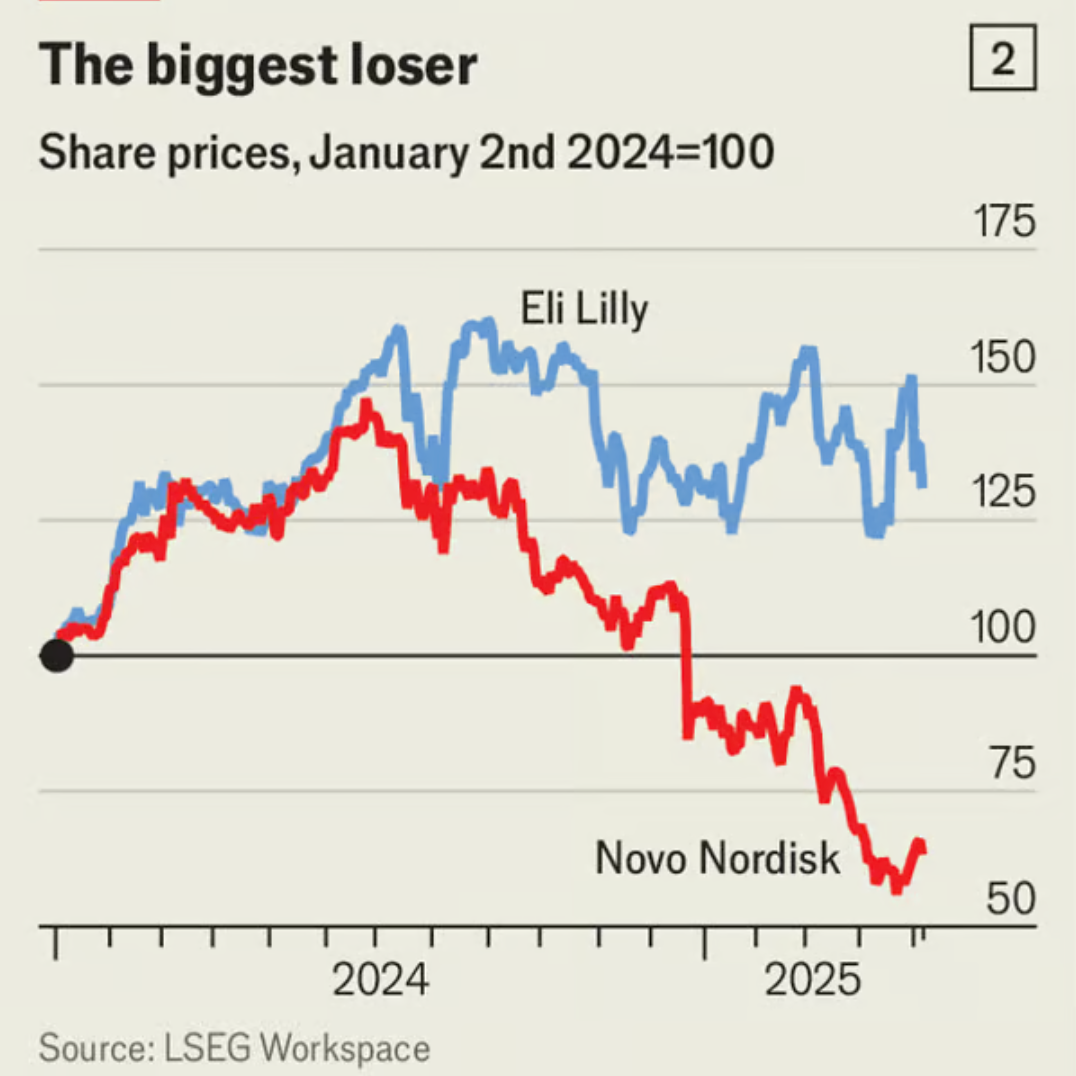
Investors are betting that Lilly will maintain its momentum. Its share price has climbed by a third since the start of 2024; Novo’s has fallen by as much (see chart 2). Lilly’s edge rests on a more effective drug, better execution, some keener pricing and a stronger pipeline.
Zepbound and Wegovy belong to a class of treatments known as GLP-1 agonists. First developed for diabetes, they suppress appetite by slowing digestion. Wegovy mimics the GLP-1 hormone; Zepbound targets an additional hormone, GIP, thought to enhance weight loss.
That dual action matters. In a head-to-head trial conducted by Lilly, patients on Wegovy lost 13.7% of their body weight; those on Zepbound, 20.2%. A third of Zepbound users shed at least 25%, twice the share for Wegovy. Prescribing has shifted: in the first quarter of 2025 Zepbound made up 60% of total weight-loss prescriptions in America and 75% of new ones.
Lilly was quicker to expand production. With Novo caught out by soaring demand, Wegovy was placed on America’s official shortage list until February. Lilly sorted out its own supply by October. That left Novo more exposed to “compounding” pharmacies, which may copy branded drugs during shortages—often at much lower prices. Novo expects revenue to rise later this year, once the shortage ends, meaning sales of copycats must stop.
Lilly has also been faster to find new sales channels. In August it began selling low-dose Zepbound vials directly to patients online for $399 (users supply their own syringes). In April it partnered with Hims & Hers, an online pharmacy, to expand sales. Novo followed after.
Price has mattered, too. Many insurers, including Medicare, America’s public-health scheme for the old, do not cover obesity drugs unless tied to another condition. IQVIA, a health-data firm, says that more than half of obesity prescriptions in America are paid for out of pocket. Wegovy is listed at around $1,350 a month, Zepbound at about $1,000.
Denmark’s former star still has time to shape up
And the pipelines? CagriSema, Novo’s prospective Zepbound rival, tied with Lilly’s drug in recent trials. That will encourage few doctors to switch. The results wiped 20% off Novo’s share price in a day.
On the next front, oral drugs, Novo has a pill awaiting approval in America. But it is costly to make, with the same active ingredient as Wegovy. Patients must also take it first thing in the morning with minimal water and wait 30 minutes before eating. David Risinger of Leerink Partners, an investment bank, doubts Novo will launch it globally. Lilly’s pill, orforglipron, is cheaper to make and can be taken without fasting. Patrik Jonsson, head of Lilly’s weight-loss division, says it has “millions of tablets” available, ahead of approval expected next year. Analysts reckon orforglipron will provide $16bn in annual sales by 2030.
Both firms face trouble ahead. Donald Trump’s tariffs, though on hold for now, could hurt. Neither makes its entire American supply locally. Last year Novo’s parent agreed to pay $16.5bn for Catalent, an American manufacturer, to boost production. In February Lilly pledged to invest $27bn in production at home. Still, Mr Jonsson points out that “reshoring takes time”. A factory takes at least three to four years to build.
Battles over price regulation in America, the largest market, are another concern. Mr Trump wants to match prices abroad, which are typically lower. Medicare, which covers 66m Americans, has also dropped a plan to reimburse obesity drugs.
Even so, both firms can look forward to fat profits. More than 100 companies are developing weight-loss drugs, but for now it is a duopoly. Analysts expect that by 2030 Lilly will have 47% of a $90bn-plus market, to Novo’s 40%. And Denmark’s former star still has time to shape up.
© 2025 The Economist Newspaper Limited. All rights reserved.