IBM och banker toppval bland högutdelare

Återkommande utdelningar kan skydda portföljen i dagens inflationsmiljö. Utdelningsaktier har klarat sig betydligt bättre än amerikanska storbolag i årets börsras och lockar även framåt, skriver Barron’s.
– Du får mer än bara avkastningen som företagsobligationer ger, säger Jenny Harrington, vd för Gilman Hill Asset Management, till tidningen.
Hon gillar it-jätten IBM och energibolaget Kinder Morgan bland högutdelare på USA:s börser just nu.
En annan förvaltare hittar intressanta utdelningscase i banksektorn, däribland US Bancorp och Truist Financial.
 Barron's
Dividend-Paying Stocks Can Help Battle Inflation
Surging bond yields have been a pleasant addition to the toolbox of income investors after years of minimal fixed-income returns. But dividend stocks can offer crucial balance and additional income to a portfolio, especially in today’s environment of high inflation.
“You’ve got to get more than just the yield that investment-grade bonds can give you,” says Jenny Harrington, CEO of Gilman Hill Asset Management, who recently added a United Rentals (ticker: URI) bond with a 5.5% coupon to some client portfolios.
Harrington also likes stocks such as IBM (IBM), paying 5%, and pipeline company Kinder Morgan (KMI), with a yield of 6.2%. “You need capital appreciation of the share price and growth of the dividend in an inflationary environment,” she says.
Dividend stocks have been relative winners in this year’s market selloff. Dividend-paying shares in the S&P 500 index are down 11%, including dividend income, compared with declines of 19% in the S&P 500 and 23% for nondividend stocks. Bonds aren’t doing much better. The Bloomberg U.S. Aggregate Bond Index is off 16%, its worst performance on record going back to 1988.
Dividend stocks have been relative winners in this year’s market selloff
Dividend stocks’ relative strength reflects a few factors. Payouts cushion against sliding share prices. And the dividend payers congregate in value sectors, such as financials, energy, and utilities, which have outpaced growth sectors, such as tech, where dividends aren’t as generous or widespread.
One key for dividend investing is not to get fixated on yield, says Stephanie Link, chief investment strategist and portfolio manager at Hightower Advisors. “It’s about dividend growth, not high dividends,” she says. “If companies are going to continue to increase their dividends, then I feel good about them.”
David Katz, chief investment officer at Matrix Advisors, says the “sweet spot” for dividends now is 3.5%-5%. That’s similar to the 10-year Treasury yield, at 4%, but dividend stocks offer potential for rising payouts, while the bond’s payout is fixed.
One place to find appealing yields is banks. The sector will face headwinds if the economy sinks into a recession next year. But big banks appear to be in far better shape than they were during the financial crisis, with improved capital buffer ratios and more-conservative loan portfolios.

Rising interest rates could also help banks generate more net interest income, though that tailwind may fade in early 2023 as the Fed’s interest-rate-hiking cycle winds down.
Katz’s holdings include U.S. Bancorp (USB), which yields 4.5%, and Truist Financial (TFC) at 4.7%. Their stocks are both down about 22% this year, including dividends.
U.S. Bancorp recently won U.S. regulatory approval to acquire the American banking assets of Japan’s MUFG. The deal must still be approved by Japanese regulators. Assuming it goes through, it would bolster Bancorp’s presence in California, says Katz, calling it a “significant positive on top of very good business trends.” Indeed, Bancorp’s credit quality looks solid, with just 0.2% of its loans nonperforming at the end of September, compared with 0.32% a year earlier.
Truist has a strong presence in the Southeast, which Katz calls “one of the best areas in the country” for retail banks. Credit quality appears to be holding up, with nonperforming loans and leases at just 0.35% of its loan portfolio, a slight improvement from 0.38% a year earlier.
Income Generators
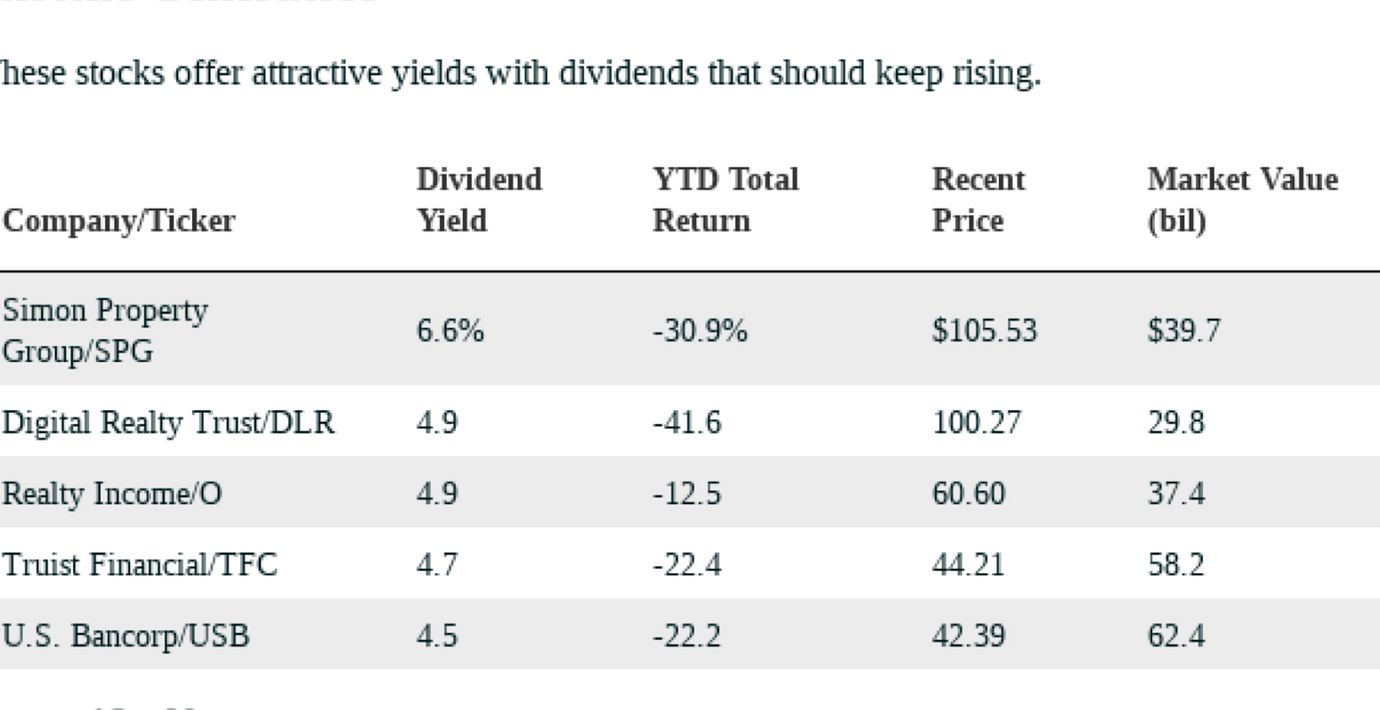
Investors have punished the real estate sector, pushing it down 27%. But some real estate investment trusts, or REITs, now yield 5% to 6%. Balance sheets in the sector are looking stronger, with leverage levels around 30%, on average, below the 39% average since 2007, according to Green Street, a real estate data analytics firm.
“It is a more attractive time for REIT investors to dig around and find opportunities,” says Michael Knott, head of U.S. REIT research at Green Street.
An economic downturn would sting the sector, but rent income should keep rolling in for well-positioned companies. “Even in a modest recession, we would expect REITs to maintain their dividends and continue to grow them,” says Mathew Kirschner, a manager of the $5.4 billion Cohen & Steers Realty Shares fund (CSJAX).
One REIT he likes is Simon Property Group (SPG), which operates upscale malls and outlets around the U.S. The stock has lost a third of its value this year, under pressure due to weak trends in mall retailing and rising interest rates. However, Simon now yields 6.6%, one of its highest payouts since early 2021. Its dividend also looks well covered by funds from operations. In August, the company raised its quarterly payout 3%, to $1.75, for an annualized rate of $7.

“Simon is clearly the dominant [mall] owner and operator,” says Kirschner. “They’ve got a great operating platform and a great balance sheet, all of which will help them in good times and bad.”
Another REIT he likes is Realty Income (O). It specializes in commercial properties for major retail tenants, including Dollar General (DG), FedEx (FDX), and CVS Health (CVS). Its tenants are generally responsible for property taxes, maintenance, and insurance, leaving Realty with steady net rental income.
Realty has a long record of monthly payouts and dividend hikes. It’s a member of the S&P 500 Dividend Aristocrats, which have paid a higher dividend for at least 25 straight years. “It’s a well-diversified portfolio,” says Kirschner, noting that Realty’s broad mix of tenants and industries helps support portfolio income.
One other REIT to consider: data-center owner Digital Realty Trust (DLR). Available space in data centers is tightening, according to Green Street. That constraint could reverse “pretty anemic rent growth,” says Knott. Indeed, Digital Realty said it’s “pushing prices higher” and has rent escalators across 95% of its portfolio, according to its latest earnings call.
Digital’s stock is down 42% this year, bumping its yield to 4.9%. The payout should rise if recent trends hold; in March, it raised its quarterly payout 5%, to $1.22 a share. Data-center leases tend to be sticky, with high renewal rates. That could make for sticky dividend income, too.