”Symboliskt sälj – Europas fonder stannar i USA-aktier”

Trots rubriker om att europeiska pensionsfonder säljer amerikanska statsobligationer är marknadens dom tydlig: Effekten är mest symbolisk.
Danska Akademikerpension sålde nyligen obligationer för 100 miljoner dollar – en bråkdel jämfört med deras över 6 miljarder i amerikanska aktier och företagsobligationer, skriver Bloomberg.
– De rensar bara i balansräkningen, säger Jack McIntyre, förvaltare på Brandywine.
Att fonder skulle sälja av sina USA-innehav som finansiellt vapen avfärdas även av finansminister Scott Bessent:
– Jag är inte det minsta orolig, säger han från Davos.
 Bloomberg
Selling Treasuries Looks Symbolic If European Funds Keep Stocks
Sales of US Treasury holdings by European pension funds have largely been shrugged off by global investors, so long as they keep their much larger stockpiles of US corporate debt and equities.
Speculation that Europe could leverage US assets to retaliate against Donald Trump’s bid for Greenland has been the chatter on trading floors and at the Davos gathering this week. Yet the reality is that, apart from being hard to do, the most significant exposure is to America’s companies rather than its government, strategists and fund managers say.
A case in point is this week’s decision by Danish pension fund AkademikerPension to divest its $100 million of Treasuries, which initially jolted the market on Tuesday. Those holdings pale in comparison to its over $6 billion in US stocks and corporate bonds. And the $30 trillion US Treasury market has coped with other institutions divesting small amounts in recent years, with several German states having cited environmental, social and governance criteria for their moves.
“Denmark loves their ESG and many funds could be having a similar conversation,” Jordan Rochester, a head of macro strategy at Mizuho, said about the AkademikerPension decision. Ultimately, they have “small actual holdings in US Treasuries,” he said.
It would take a bond move by a larger holder — like Norway’s sovereign wealth fund — to really hurt US capital markets. While that’s seen as unlikely, any major divestment could have a signaling effect that dents confidence in US assets.
The risk of Europeans “weaponizing” US assets, highlighted in a Deutsche Bank AG report, led US Treasury Secretary Scott Bessent to say it “defies any logic” and to tell Davos that the German bank’s CEO had called him to dismiss it. He also downplayed AkademikerPension’s decision.
Denmark’s investment in US Treasuries is “irrelevant,” Bessent told reporters at Davos. “They’ve been selling Treasuries for years. I’m not concerned at all.”
“I think part of the problem with this ‘Sell America 2.0’ trade is: where are the alternatives?”
The issue is that pension funds like AkademikerPension, which have liabilities in European currencies, tend not to opt for sizable allocations to US Treasuries. Instead, such funds prefer the debt of governments closer to home for fixed-income.
So far, exiting from all US assets has proven a step too far. Before Trump’s weekend announcement of tariffs on eight countries over opposition to his Greenland claim, AkademikerPension’s CIO Anders Schelde told Bloomberg that divesting from all US assets would be a “major decision” and doesn’t make sense to do based on “unpredictable” statements from Trump.
“They are basically cleaning up a line item by selling US Treasuries as opposed to US equities and investment-grade credit,” said Jack McIntyre, a portfolio manager at Brandywine Global Investment Management in Philadelphia, who called the divestment “symbolic.”
Signaling Effect
That’s not to say symbolism doesn’t matter. The fact AkademikerPension’s decision hit Treasuries, even temporarily, shows investors are nervous that others may follow.
“The signaling effect from that news overshadows the benign underlying economic impact,” said Elias Haddad, global head of market strategy at Brown Brothers Harriman, referring to the potential loss of confidence in US trade and security policies.
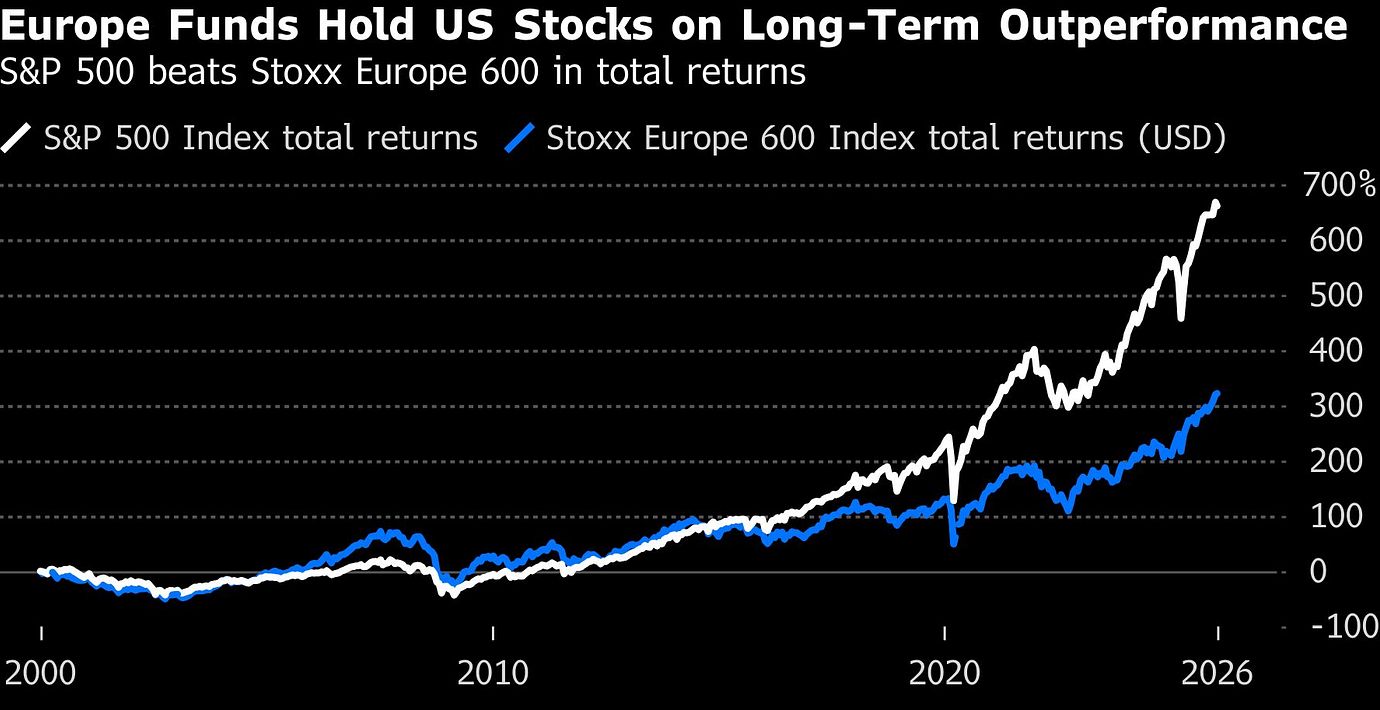
The biggest public European player is Norway’s investment fund, which holds over $180 billion of Treasuries, a hefty figure but still much less than its $759 billion in US stocks.
Norway’s fund declined to comment. The country’s finance minister Jens Stoltenberg told Bloomberg TV the $2.1 trillion fund has no reason to pull back investments from the US now.
If it was the Norwegian sovereign wealth fund, “then it would be a different matter,” said Gary Paulin, chief international investment strategist at Northern Trust Asset Management, when asked about the Danish divestment. “We’re not seeing any change in folks selling US dollar assets. I am seeing more interest in dollar hedging.”
Meanwhile the €2 trillion Dutch pension sector, Europe’s largest, holds only €34 billion in US government bonds, according to the nation’s central bank. That compares to nearly 10 times as much in comparable European debt and €465 billion of long-term investments in US corporations and financial institutions.
Overall, funds domiciled in the European Union do hold about $1.8 trillion in long-term US Treasuries, according to US data, with more held in neighboring Norway and the UK. Yet much of that is in private hands and may also belong to non-European players.
Sell America 2.0
The Greenland tensions may add to funds thinking about diversifying away from the US due to unpredictable policy making and large deficits. Sweden’s biggest private pension fund Alecta has divested most of its holdings in Treasuries since early 2025 owing to growing macroeconomic risks, according to Chief Investment Officer Pablo Bernengo.
Barclays Plc analysts led by Anshul Pradhan say that, despite speculation, they’ve “not seen evidence of broad foreign sales” since Trump’s “Liberation Day” tariffs imposed last April. UBS Chief Executive Officer Sergio Ermotti said Tuesday that “diversifying away from America is impossible.”
“I think part of the problem with this ‘Sell America 2.0’ trade is: where are the alternatives?” said George Catrambone, head of fixed income at DWS Americas. “Do you really want to make long-term investment decisions based on potentially a Davos distraction?”
Brandywine’s McIntyre said he does see the potential for European funds trimming their US equity exposure, which he bets will weaken the US dollar over time — a trend that’s been playing out over the past year. Yet that’s different from outright or sudden divestments because of geopolitical concerns.
“They could say it’s under the guise of the investment theme no longer being quite as compelling, and I actually understand that because of the concentrated returns of US tech stocks over the last several years,” he said.
--With assistance from Tom Fevrier, Michael MacKenzie, Heidi Taksdal Skjeseth, Michael Msika and Frances Schwartzkopff.
More stories like this are available on bloomberg.com
©2026 Bloomberg L.P.