Aktivist släppt ur fängelse efter massiva protesterna
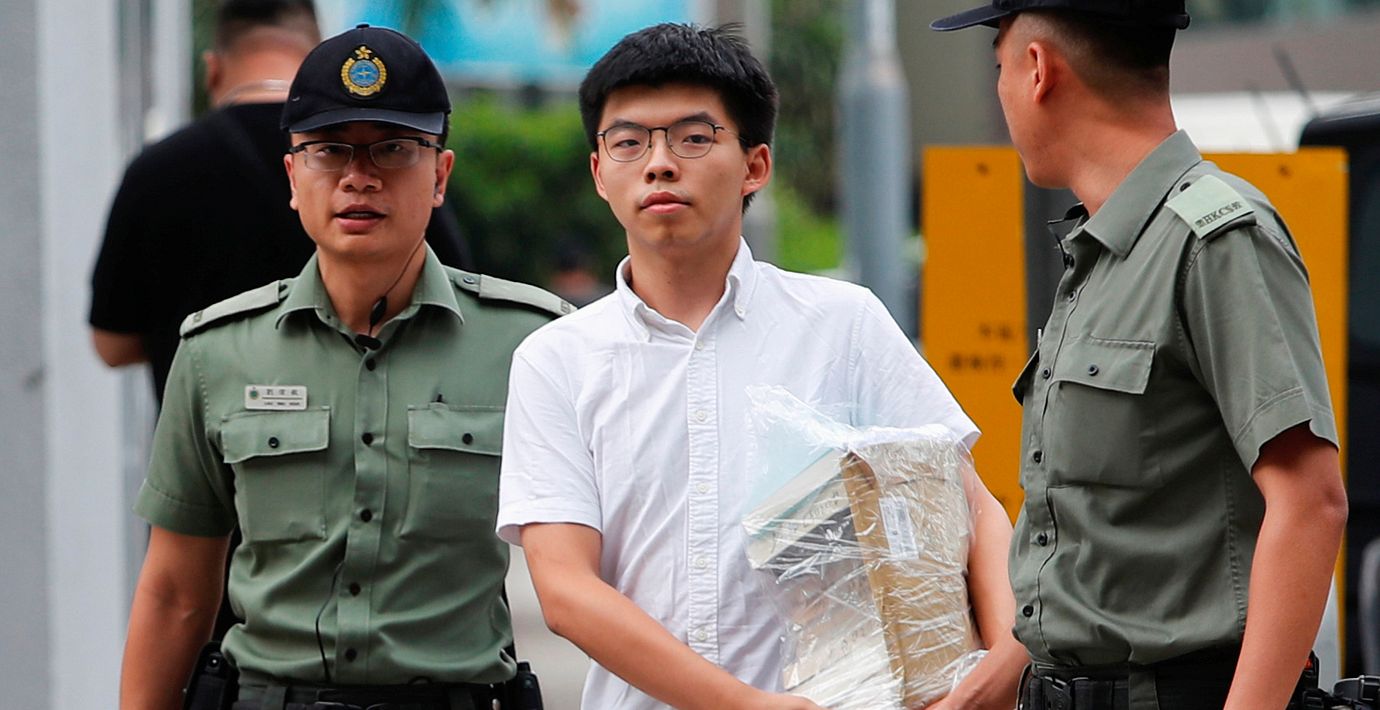
Aktivisten Joshua Wong som var en av frontfigurerna i stora protester i Hongkong för demokratiska rättigheter 2014 har släppts ur fängelse i förtid, rapporterar flera medier.
Beskedet om Wongs frigivning kommer efter fortsatta protester mot Hongkongs ledning och tolkas som ett försök att lugna ner situationen.
Demonstranter fortsätter kräva Hongkongledaren Carrie Lams avgång efter att hon har försökt driva igenom en lag som gör att Hongkongs invånare kan bli utlämnade till Kina i rättsprocesser.
Wong anslöt sig till kravet så fort han släppts.
bakgrund
Joshua Wong
Wikipedia (en)
Joshua Wong Chi-fung (Chinese: 黃之鋒; Sidney Lau: Wong4 Ji1 Fung1, born 13 October 1996) is a Hong Kong student activist and politician who serves as secretary-general of pro-democracy party Demosistō. Wong was previously convenor and founder of the Hong Kong student activist group Scholarism. Wong first rose to international prominence during the 2014 Hong Kong protests, and his pivotal role in the Umbrella Movement resulted in his inclusion in TIME magazine's Most Influential Teens of 2014 and nomination for its 2014 Person of the Year; he was further called one of the "world's greatest leaders" by Fortune magazine in 2015,, and nominated for the Nobel Peace Prize in 2017.
In August 2017, Wong and two other pro-democracy activists were convicted and jailed for their roles in the occupation of Civic Square at the incipient stage of the 2014 Occupy Central protests; in January 2018, Wong was convicted and jailed again for failing to comply with a court order for clearance of the Mong Kok protest site during the Mong Kong protests in 2014.
Demokratiprotesterna i Hongkong 2014
Wikipedia (en)
A series of sit-in street protests, often called the Umbrella Revolution (雨傘革命) and sometimes used interchangeably with Umbrella Movement (雨傘運動), or Occupy Movement (佔領行動), occurred in Hong Kong from 26 September to 15 December 2014.The protests began after the Standing Committee of the National People's Congress (NPCSC) issued a decision regarding proposed reforms to the Hong Kong electoral system. The decision was widely seen to be highly restrictive, and tantamount to the Chinese Communist Party (CCP)'s pre-screening of the candidates for the leader of Hong Kong.Students led a strike against the NPCSC's decision beginning on 22 September 2014, and the Hong Kong Federation of Students and Scholarism started protesting outside the government headquarters on 26 September 2014. On 28 September, events developed rapidly. The Occupy Central with Love and Peace movement announced the beginning of their civil disobedience campaign. Students and other members of the public demonstrated outside government headquarters, and some began to occupy several major city intersections. Protesters blocked both east–west arterial routes in northern Hong Kong Island near Admiralty. Police tactics – including the use of tear gas – and triad attacks on protesters led more citizens to join the protests and to occupy Causeway Bay and Mong Kok. The number of protesters peaked at more than 100,000 at any given time, overwhelming the police thus causing containment errors.Government officials in Hong Kong and in Beijing denounced the occupation as "illegal" and a "violation of the rule of law", and Chinese state media and officials claimed repeatedly that the West had played an "instigating" role in the protests, and warned of "deaths and injuries and other grave consequences." The protests precipitated a rift in Hong Kong society, and galvanised youth – a previously apolitical section of society – into political activism or heightened awareness of their civil rights and responsibilities. Not only were there fist fights at occupation sites and flame wars on social media, family members found themselves on different sides of the conflict.Key areas in Admiralty, Causeway Bay and Mong Kok were occupied and remained closed to traffic for 77 days. Despite numerous incidents of intimidation and violence by triads and thugs, particularly in Mong Kok, and several attempts at clearance by the police, suffragists held their ground for over two months. After the Mong Kok occupation site was cleared with some scuffles on 25 November, Admiralty and Causeway Bay were cleared with no opposition on 11 and 14 December, respectively.
The Hong Kong government's use of the police and courts to resolve political issues led to accusations that these institutions had been turned into political tools, thereby compromising the police and judicial system in the territory and eroding the rule of law in favour of "rule by law". At times violent police action during the occupation was widely perceived to have damaged the reputation of what was once recognised as one of the most efficient, honest and impartial police forces in the Asia Pacific region. The protests ended without any political concessions from the government, but instead triggered rhetoric from Chief executive of Hong Kong CY Leung and mainland officials about rule of law and patriotism, and an assault on academic freedoms and civil liberties of activists.
Omni är politiskt obundna och oberoende. Vi strävar efter att ge fler perspektiv på nyheterna. Har du frågor eller synpunkter kring vår rapportering? Kontakta redaktionen