Frihandelsförhandlingar i Asien går in i kritiskt skede
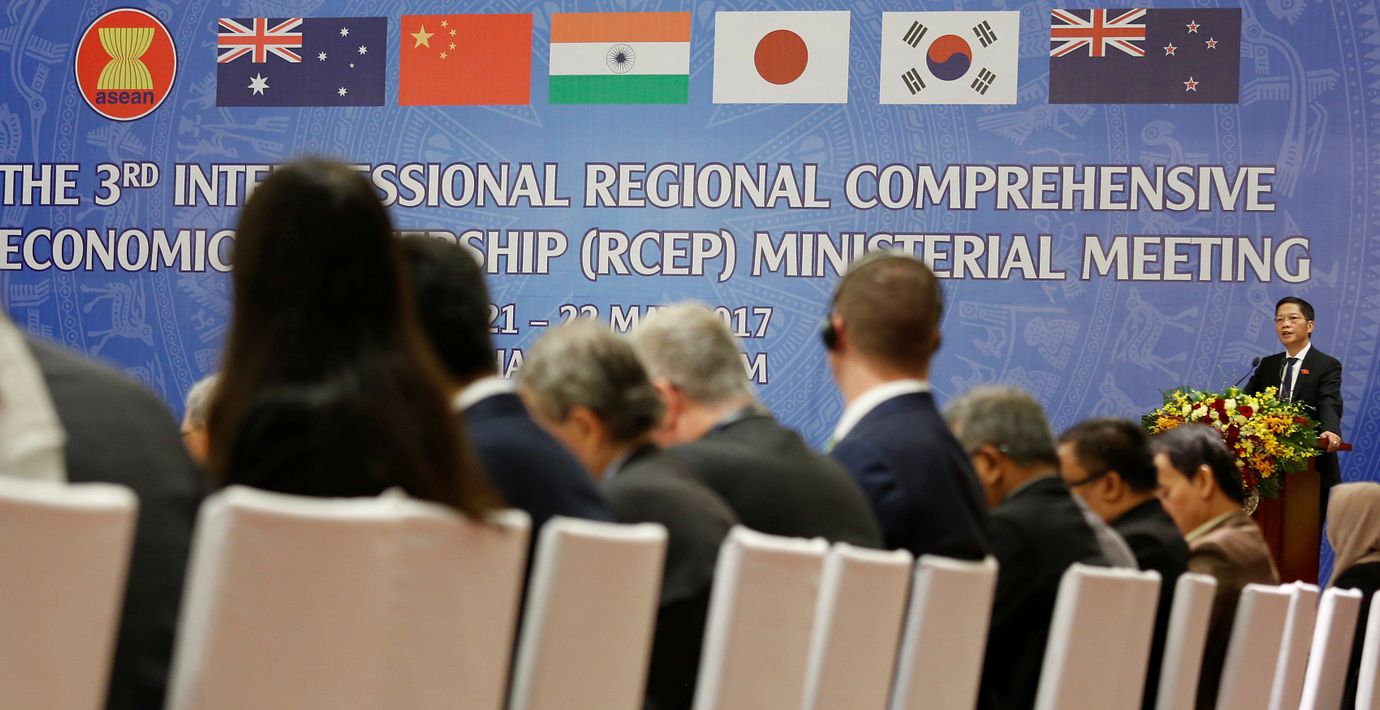
Det asiatiska frihandelsavtalet RCEP, som vid sitt undertecknande kan komma att bli det största i världen, går in i ett kritiskt skede, skriver AFP.
Diplomater säger till nyhetsbyrån att man hoppas ha ett färdigt avtal i november – strukturer som ska implementeras under 2020.
16-nationersavtalet, som kommer gälla för ungefär hälften världens befolkning, exkluderar handel med USA. Bakgrunden till förhandlingarna är att Donald Trump dragit sig tillbaka från ett tidigare avtal för Stillahavsregionen, TPP.
bakgrund
Regional Comprehensive Economic Partnership (RCEP)
Wikipedia (en)
Regional Comprehensive Economic Partnership (RCEP) is a proposed free trade agreement (FTA) between the ten member states of the Association of Southeast Asian Nations (ASEAN) (Brunei, Cambodia, Indonesia, Laos, Malaysia, Myanmar, the Philippines, Singapore, Thailand, Vietnam) and the six Asia-Pacific states with which ASEAN has existing free trade agreements (Australia, China, India, Japan, South Korea and New Zealand).
RCEP negotiations were formally launched in November 2012 at the ASEAN Summit in Cambodia. The free trade agreement is scheduled and expected to be signed in November 2018 during the ASEAN Summit and Related Summit in Singapore, after the first RCEP summit was held on 14 November 2017 in Manila, Philippines. RCEP is viewed as an alternative to the Trans-Pacific Partnership (TPP), a proposed trade agreement which includes several Asian and American nations but excludes China and India.In 2017, prospective RCEP member states accounted for a population of 3.4 billion people with a total Gross Domestic Product (GDP, PPP) of $49.5 trillion, approximately 39 percent of the world's GDP, with the combined GDPs of China and Japan making up more than half that amount.
RCEP is the world's largest economic bloc, covering nearly half of the global economy. According to estimates by PwC, the Gross Domestic Product (GDP, PPP) of RCEP member states is likely to amount to nearly $250 trillion by 2050, or a quarter of a quadrillion dollars, with the combined GDPs of China and India making up more than 75% the amount. RCEP's share of the global economy could account for half of the estimated $0.5 quadrillion global GDP (PPP) by 2050.
Omni är politiskt obundna och oberoende. Vi strävar efter att ge fler perspektiv på nyheterna. Har du frågor eller synpunkter kring vår rapportering? Kontakta redaktionen