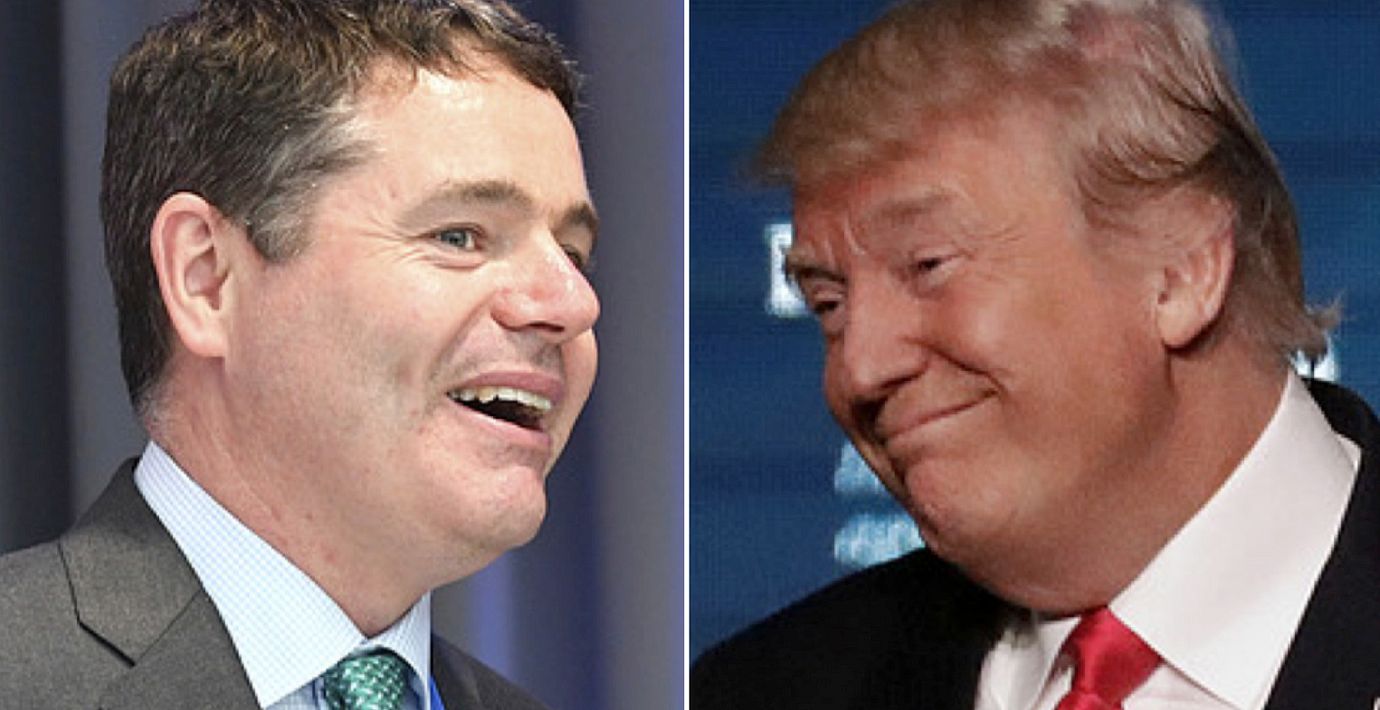
Irland: Vi kan konkurrera med Trumps låga bolagsskatt
Irlands generösa skattelagar står sig fortsatt väl i konkurrensen om bolagen även efter Donald Trumps stora skattereform. Det säger landets finansminister Paschal Donohoe på tisdagen, rapporterar Reuters.
– I kontakterna jag har haft med internationella företag efter att det stått klart i vilken riktning USA går har jag fått den här uppfattningen bekräftad, säger Donohoe enligt nyhetsbyrån.
bakgrund
Paschal Donohoe
Wikipedia (en)
Paschal Luke Donohoe (born 19 September 1974) is an Irish Fine Gael politician who has served as Minister for Finance since June 2017 and Minister for Public Expenditure and Reform since May 2016. He has been a Teachta Dála (TD) since 2011, currently for the Dublin Central constituency. He previously served as Minister for Transport, Tourism and Sport from 2014 to 2016 and Minister of State for European Affairs from 2013 to 2014.
Donohue, originally from Blanchardstown. He studied Politics and Economics at Trinity College, Dublin. From 1997 he worked with Procter & Gamble in the UK, before returning to Ireland and taking a position with Diageo. In 2004 Donohoe was elected to Dublin City Council and served on a number of committees before his election to Seanad Éireann in 2007 and his eventual election to Dáil Éireann.
After an initial period on the backbenches, Donohoe was appointed Minister of State for European Affairs following the resignation of Lucinda Creighton in July 2013. A year later he was promoted to cabinet as Minister for Transport, Tourism and Sport.
Following the formation of a Fine Gael minority government in May 2016, Donohoe was appointed Minister for Public Expenditure and Reform.
bakgrund
Tax Cuts and Jobs Act of 2017
Wikipedia (en)
Public law no. 115-97, an Act to provide for reconciliation pursuant to titles II and V of the concurrent resolution on the budget for fiscal year 2018), is a congressional revenue act originally introduced in Congress as the Tax Cuts and Jobs Act of 2017 (TCJA). It amended the Internal Revenue Code of 1986, and was based on tax reform advocated by congressional Republicans and the Trump administration. Major elements include reducing tax rates for businesses and individuals; a personal tax simplification by increasing the standard deduction and family tax credits, but eliminating personal exemptions and making it less beneficial to itemize deductions; limiting deductions for state and local income taxes (SALT) and property taxes; further limiting the mortgage interest deduction; reducing the alternative minimum tax for individuals and eliminating it for corporations; reducing the number of estates impacted by the estate tax; and repealing the individual mandate of the Affordable Care Act (ACA).
The nonpartisan Congressional Budget Office (CBO) reported that under the Act individuals and pass-through entities like partnerships and S corporations would receive about $1,125 billion in net benefits (i.e. net tax cuts offset by reduced healthcare subsidies) over 10 years, while corporations would receive around $320 billion in benefits. The individual and pass-through tax cuts fade over time and become net tax increases starting in 2027, while the corporate tax cuts are permanent. This enabled the Senate to pass the bill with only 51 votes, without the need to defeat a filibuster, under the budget reconciliation process.
The CBO estimated that implementing the Act would add an estimated $1.455 trillion to the national debt over ten years, or about $1.0 trillion after macroeconomic feedback effects, in addition to the $10 trillion increase forecast under the current policy baseline and existing $20 trillion national debt. CBO reported on December 21, 2017: "Overall, the combined effect of the change in net federal revenue and spending is to decrease deficits (primarily stemming from reductions in spending) allocated to lower-income tax filing units and to increase deficits (primarily stemming from reductions in taxes) allocated to higher-income tax filing units."
The nonpartisan Joint Committee on Taxation estimated that the GDP level would be 0.8% percent higher, employment level would be 0.6% higher, and personal consumption level would be 0.6% higher during the 2018–2027 period on average due to the Act. These are higher levels, not higher annual growth rates, so these are relatively minor economic impacts over 10 years.
The distribution of impact by individual income group varies significantly based on the assumptions involved and point in time measured. In general, businesses and upper income groups will mostly benefit regardless, while lower income groups will see the initial benefits fade over time or be adversely impacted. For example, the CBO and JCT estimated that:
During 2019, income groups earning under $20,000 (about 23% of taxpayers) would contribute to deficit reduction (i.e., incur a cost), mainly by receiving fewer subsidies due to the repeal of the individual mandate of the Affordable Care Act. Other groups would contribute to deficit increases (i.e., receive a benefit), mainly due to tax cuts.
During 2021, 2023, and 2025, income groups earning under $40,000 (about 43% of taxpayers) would contribute to deficit reduction, while income groups above $40,000 would contribute to deficit increases.
During 2027, income groups earning under $75,000 (about 76% of taxpayers) would contribute to deficit reduction, while income groups above $75,000 would contribute to deficit increases.
The Tax Policy Center (TPC) estimated that the bottom 80% of taxpayers (income under $149,400) would receive 35% of the benefit in 2018, 34% in 2025, and none of the benefit in 2027, with some groups incurring costs. TPC also estimated 72% of taxpayers would be adversely impacted in 2019 and beyond, if the tax cuts are paid for by spending cuts separate from the legislation, as most spending cuts would impact lower- to middle-income taxpayers and outweigh the benefits from the tax cuts. The law also impacts healthcare by repealing the ACA individual mandate, resulting in projections of up to 13 million fewer persons covered by health insurance and projections of higher insurance premiums on the ACA exchanges.
Critics in the media, think tanks, and academia assailed the law in terms of its adverse impact (e.g. higher budget deficit, higher trade deficit, worse income inequality, lower healthcare coverage and higher healthcare costs), disproportionate impact on certain states and professions, and the misrepresentations made by its advocates. It is among the least popular major legislation in recent U.S. history, with about 32% approval, nearly all of it Republican.
The House passed the penultimate version of the bill on December 19, 2017, though for Senate procedural reasons, small changes were needed and a revote was held in the House. The Senate passed the final version on December 20 in a 51-48 vote and that final version was passed by the House of Representatives, also on December 20, 2017. The bill was signed into law by President Donald Trump on December 22, 2017. Most of the changes introduced by the bill went into effect on January 1, 2018, and will not affect 2017 taxes.
Omni är politiskt obundna och oberoende. Vi strävar efter att ge fler perspektiv på nyheterna. Har du frågor eller synpunkter kring vår rapportering? Kontakta redaktionen