Klarnas IPO kan dra igång en våg av fintech-noteringar

Klarnas planer på att börsnoteras på Wall Street under första halvåret nästa år har väckt förhoppningar om att den utdragna IPO-torkan för fintech-bolag kan få ett slut. En ny våg av noteringar kan följa och bolag som Zilch, Chime och Revolut ser över sina egna börsplaner, skriver Bloomberg.
Efter flera års motvind börjar sektorn återhämta sig, med stigande aktiekurser och hopp om att Donald Trump ska lätta på regleringarna i branschen. Men om fler vågar följa Klarnas exempel hänger mycket på hur det går i debuten, skriver nyhetsbyrån.
 Bloomberg
Klarna’s Planned IPO Sets the Stage for More Fintech Listings
Trustly, Chime, Zilch among candidates for a stock listing. Sector stocks have bounced back after painful IPO losses
Klarna Bank AB’s planned initial public offering is fueling hopes that a long drought of fintech listings may be coming to an end, heralding a wave of debuts for the sector over the next couple of years.
The Swedish buy-now, pay-later giant plans to go public in New York during the first half of next year, Bloomberg has reported. A successful listing — coupled with rising share prices and the prospect of lighter regulation during a second Donald Trump presidency — could finally prompt some of Klarna’s peers to do the same, according to bankers, venture capitalists and analysts.
Other fintech firms are poised to move forward with their IPO plans. Zilch Technology Ltd. and Chime Financial Inc. are weighing first-time share sales in 2025, and executives from Plaid Inc. and challenger banks Revolut Ltd. and Zopa Bank Ltd. have signaled they are considering listings. Trustly Group AB‘s owner is exploring options for the fintech including a sale or IPO, Bloomberg News has reported. Brex Inc. and Ramp Business Corp. are also considering eventual IPOs.
“Klarna’s much-anticipated filing could presage an uptick in fintech public offerings after a relatively slow period”
How fast these companies come to market and where they choose to list could be influenced by how Klarna fares.
“Klarna’s much-anticipated filing could presage an uptick in fintech public offerings after a relatively slow period,” said Mark Palmer, senior research analyst for fintech and digital assets at The Benchmark Company. “The recent upward surge in fintech stock prices and valuations bodes well for new public offerings in the space, as do investors’ expectations of a more fintech-friendly regulatory regime during the new Trump Administration.”
Klarna, Zilch, Trustly, Trustly majority owner Nordic Capital, Revolut, Plaid, Brex and Chime declined to comment or did not respond to requests for comment for this story. A Zopa Bank spokesperson said “an IPO is not an immediate priority,” but that it continues to work toward one, preferably in the UK, when the time is right. A Ramp spokesperson said, “we have ambitions to be a public company but aren’t actively planning for it at the moment.”
Klarna confidentially filed for an IPO with the US Securities and Exchange Commission, it said in a statement last week. While the company provided no financial details, analysts last month put Klarna’s implied valuation at about $14.6 billion after shareholder Chrysalis Investments Ltd. increased the value of its stake. That would mark an improvement from the $6.7 billion valuation it garnered in its last fundraising round in 2022, but is still much lower than the $45.6 billion valuation Klarna boasted in 2021.
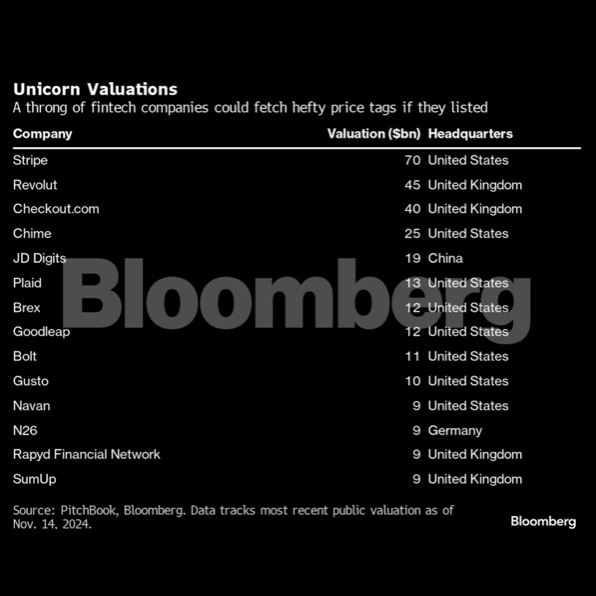
Fin or Tech?
Fintech valuations collapsed during a wider technology rout in 2022 triggered by rising interest rates and geopolitical instability. What price Klarna’s shares command will offer clues to other IPO hopefuls on what they can expect: will they be assigned rich valuations of tech stocks, or more down-to-earth prices of financial firms?
“The industry needs liquidity, and valuations need to come back to Earth,” said Sydney Thomas, a founding general partner at Symphonic Capital. She called Klarna’s private valuation decline “reasonable” and its current estimated valuation “still exceptional,” given what the industry has been through.
“I hope Klarna’s IPO gives other founders the courage to pursue an exit, even if it means doing so at a lower valuation,” Thomas said.
VCs backing fintechs are optimistic that there is once again a spot in the stock market for fast-growing companies, particularly those that are profitable or on track to be.
“The fintechs – public and private – that are solving real problems and have strong fundamental unit economics will continue to perform well,” said Nigel Morris, a managing partner at QED Investors.
“I hope Klarna’s IPO gives other founders the courage to pursue an exit, even if it means doing so at a lower valuation”
Two of QED’s profitable portfolio companies are San Francisco-based SoFi Technologies Inc. and Brazilian challenger bank Nu Holdings Ltd., or NuBank. SoFi’s shares are up around 47% so far this year, while NuBank’s are up 62%.
But the reality of IPO investing has changed since those firms went public in 2021, part of a growth-focused class of listings that emerged from the Covid-19 pandemic. Many of those stocks got battered when the era of cheap borrowing came to an abrupt end, leaving investors shell-shocked. Troubles spilled into private markets as well, where companies like Klarna struggled to keep their hefty valuations while scrambling for cash.
With the exception of artificial intelligence companies, IPO investors have lately favored more predictable, profitable businesses over promises of future growth. They have also demanded steep valuation discounts to account for the risk of betting on untested stocks.
There are signs that the tide may be starting to turn. For example, shares of American insurtech Lemonade Inc. are up almost 189% this year and are back above their IPO price — even though they remain down massively from an early 2021 peak.
Other fintech stocks have also been on the rise. Bank of America Corp.’s BofA Broad Fintech Index is up around 36% this year, while the Ark Fintech Innovation ETF is up about 38%. Both are outperforming the S&P 500.

Valuation Divergence
Investors are also less inclined to paint the entire fintech sector with a broad label, preferring certain sub-sectors to others. Digital lending models have fallen out favor, while payment firms are getting more traction, according to some VCs.
A slew of lending firms including LendingClub Corp. were part of the first generation of fintechs that went public around a decade ago. But some have struggled to compete as their cost of capital rose, while banks were able to maintain lower funding costs, including through deposits.
Lending companies’ valuations “fell to Earth” because of those competitive dynamics, said Tom Glocer, an angel investor and executive chairman at startup Capitolis Inc. On the other hand, “everyone likes payments businesses because they want to get the Adyen NV multiple.”
Shares of that Dutch fintech have soared 406% since its IPO on Euronext Amsterdam in 2018, even after taking a dive last year on weak earnings. The stock trades at 34 times its expected earnings for 2025, and around 12 times its expected revenue, including debt, according to data compiled by Bloomberg.
Klarna, which extends short-term credit to shoppers worldwide, will have to convince investors that it’s not a traditional lending business to fetch its aspirational valuation. The firm has been expanding into areas beyond its core BNPL product, including more retail-banking offerings and by leveraging artificial intelligence to improve its services.

Home Markets
Even with Adyen’s strong performance, many European fintechs are tempted by the promise of higher valuations and deeper liquidity in the US. That piles pressure on their home countries to retain those listings.
Revolut, Britain’s biggest fintech, will be closely watched as it decides when, where and whether to list. Staying in London would be a big win for the UK’s tech industry and its bourse, which has suffered from a dearth of IPOs since 2021. However, the US’s market advantages, along with potential regulatory benefits under Trump, may prove hard to resist.
Some firms may simply stay private while seeking additional funding rounds and stake sales. That would give them time to improve valuations, while offering liquidity to early investors and employees.
“For certain companies there is a lot of ongoing dialogue and desire to reconfigure their current capital structure to be more public-company ready,” Brennin Kroog, a managing director at Lazard Inc., said in an interview.
Revolut completed a $500 million stock sale for shareholders in August that valued the company at $45 billion. Soon after, its British peer Monzo Bank Ltd. also announced an employee share sale that gave it a $5.9 billion valuation.
Klarna’s filing doesn’t necessarily mean everyone else will follow, said Rob Moffat, a partner at Revolut backer Balderton Capital.
“It is great news but not counting chickens until the IPO has successfully completed,” he said. “Klarna was always going to be one of the first to go, it was founded in 2005.”
For more articles like this please visit us at bloomberg.com