Kista av svamp och hampa – grön ekonomi når döden
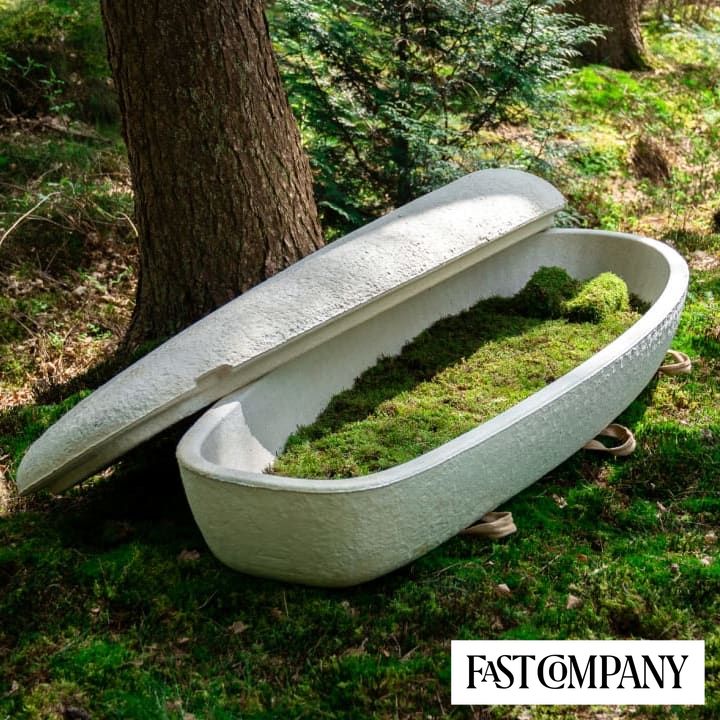
När Marsya Ancker-Roberts far gick bort i juni vände hon sig till Loop Biotech – en nederländsk startup som tillverkar biologiskt nedbrytbara kistor av mycelium och hampa.
Kistorna bryts ner på 45 dagar och återför näring till jorden, till skillnad från traditionella träkistor som ofta behandlas med kemikalier som läcker ut i jorden.
Företaget är en del av en växande nisch inom begravningsbranschen, skriver Fast Company. Andra aktörer inkluderar Resting Reef, som skapar marina minnesmärken av kremerad aska, och Coeio, som tillverkar nedbrytbara begravningsdräkter av svamp och andra organismer.
 Fast Company
He was buried in a mushroom casket. Soon he’ll be part of the soil
The Living Cocoon enriches the soil as it biodegrades, turning burial ceremonies into small acts of generosity toward the planet.
When Marsya Ancker-Robert was younger, her father used to tell that her that he wanted to be buried naked, under a tree in the woods. The idea horrified Ancker-Robert, but when her father passed away earlier this June, the first call she made was to a Dutch company called Loop Biotech.
Since 2020, Loop Biotech has been making biodegradable caskets out of mycelium, the root-like structure of mushrooms, and hemp. Unlike traditional wooden caskets, which are often treated with chemicals that leech into the soil, the company’s offerings are made of natural materials that enrich the soil as they biodegrade—a process that only takes 45 days after burial.
“I have confidence that my dad will be fully part of the garden by winter”
So far, Loop Biotech has sold about 2,500 caskets in Europe—primarily in The Netherlands, but also in Germany and other parts of central Europe. But Ancker-Robert’s father, Mark Ancker, has just become the first person in the U.S. to be buried in Loop Biotech’s mycelium casket, called Living Cocoon. “It was dignified, and beautiful,” says Ancker-Robert, who buried her father in a forest clearing on his property. “I have confidence that my dad will be fully part of the garden by winter.”
Growing caskets
Loop Biotech was founded in 2020 by Bob Hendrikx, an architect and biodesigner known for his affinity for nature-based solutions, like a Living Bin that uses sea anemones to “eat” or compost our trash, or a Living Bench that uses algae water to cleanse the air around it. It is part of growing cohort of start-ups shaking up the $622 million green burial market with nature-based solutions. Resting Reef, from London, turns cremated ashes into underwater memorials that double as coral reefs. Coeio, from California, makes burial suits out of mushrooms and other organisms that accelerate decomposition.
For Hendrikx, nature was always the starting point. When the designer first came up with the idea for a mycelium casket, he wasn’t looking for sustainable solutions to burial. He was looking for ways to harness mycelium’s natural ability to recycle dead organic matter into nutrient-rich soil. He knew that mycelium thrives best in soil, which led him to question the kinds of applications it could most benefit. “We call it organism-centered design,” he says, contrasting the approach with human-centered design.
Today, Loop caskets are made with mycelium, hemp, and nothing else. The two ingredients are mixed and poured into a mold, and a coffin grows out of that mold in just seven days. But nailing down the exact formula took several years. “Too long,” says Hendrikx with a laugh.
America is experiencing a green burial revolution
Mycelium is a finicky organism that needs the right conditions to grow and is influenced by several environmental factors such as temperature, humidity, CO₂, and oxygen. Even the moon, which influences air pressure on Earth, can have an effect, he says: “Collaborating with nature really allows you to see this interconnectivity of the ecosystem.”
The company has a 1,500-square-meter growing facility in Delft, with the capacity to grow 500 caskets at a time. In order to scale, he wants to double the production capacity and potentially speed up the growth, too. This facility is what the company calls their blueprint. Once it is optimized, Hendrikx is hoping to replicate the model outside The Netherlands and grow the caskets locally, using local materials.
The company has raised just over $3 million to date, and is planning a new funding round to finance the expansion. And for Hendrikx, the road to success transcends mycelium caskets. “Once we are profitable, we’ve shown the world that you can enrich nature while making money, so it’s a business case for a regenerative business model,” he says.
A first for the U.S.
The burial in Maine marks a new chapter in the company’s journey, with mycelium caskets ($3,995) and urns ($395) now available to customers nationwide. But Hendrikx says he’s been getting requests for years.
America is experiencing a green burial revolution. The total number of green burial cemeteries in the U.S. has quadrupled over the past 10 years, going from just over 100 in 2015 to more than 400 by 2025. Over the past two decades, the nonprofit Green Burial Council has seen a 72% increase in demand from cemeteries for more sustainable end-of-life options.
Loop Biotech’s expansion will likely depend on how willing people are to spend a few extra dollars on a biodegradable casket. An entry-level casket in the United States hovers around $800 for a simple metal burial casket, though average costs range from about $2,000 to $5,000.
It will also depend on how fast the company establishes a robust infrastructure in the country. Already, Hendrikx has built a network of distribution partners and sustainable funeral homes that offer green burial alternatives. They also have a warehouse in L.A. where they can ship their products from. But if your local funeral home doesn’t offer mycelium caskets, and you’ve never heard about the company, you may never know it exists.
“The process is helping to turn the grieving process into one of creation and gives me something to daydream about instead of focusing on the loss”
Ancker-Robert found out about Loop Biotech from a Tedx talk that Hendrikx gave in January, and she was really surprised she was the first person to order one. As it happens, Loop Biotech was gearing up to launch in the U.S. on World Environment Day when she called.
Ancker-Robert allowed Hendrikx to film the ceremony, which turned into a small act of generosity for the planet. People made offerings of his favorite foods as well as flowers that Ancker-Robert will plant right above her father’s resting place so they can grow into a perennial flower garden. “The process is helping to turn the grieving process into one of creation and gives me something to daydream about instead of focusing on the loss,” she says. “I would much prefer to think of my father as part of the garden than as a dead body lying in the ground.”
Ancker-Robert describes her father a free spirit who, in the ’80s, would jump into dumps to salvage food and drive around his community to distribute it. “There’s a famous picture of the traffic jam on the way to Woodstock. In it there is a young man in a striped shirt sitting on a VW bus looking at the traffic with binoculars,” she says. “That’s my dad.”
© 2025 Mansueto Ventures, LLC, as first published in Fast Company. Distributed by Tribune Content Agency.