Post-it-bolaget är köpvärt efter uppstädning
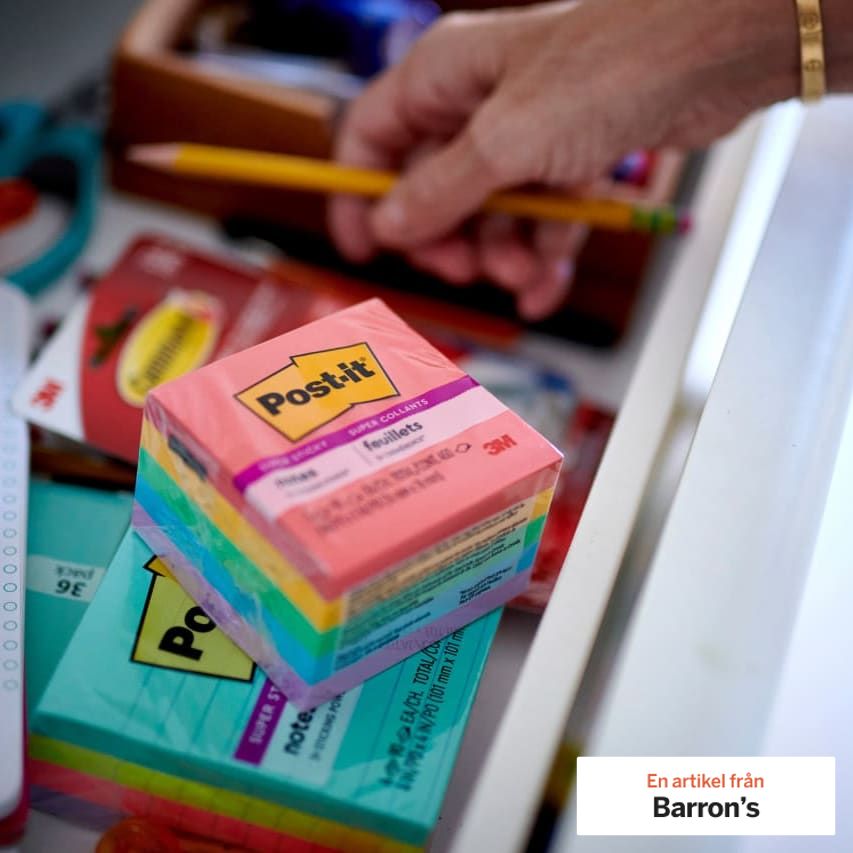
3M, som är känt för sina färgglada post-it-lappar, var fram till nyligen hopplöst ute i börskylan. Bolaget, som förlorat en tredjedel av sitt börsvärde de senaste fem åren, ansågs oinvesterbart av många investerare så sent som vid nyår. Men efter omfattande förändringar i bolaget ser det plötsligt ljusare ut, skriver Barron’s.
En attraktiv värdering, uppstädad balansräkning, generös utdelningspolicy och ny strategi med större fokus på kärnverksamheten är några av argumenten för att plocka upp aktien nu.
 Barron's
3M Is Leaner and Ready to Grow. It’s Time to Buy the Stock.
The company, battered by the market, has been making big changes—including spinning off its healthcare unit and settling lawsuits—that make it a more nimble company.
For a long time now, 3M has felt like it was held together by Scotch tape. But after a series of recent moves, it appears to be made of stronger stuff.
3M, the maker of all things sticky, including Post-it Notes, hasn’t had an easy time lately. Legal problems tied to “forever chemicals” found in water supplies and potentially faulty earplugs sold to the government have been an overhang on shares. The company’s other businesses— which include adhesives for electronics, advanced materials for cars, and reflective tapes—have struggled, as well, resulting in stagnant growth and narrowing profit margins. The stock has dropped 34% over the past five years, and by the end of 2023 was considered nearly uninvestible by many investors.
No longer. 3M has been making big changes that have resulted in a smaller, safer, and more nimble company. It spun off its healthcare business on April 1, announced legal settlements, reset its dividend, and installed a new CEO on May 1. Even growth is expected to be better as it focuses on a narrower set of businesses and the manufacturing economy begins to improve.
”Historically, 3M has been good to play a cyclical rebound”
“Historically, 3M has been good to play a cyclical rebound,” says BofA Securities analyst Andrew Obin. “Growth has been a challenge, but the stock is inexpensive.
It’s hard to overstate how far 3M has fallen in the past few years. Sales dropped 3% year over year in 2023, while earnings fell 12%, to $9.24 a share, down from $10.46 earned in 2018—a year when sales grew 3.2%. The company was less profitable, too, with operating profit margins slipping to 20.3% last year from 24.7% in 2018. A stock that once fetched 16 times next year’s earnings estimates, a slight premium to the S&P 500 , traded for 10 times at the start of 2024, or about half the index’s price/earnings ratio. More than just a symptom of its slowing business, 3M’s stock was pressured by the unknown amount the company might be forced to pay to cover its earplug and PFAS—short for per- and polyfluoroalkyl substances—liabilities.
Things started to get interesting last year. 3M reached settlements over PFAS—the company will contribute up to $12.5 billion over 13 years for cleanup—and agreed to pay up to $6 billion to settle claims related to earplugs sold to the military. The amounts are large, but known—and manageable. “These have been the two most significant litigation matters that have been in front of us,” former CEO Mike Roman told Barron’s. “Really good to have those two milestones complete.”
Roman stepped down as CEO on May 1, leaving a stock that had dropped about 5% annually over his nearly six-year tenure. It wasn’t all his fault. Neuberger Berman portfolio manager Evelyn Chow acknowledges “the immensity of the challenges he faced,” even if she wishes he had been more aggressive in tackling 3M’s expenses, and he made some tough decisions before ceding control of the company to former L3Harris Technologies CEO Bill Brown. Roman spun off 3M’s healthcare division as Solventum , leaving the company with businesses that serve transportation and industrial markets, electronics customers, and consumers with its Scotch brand tape and Post-it Notes.
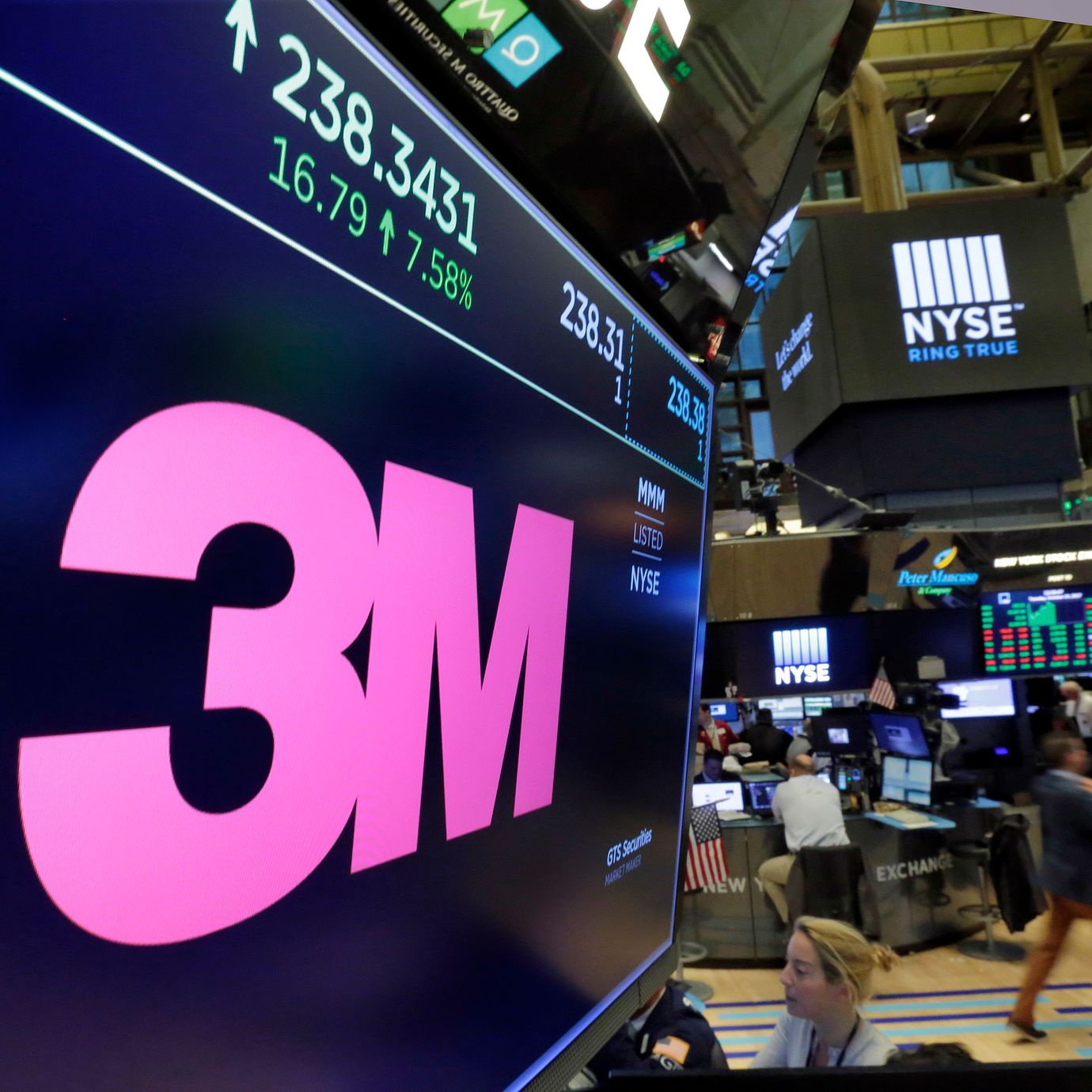
Roman also “reset” the dividend, clearing the decks for Brown. 3M announced plans to set aside about 40% of its annual free cash flow for dividend payments. Wall Street expects free cash flow of about $3.7 billion in 2024, which supports a dividend closer to $3 a year, compared with the $6.01 it paid over the past 12 months before the spinoff.
Investors can think of the reduced dividend and the spinoff as prices paid to fix the balance sheet, given the legal issues. The spin resulted in a $7.7 billion dividend paid from Solventum, while 3M still holds about 20% of Solventum stock worth another $2.2 billion. Taken together, the new 3M balance sheet will have the equivalent of $16 billion in debt and legal liabilities on its books, net of cash and stock. Earnings before interest, taxes, amortization, and depreciation, or Ebitda, are forecast to be about $6.4 billion this year. That leaves 3M’s debt-to-Ebitda ratio, a common measure of balance-sheet strength, at a theoretical 2.5 times. (It’s theoretical because the legal settlements are paid out over time.) That ratio is higher than the 1.6 times for industrial companies in the S&P 500, but not alarming.

3M’s valuation captures most of the risks but little of the reward. The company trades for just 12 times Wall Street’s $8 estimate for 2025 earnings per share, below the Industrial Select Sector SPDR exchange-traded fund’s 21 times. The multiple should move higher with better execution and stronger business demand, which has already started to improve. The company reported earnings of $2.39 per share on sales of $7.7 billion, both topping analyst forecasts. Organic sales grew by 0.8%, the first positive reading in four quarters, and operating profit margins in the nonhealthcare business segments improved almost six percentage points year over year.
The result impressed J.P. Morgan analyst Stephen Tusa, who upgraded 3M to Overweight from Neutral after the first-quarter earnings report, citing an “attractive” valuation, the “cleaned-up balance sheet,” the dividend cut, and a “turn in earnings momentum” among the reasons for his more optimistic view. His price target of $111 a share—up 14% from a recent $97.33—works out to about 14 times his estimated 2025 earnings per share of $7.85. At a historically reasonable 16 times earnings, 3M stock would be roughly $126 a share, up 30% from recent levels.
Don’t fight the tape.