Röd eller blå – USA:s investerare styr portföljen efter politiken

”Lämna politiken utanför portföljen” är en gammal sanning på Wall Street. Men investerare börjar allt oftare göra avsteg från den regeln, skriver Wall Street Journal.
Nya mätningar visar ett historiskt stort gap mellan demokraters och republikaners syn på hur aktiemarknaden kommer att utvecklas det närmaste halvåret. Det avspeglas i sin tur i investeringsbesluten.
– Om jag vet hur folk röstar kan jag berätta hur de känner för börsen, säger förmögenhetsförvaltaren David Sadkin till tidningen.
 The Wall Street Journal
Red vs. Blue Is Dividing Stock Portfolios Like Never Before
A political gap in optimism about markets is translating into trading decisions
An adage on Wall Street holds that it is unwise to play politics with your portfolio. Americans are increasingly doing just that.
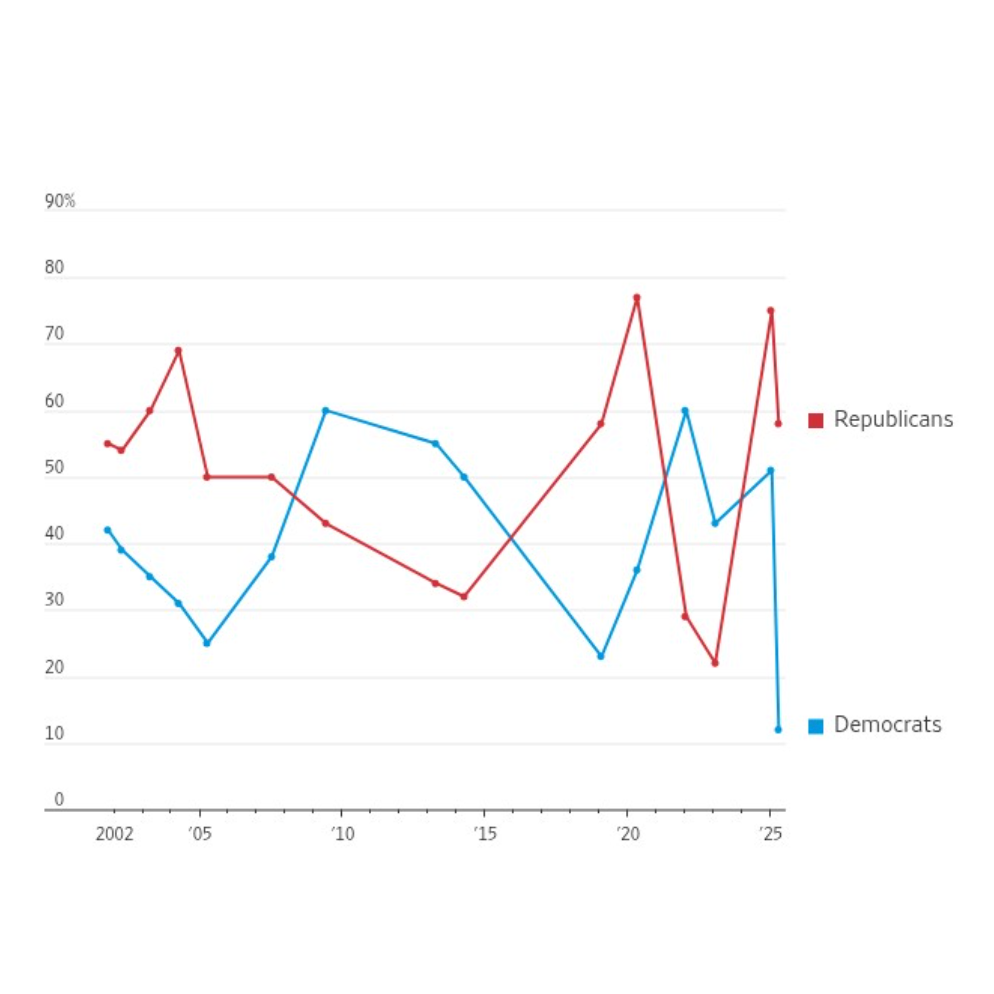
A Gallup poll this spring showed that Democrats who expected stocks to tumble over the next six months exceeded Republicans by 59 percentage points. Republicans expecting stocks to climb over that period topped Democrats by 47 percentage points.
That “optimism gap” is translating into trading decisions. David Sadkin, partner at Bel Air Investment Advisors, who oversees around $12 billion in assets for wealthy individuals, said that has become clear in calls he has received from clients since President Trump’s tariffs this spring roiled markets.
One wealthy couple, who weren’t fans of Trump’s policies, asked Sadkin about moving all assets abroad, fearful that American assets from U.S. stocks to bonds to the dollar would tank on the president’s watch.
“If I know how people voted, I could tell you how they feel about the stock market,” Sadkin said.
The party affiliations of Americans have long shaped how they feel about the economy, or the price of eggs and milk at the grocery store, as people give lower marks when their party is out of power. The perception gap started growing much wider after the election of Donald Trump in 2016, according to a monthly consumer survey conducted by the University of Michigan.
The 47-point gap in partisan optimism regarding the stock market’s trajectory is the largest divide observed in Gallup data provided to The Wall Street Journal going back to 2001. That year, during George W. Bush’s presidency, the optimism gap between Republicans and Democrats stood at 13 percentage points.
Increasingly, people are peering at their investment portfolios through their red and blue goggles.
A group of researchers in a study analyzed securities filings for local independent investment advisers in 309 U.S. counties and found that wealthy people who lean Democratic or Republican are choosing different stocks.
The divide between their portfolios emerged in 2013, when Barack Obama was president, and kept growing through 2019, during Trump’s first term, according to Elena Pikulina, one of the study’s authors.
One investor who voted for Trump and isn’t too concerned about the tariff turmoil is Bruce Besten, a 68-year-old restaurant owner in Louisville, Ky. He said media “hype” about how tariffs would pummel the economy created buying opportunities for him during the big market swoon in April, when he picked up stocks including Nvidia.
”What’s good for the business environment is good for the stock market”
“In general, when a person with his mindset is in office, it’s good for the business environment,” said Besten, who holds shares of around two dozen companies and has typically favored financials and energy stocks. “What’s good for the business environment is good for the stock market.”
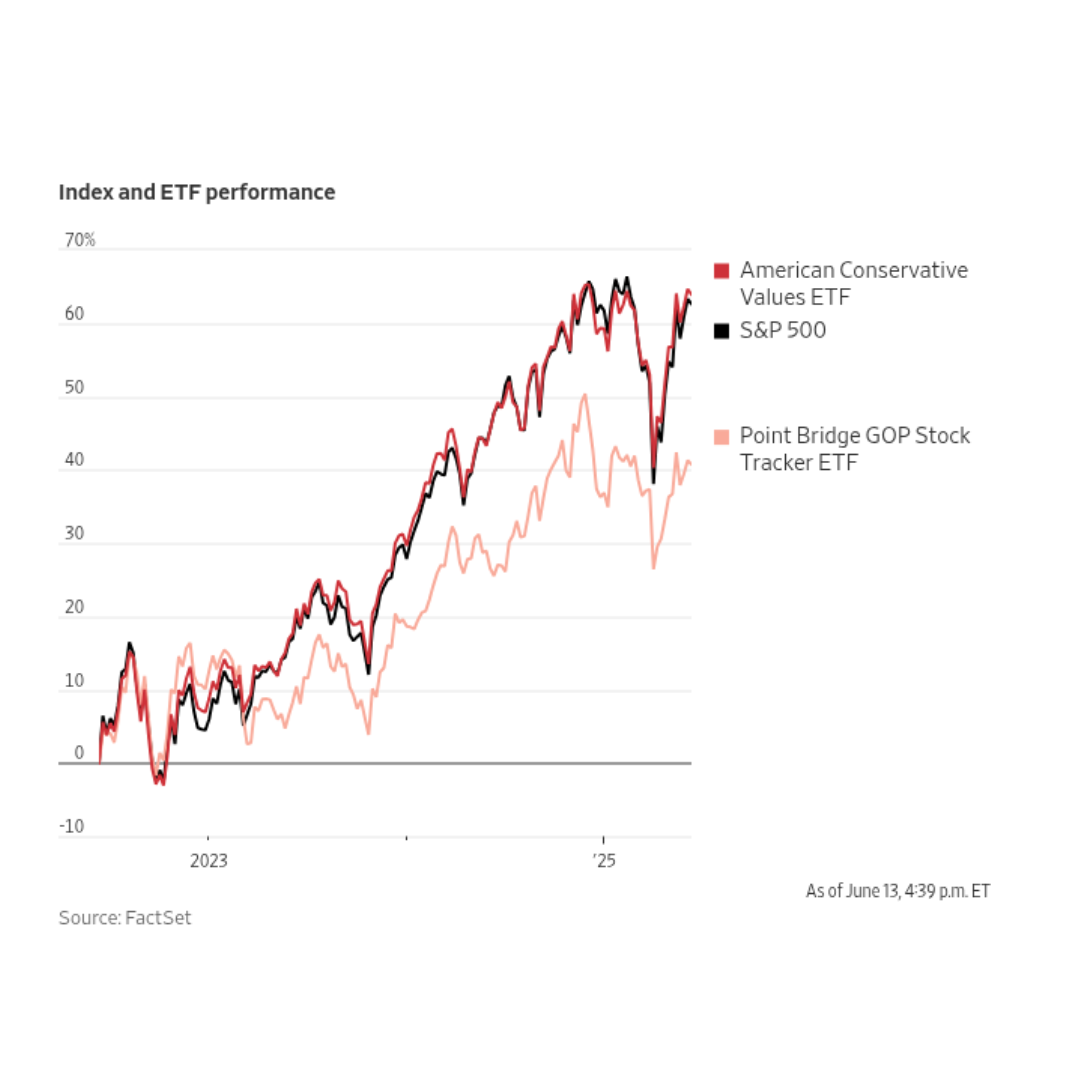
Wall Street is finding ways to capitalize on investors’ partisanship. Trump Media & Technology Group, the media company tied to the president, launched investments giving individuals access to “non-woke” companies. Funds including the American Conservative Values ETF and Point Bridge America First ETF, which goes by the ticker “MAGA,” have drawn tens of millions of dollars in assets.
The conservative-values ETF has roughly tracked the S&P 500’s performance over the past three years. The MAGA fund has lagged behind the S&P 500 by more than 20 percentage points.
At the same time, those who sold at the height of April’s tariff turmoil would have missed out on recovering their losses when stocks staged a full recovery. The S&P 500 is now back near all-time highs, showing why buying and selling based on political leanings can be disastrous for portfolios.
Investing $1,000 upon President Dwight Eisenhower’s inauguration in 1953, and holding only when a Republican was president, would produce about $29,000 today, according to Paul Hickey at Bespoke Investment Group. The same sum held only during subsequent Democratic administrations would be worth more than double that. Simply buying and holding would have yielded around $1.9 million.
That offers only so much comfort to those who remain nervous about the fallout from Trump’s rapid shifts in policy. Eknath Belbase in Ithaca, N.Y., started moving more of his money internationally, worried about high valuations in the U.S. The president’s spat with Ukrainian President Volodymyr Zelensky in the Oval Office led him to rethink America’s relationship with the rest of the world. The 54-year-old said he has trimmed his U.S. exposure to around 50% of his stockholdings.
“They’re making the game plan up as they go along,” he said.
”They were OK. It wasn’t through Biden”
Some investors said that doing nothing might still be the best move—whatever one’s political leanings. Ronald Gallagher, an 81-year-old retiree in Paradise Valley, Ariz., voted for Trump and thinks stocks will likely do better under his administration than they would if Kamala Harris had won.
But he stayed the course during the Biden administration, and the past two years were good for his portfolio—even if he doesn’t think Biden deserves the credit for stocks’ back-to-back gains of more than 20%, the best showing in a quarter-century.
“They were OK,” Gallagher said of the returns. “It wasn’t through Biden.”