Hem
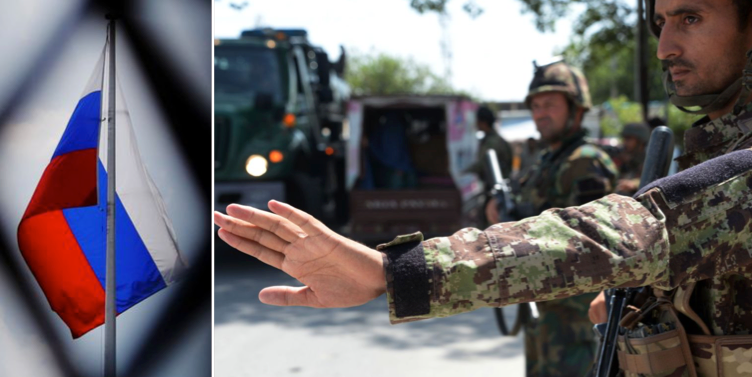
Illustrationsbild. (TT)

Rysk diplomati i Afghanistan ett huvudbry för USA

Rysslands engagemang i Afghanistan vållar nu huvudbry för USA – som med 6,5 miljarder dollar årligen sponsrar afghanska regeringens säkerhetsstyrkor, skriver AP.

Detta sedan Afghanistans regering gått med på att förhandla med den talibanska terrormilisen ”vid sidlinjen” under utsatt möte i Moskva nästa vecka. Det skriver Washington Post, med hänvisning till källor i Rysslands utrikesdepartement.

Maktfaktorer som Ryssland, Kina, Iran och Pakistan, alla länder med frostiga relationer till USA, har på senare tid flyttat fram positionerna för att få geopolitisk makt i det strategiska läge som Afghanistan utgör som mittpunkt i den asiatiska kontinenten.

Beskyllningarna rörande vem som hjälper vem i konflikten går i alla riktningar, men klart står att USA:s inflytande i landet – som genom historien drabbats hårt av storpolitiska maktkonflikter – nu riskerar att försvagas, skriver New York Times.

bakgrund
 
Taliban
Wikipedia (sv)
Taliban (pashto: طالبان), av arabiskans ṭālib (طالب) för "student", är en politisk-religiös väpnad islamistisk rörelse som grundades i Kandahar 1994 och regerade merparten av Afghanistan åren 1996–2001. Talibanrörelsen är en i huvudsak pashtunsk organisation som följer en fundamentalistisk form av deobandilära, en gammal sydasiatisk variant av sunniislam, i kombination med strikt hängivelse till pashtunwali, pashtunernas traditionella livsstil och kulturella normer. Talibanerna har sitt ursprung i de karga pakistanska flyktingläger som afghaner flydde till efter Sovjetunionens intervention i Afghanistan 1979 och idag har de stort inflytande även på Pakistans sida om gränsen. Många medlemmar utbildas i ultrakonservativa madrassor, koranskolor, som är mycket vanliga i Pakistan.
bakgrund
 
Afghanistan
Wikipedia (en)
Afghanistan ( ( listen); Pashto/Dari: افغانستان‬, Pashto: Afġānistān [avɣɒnisˈtɒn, ab-], Dari: Afġānestān [avɣɒnesˈtɒn]), officially the Islamic Republic of Afghanistan, is a landlocked country located within South Asia. Afghanistan is bordered by Pakistan in the south and east; Iran in the west; Turkmenistan, Uzbekistan, and Tajikistan in the north; and in the far northeast, China. Its territory covers 652,000 square kilometers (252,000 sq mi) and much of it is covered by the Hindu Kush mountain range, which experience very cold winters. The north consists of fertile plains, whilst the south-west consists of deserts where temperatures can get very hot in summers. Kabul serves as the capital and its largest city. Human habitation in Afghanistan dates back to the Middle Paleolithic Era, and the country's strategic location along the Silk Road connected it to the cultures of the Middle East and other parts of Asia. The land has historically been home to various peoples and has witnessed numerous military campaigns, including those by Alexander the Great, Mauryas, Muslim Arabs, Mongols, British, Soviet, and since 2001 by the United States with NATO-allied countries. It has been called "unconquerable" and nicknamed the "graveyard of empires". The land also served as the source from which the Kushans, Hephthalites, Samanids, Saffarids, Ghaznavids, Ghorids, Khaljis, Mughals, Hotaks, Durranis, and others have risen to form major empires.The political history of the modern state of Afghanistan began with the Hotak and Durrani dynasties in the 18th century. In the late 19th century, Afghanistan became a buffer state in the "Great Game" between British India and the Russian Empire. Its border with British India, the Durand Line, was formed in 1893 but it is not recognized by the Afghan government and it has led to strained relations with Pakistan since the latter's independence in 1947. Following the Third Anglo-Afghan War in 1919 the country was free of foreign influence, eventually becoming a monarchy under King Amanullah, and later for 40 years under Zahir Shah. In the late 1970s, Afghanistan in a series of coups first became a socialist state and then a Soviet Union protectorate. This evoked the Soviet–Afghan War in the 1980s against rebels. By 1996 most of Afghanistan was captured by the fundamentalist Islamic group the Taliban, who ruled most of the country as a totalitarian regime for almost five years. The Taliban were forcibly removed by the NATO-led coalition, and a new democratically-elected government political structure was formed. Afghanistan is a unitary presidential Islamic republic with a population of 35 million, mostly composed of ethnic Pashtuns, Tajiks, Hazaras and Uzbeks. It is a member of the United Nations, the Organisation of Islamic Cooperation, the Group of 77, the Economic Cooperation Organization, and the Non-Aligned Movement. Afghanistan's economy is the world's 108th largest, with a GDP of $64.08 billion; the country fares much worse in terms of per-capita GDP (PPP), ranking 167th out of 186 countries in a 2016 report from the International Monetary Fund.
bakgrund
 
Kriget i Afghanistan (2001-nu)
Wikipedia (en)
The War in Afghanistan (or the U.S. War in Afghanistan; code named Operation Enduring Freedom – Afghanistan (2001–2014) and Operation Freedom's Sentinel (2015–present)) followed the United States invasion of Afghanistan of October 7, 2001. The U.S. was supported initially by the United Kingdom and Canada and later by a coalition of over 40 countries, including all NATO members. The war's public aims were to dismantle al-Qaeda and to deny it a safe base of operations in Afghanistan by removing the Taliban from power. The War in Afghanistan is the second longest war in United States history, behind the Vietnam War.Following the September 11 attacks in 2001 on the U.S., which President George W. Bush blamed on Osama bin Laden who was living or hiding in Afghanistan, President Bush demanded that the Taliban hand over Osama bin Laden and expel al-Qaeda; bin Laden had already been wanted by the U.S. since 1998. The Taliban declined to extradite him unless they were provided evidence of his involvement in the September 11 attacks and also declined demands to extradite others on the same grounds. The U.S. dismissed the request for evidence as a delaying tactic, and on October 7, 2001 launched Operation Enduring Freedom with the United Kingdom. The two were later joined by other forces, including the Northern Alliance which had been fighting the Taliban in the ongoing civil war since 1996. In December 2001, the United Nations Security Council established the International Security Assistance Force (ISAF), to assist the Afghan interim authorities with securing Kabul. At the Bonn Conference the same month, Hamid Karzai was selected to head the Afghan Interim Administration, which after a 2002 loya jirga (grand assembly) in Kabul became the Afghan Transitional Administration. In the popular elections of 2004, Karzai was elected president of the country, now named the Islamic Republic of Afghanistan.NATO became involved in ISAF in August 2003, and later that year assumed leadership of it. At this stage, ISAF included troops from 43 countries with NATO members providing the majority of the force. One portion of U.S. forces in Afghanistan operated under NATO command; the rest remained under direct U.S. command. Following defeat in the initial invasion, the Taliban was reorganized by its leader Mullah Omar, and launched an insurgency against the government and ISAF in 2003. Though outgunned and outnumbered, insurgents from the Taliban, Haqqani Network, Hezb-e-Islami Gulbuddin and other groups have waged asymmetric warfare with guerrilla raids and ambushes in the countryside, suicide attacks against urban targets and turncoat killings against coalition forces. The Taliban exploited weaknesses in the Afghan government, which is among the most corrupt in the world, to reassert influence across rural areas of southern and eastern Afghanistan. In the initial years there was little fighting, but from 2006 the Taliban made significant gains and showed an increased willingness to commit atrocities against civilians. ISAF responded in 2006 by increasing troops for counterinsurgency operations to "clear and hold" villages and "nation building" projects to "win hearts and minds". Violence sharply escalated from 2007 to 2009. While ISAF continued to battle the Taliban insurgency, fighting crossed into neighboring North-West Pakistan. Troop numbers began to surge in 2009 continued to increase through 2011 when roughly 140,000 foreign troops operated under ISAF and U.S. command in Afghanistan. Of these 100,000 were from the U.S. On May 1, 2011, United States Navy SEALs killed Osama bin Laden in Abbotabad, Pakistan. In May 2012, NATO leaders endorsed an exit strategy for withdrawing their forces. UN-backed peace talks have since taken place between the Afghan government and the Taliban. In May 2014, the United States announced that its major combat operations would end in December 2014, and that it would leave a residual force in the country. In October 2014, British forces handed over the last bases in Helmand to the Afghan military, officially ending their combat operations in the war. On December 28, 2014, NATO formally ended ISAF combat operations in Afghanistan and officially transferred full security responsibility to the Afghan government. The NATO-led Operation Resolute Support was formed the same day as a successor to ISAF. As of May 2017, over 13,000 foreign troops remain in Afghanistan without any formal plans to withdraw, and continue their fight against the Taliban, which remains by far the largest single group fighting against the Afghan government and foreign troops.Tens of thousands of people have been killed in the war. Over 4,000 ISAF soldiers and civilian contractors, over 15,000 Afghan national security forces were killed, as well as over 31,000 civilians.
bakgrund
 
Sovjet-afghanska kriget (1979–1989)
Wikipedia (en)
The Soviet–Afghan War lasted over nine years, from December 1979 to February 1989. Insurgent groups known collectively as the mujahideen, as well as smaller Maoist groups, fought a guerrilla war against the Soviet Army and the Democratic Republic of Afghanistan government, mostly in the rural countryside. The mujahideen groups were backed primarily by the United States, Saudi Arabia, and Pakistan, making it a Cold War proxy war. Between 562,000 and 2,000,000 civilians were killed and millions of Afghans fled the country as refugees, mostly to Pakistan and Iran. Prior to the arrival of Soviet troops, Afghanistan's communist party took power after a 1978 coup, installing Nur Mohammad Taraki as president. The party initiated a series of radical modernization reforms throughout the country that were deeply unpopular, particularly among the more traditional rural population and the established traditional power structures. The government's Stalinist-like nature of vigorously suppressing opposition, executing thousands of political prisoners and ordering massacres against unarmed civilians, led to the rise of anti-government armed groups, and by April 1979 large parts of the country were in open rebellion. The government itself experienced in-party rivalry, and in September 1979 Taraki was murdered under orders of his rival and Minister of Foreign Affairs, Hafizullah Amin, which soured relations with the Soviet Union. Eventually the Soviet government, under leader Leonid Brezhnev, decided to deploy the 40th Army on December 24, 1979. Arriving in the capital Kabul, they staged a coup, killing president Amin and installing Soviet loyalist Babrak Karmal from a rival faction. The deployment had been variously called an "invasion" (by Western media and the rebels) or a legitimate supporting intervention (by the Soviet Union and the Afghan government) on the basis of the Brezhnev Doctrine. In January 1980, foreign ministers from 34 nations of the Islamic Conference adopted a resolution demanding "the immediate, urgent and unconditional withdrawal of Soviet troops" from Afghanistan, while the UN General Assembly passed a resolution protesting the Soviet intervention by a vote of 104 (for)–18 (against), with 18 abstentions and 12 members of the 152-nation Assembly absent or not participating in the vote. Afghan insurgents began to receive massive amounts of aid and military training in neighboring Pakistan and China, paid for primarily by the United States and Arab monarchies in the Persian Gulf. As documented by the National Security Archive, "the Central Intelligence Agency (CIA) played a significant role in asserting U.S. influence in Afghanistan by funding military operations designed to frustrate the Soviet invasion of that country. CIA covert action worked through Pakistani intelligence services to reach Afghan rebel groups." Soviet troops occupied the cities and main arteries of communication, while the mujahideen waged guerrilla war in small groups operating in the almost 80 percent of the country that was outside government and Soviet control, almost exclusively being the rural countryside. The Soviets used their air power to deal harshly with both rebels and civilians, levelling villages to deny safe haven to the mujahideen, destroying vital irrigation ditches, and laying millions of land mines.The military intervention was sharply and almost immediately denounced by the international community, with numerous sanctions and embargoes being imposed against the Soviet Union and the U.S.-led 1980 Summer Olympics boycott against Moscow, which was holding the event; the boycott and sanctions exacerbated Cold War tensions and enraged the Soviet government which later began and led a revenge boycott of the 1984 Olympics held in Los Angeles. The Soviets initially planned to secure towns and roads, stabilize the government under new leader Karmal, and withdraw within six months or a year. But they were met with fierce resistance from the guerillas, and were stuck in a bloody war that lasted nine years. By the mid-1980s, the Soviet contingent was increased to 108,800 and fighting increased, but the military and diplomatic cost of the war to the USSR was high. By mid-1987 the Soviet Union, now under reformist leader Mikhail Gorbachev, announced it would start withdrawing its forces after meetings with the Afghan government. The final troop withdrawal started on May 15, 1988, and ended on February 15, 1989, leaving the government forces alone in its battle against the insurgents, which continued until 1992 when the former Soviet-backed government collapsed. Due to its length, it has sometimes been referred to as the "Soviet Union's Vietnam War" or the "Bear Trap" by the Western media. The Soviets' failure at the war is thought to be a contributing factor to the fall of the Soviet Union.
Omni är politiskt obundna och oberoende. Vi strävar efter att ge fler perspektiv på nyheterna. Har du frågor eller synpunkter kring vår rapportering? Kontakta redaktionen