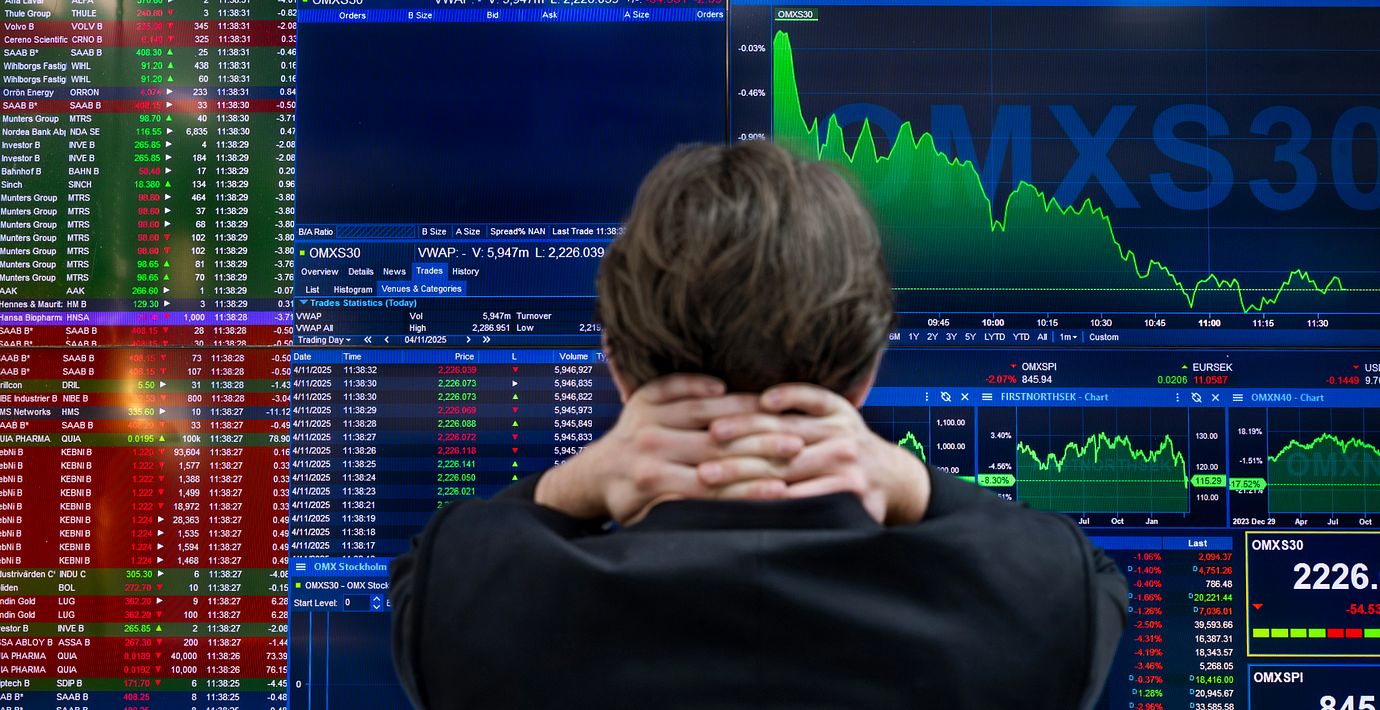
Satsade studielån trots farfars varning – rasade 40 procent
Innan pandemin frågade finska studenten Jonathan Back sin farfar om han borde investera på börsen, skriver Yle. Farfadern avrådde på grund av ett nytt virus i Kina, men Back satsade ändå.
Den 10 februari 2020 köpte han sina första aktier och en vecka senare hade portföljen rasat 40 procent. I dag är samma portfölj 50 procent upp. Men hade Back väntat två–tre veckor hade pengarna kunnat fördubblas.
– Oftast är det bäst att lyssna på de erfarna, säger han till Yle.
bakgrund
Aktiemarknadskraschen 2020
Wikipedia (en)
On 20 February 2020, stock markets across the world suddenly crashed after growing instability due to the COVID-19 pandemic. The crash ended on 7 April 2020.
Beginning on 13 May 2019, the yield curve on U.S. Treasury securities inverted, and remained so until 11 October 2019, when it reverted to normal. Through 2019, while some economists (including Campbell Harvey and former New York Federal Reserve economist Arturo Estrella), argued that a recession in the following year was likely, other economists (including the managing director of Wells Fargo Securities Michael Schumacher and San Francisco Federal Reserve President Mary C. Daly) argued that inverted yield curves may no longer be a reliable recession predictor. The yield curve on U.S. Treasuries would not invert again until 30 January 2020 when the World Health Organization declared the COVID-19 outbreak to be a Public Health Emergency of International Concern, four weeks after local health commission officials in Wuhan, China announced the first 27 COVID-19 cases as a viral pneumonia strain outbreak on 1 January.
The curve did not return to normal until 3 March when the Federal Open Market Committee (FOMC) lowered the federal funds rate target by 50 basis points. In noting decisions by the FOMC to cut the federal funds rate by 25 basis points three times between 31 July and 30 October 2019, on 25 February 2020, former U.S. Under Secretary of the Treasury for International Affairs Nathan Sheets suggested that the attention of the Federal Reserve to the inversion of the yield curve in the U.S. Treasuries market when setting monetary policy may be having the perverse effect of making inverted yield curves less predictive of recessions.
During 2019, the IMF reported that the world economy was going through a 'synchronized slowdown', which entered into its slowest pace since the Great Recession. Weakness was exhibited in the consumer market as global markets began to suffer through a 'sharp deterioration' of manufacturing activity. Global growth was believed to have peaked in 2017, when the world's total industrial sector output began to start a sustained decline in early 2018. The IMF blamed 'heightened trade and geopolitical tensions' as the main reason for the slowdown, citing Brexit and the China – United States trade war as primary reasons for slowdown in 2019, while other economists blamed liquidity issues.
The crash caused a short-lived bear market, and in April 2020 global stock markets re-entered a bull market, though U.S. market indices did not return to January 2020 levels until November 2020. The crash signaled the beginning of the COVID-19 recession. The 2020 stock market crash followed a decade of economic prosperity and sustained global growth after recovery from the Great Recession. Global unemployment was at its lowest in history, while quality of life was generally improving across the world. However, in 2020, the COVID-19 pandemic, the most impactful pandemic since the Spanish flu, began decimating the economy. Global economic shutdowns occurred due to the pandemic, and panic buying, and supply disruptions exacerbated the market. The International Monetary Fund had pointed to other mitigating factors seen before the pandemic, such as a global synchronized slowdown in 2019, as exacerbants to the crash, especially given that the market was already vulnerable.
Omni är politiskt obundna och oberoende. Vi strävar efter att ge fler perspektiv på nyheterna. Har du frågor eller synpunkter kring vår rapportering? Kontakta redaktionen