Hem
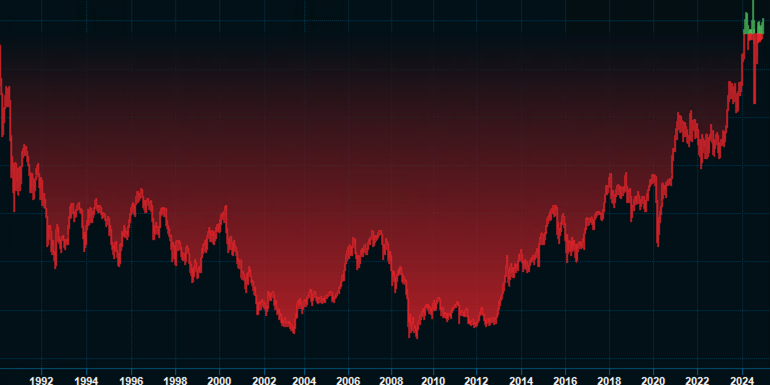
Nikkei 225 sedan 1990. (Infront)

Tokyo är tillbaka på toppen – 30 år efter att bubblan sprack

Tokyobörsen har ett starkt men turbulent år bakom sig och Nikkei 225 är i skrivande stund upp drygt 20 procent för 2024, vilket är något svagare än 2023. En symbolisk seger för marknaden är dessutom att den avslutar året högre än toppen på omkring 39 000 punkter som nåddes innan börsbubblan sprack i början av 90-talet, skriver Financial Times.

Nikkei 225 toppade strax över 42 000 punkter i somras efter ett rally drivet av återköp samt intresse från aktivistfonder och småsparare. Sedan följde ”carry trade”-kraschen i augusti innan en återhämtning följde. Tack vare ett tomterally drivet av bland annat fusions-samtalande Nissan och Honda är Nikkei nu åter över 40 000 punkter.

Takeo Kamai på CLSA Securities har dessutom hopp om fortsättningen.

– Det kan finnas försiktigt optimistiska investerare som återupptar intresset för ”köp japanskt”-narrativet inför det kommande året, säger han till FT.

bakgrund
 
Bubblan i Japan
Wikipedia (en)
The Japanese asset price bubble (バブル景気, baburu keiki, lit. 'bubble economy') was an economic bubble in Japan from 1986 to 1991 in which real estate and stock market prices were greatly inflated. In early 1992, this price bubble burst and Japan's economy stagnated. The bubble was characterized by rapid acceleration of asset prices and overheated economic activity, as well as an uncontrolled money supply and credit expansion. More specifically, over-confidence and speculation regarding asset and stock prices were closely associated with excessive monetary easing policy at the time. Through the creation of economic policies that cultivated the marketability of assets, eased the access to credit, and encouraged speculation, the Japanese government started a prolonged and exacerbated Japanese asset price bubble. By August 1990, the Nikkei stock index had plummeted to half its peak by the time of the fifth monetary tightening by the Bank of Japan (BOJ). By late 1991, other asset prices began to fall. Even though asset prices had visibly collapsed by early 1992, the economy's decline continued for more than a decade. This decline resulted in a huge accumulation of non-performing assets loans (NPL), causing difficulties for many financial institutions. The bursting of the Japanese asset price bubble contributed to what many call the Lost Decade. Japan's average nationwide land prices finally began to increase year-over-year in 2018, with a 0.1% rise over 2017 price levels.
Omni är politiskt obundna och oberoende. Vi strävar efter att ge fler perspektiv på nyheterna. Har du frågor eller synpunkter kring vår rapportering? Kontakta redaktionen