”Trump tar handelspolitiken tillbaka till 1800-talet” – varning för börsfrossa
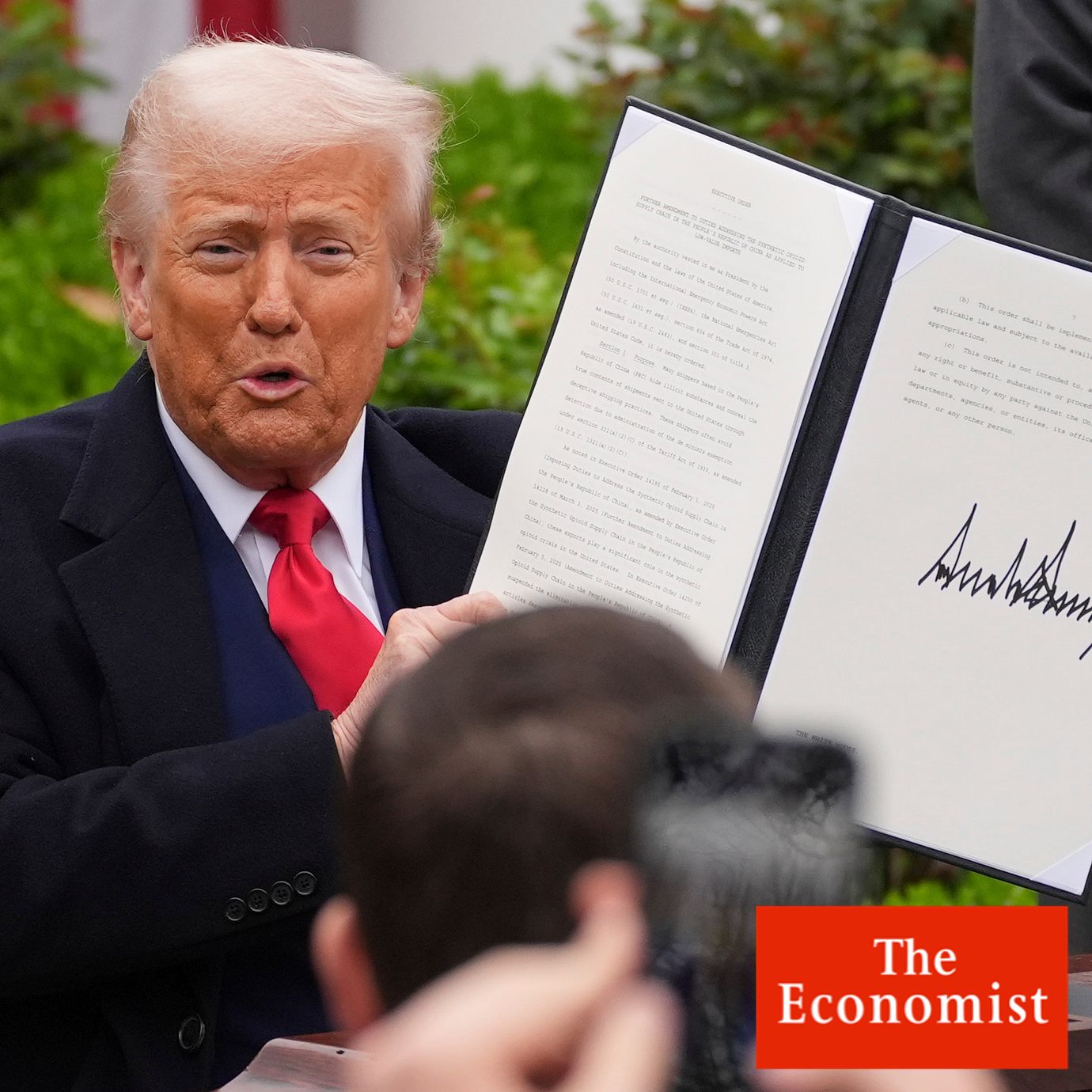
Med sin nya tulloffensiv ritar Donald Trump om USA:s ekonomiska kurs. En generell tull på 10 procent införs på all import, och betydligt högre nivåer riktas mot länder med stora handelsöverskott gentemot USA – upp mot 54 procent för vissa länder.
– Det här är en ekonomisk självständighetsförklaring, säger Trump själv om beslutet.
Ekonomer varnar för stigande priser, minskad tillväxt och ökad risk för recession. Enligt analytiker innebär åtgärderna den mest omfattande protektionismen sedan sent 1800-tal, skriver The Economist – och varnar för börsfrossa.
 The Economist
Trump takes America’s trade policies back to the 19th century
The president jacks up tariffs on all countries, with particularly sharp rises for much of Asia.
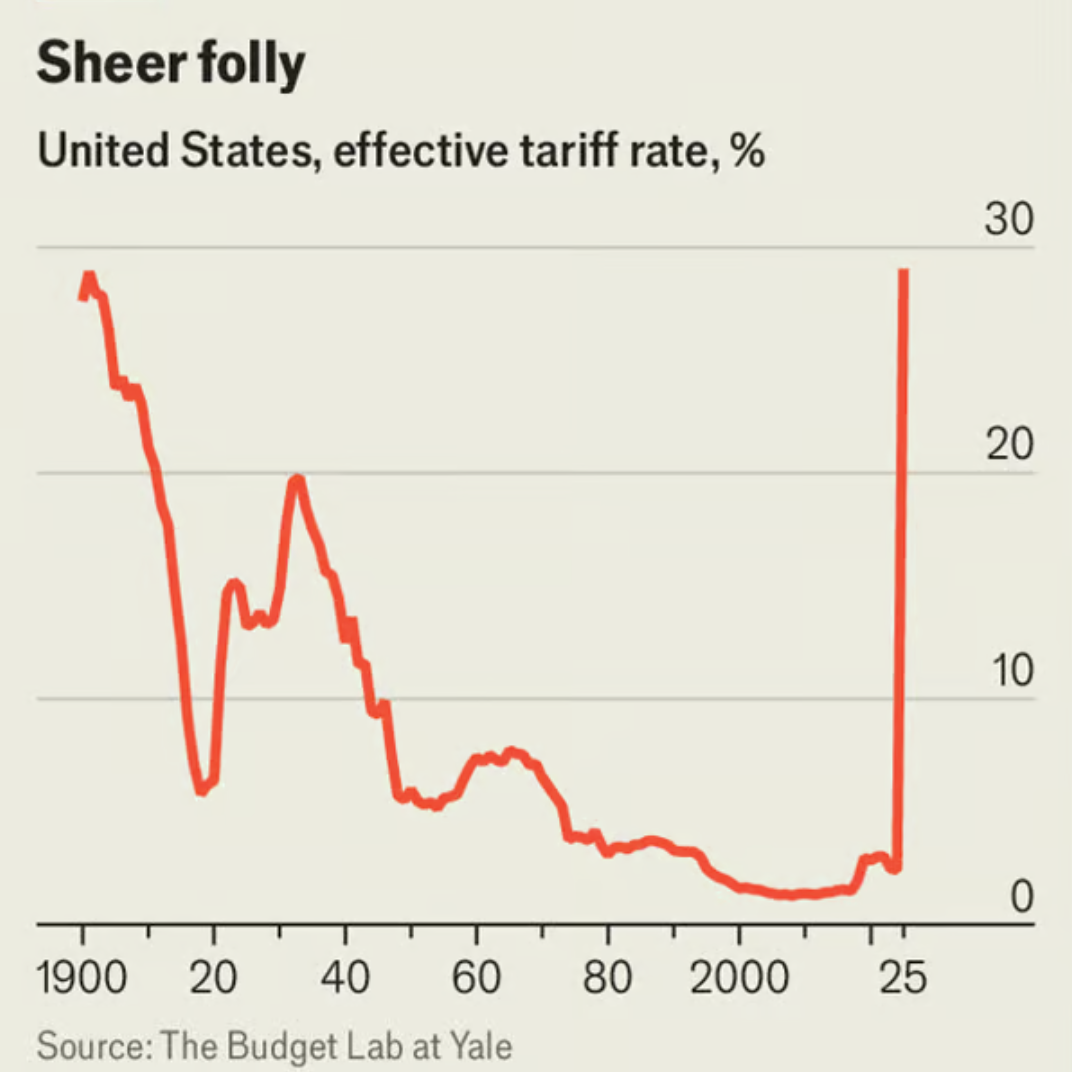
Few expected him to go quite so far. In a stunning shift in American economic strategy, Donald Trump has yanked up tariffs across the board. On April 2nd, speaking from the Rose Garden of the White House, he declared that America would impose levies of 10% on all imports plus higher “reciprocal” rates—much higher in some cases—to get back at countries which, in his view, have treated America unfairly. Coming on top of other tariffs announced since his return to the White House, the result is that, in the space of ten weeks, he has erected a wall of protection around the American economy akin to that of the late 1800s (see chart).
For Mr Trump the measures represent an attempt to bring a long era of increasingly free global trade to a definitive end. Such openness has, he argued, allowed other countries to “rip off” America. “For years, hard-working American citizens were forced to sit on the sidelines as other nations got rich and powerful, much of it at our expense…Now it’s our turn to prosper,” he said in his address. The new tariffs—far and away the broadest he has ever implemented—are nothing less than a “declaration of economic independence”, Mr Trump announced.
Conveniently ignored by him are the twin facts that globalisation has delivered unprecedented prosperity to America and that the country has been the main architect of the rules underpinning international trade. Now, if Mr Trump gets his way, the economic order that was slowly and steadily built up in the aftermath of the second world war is dead and buried. Instead, Mr Trump extolled the prosperity of America in the late 19th century, when the country was much poorer than it is today. “We can be so much wealthier than any country, it’s not even believable,” he said.
“If you want your tariff rate to be zero, then you build your product right here in America”
Businesses, investors and diplomats are still trying to wrap their heads around the details of Mr Trump’s new tariffs. But when looked at in totality, they appear to be bleaker than many of the worst-case scenarios for his trade policies envisioned even just a few days ago. Imports into America will now face a weighted-average tariff rate of nearly 29%, according to Evercore ISI, a research firm. That is a dramatic increase from 2% or so last year.
For both Americans and the rest of the world, there is little time to adjust. The universal tariff of 10% on all countries is due to take effect on April 5th, while the reciprocal tariffs targeting countries with large surpluses in their bilateral trade with America will start on April 9th. To calculate the reciprocal rates, the White House suggested that it had weighed each country’s tariffs against America, along with other measurements, including currency manipulation and trade barriers, before dividing the figure roughly in half—an act of great kindness, as Mr Trump put it. But data implied that it may have simply looked at America’s bilateral deficit as a share of imports from each country in order to calculate reciprocal rates, which would have been a remarkably crude methodology.
As a consequence of this approach, the European Union will now face tariffs of 20%, India 26% and Vietnam 46%. China, for its part, will see tariffs of 54%, since its reciprocal rate will stack on top of its existing levies. Mr Trump also vowed to close a loophole that allows foreign manufacturers, often Chinese ones, to send products worth less than $800 into America without any tariffs in a move that could wreak havoc on the e-commerce industry.
In a small mercy, tariffs on specific sectors, including a new 25% levy on cars, will be exempted from the country rates, meaning that autos made in, say, Germany will face just that 25% surcharge, without the additional EU tariff on top of it. The same logic applies to imports of aluminium and steel. Goods from Mexico and Canada, America’s two biggest trading partners, will also be free from tariffs, provided that they comply with the USMCA, a North American trade pact which Mr Trump renegotiated during his first term in office. Those that do not will still face a 25% tariff. And that was about it for the exemptions. “If you want your tariff rate to be zero, then you build your product right here in America,” Mr Trump said.
Around the world, stockmarkets are likely to come under heavy selling pressure
Until recently many observers clung to two hopeful interpretations of Mr Trump’s hawkishness. The first was that he wanted to deploy tariffs primarily to gain negotiating leverage as he sought concessions from other countries. The second was that Mr Trump would be disciplined by the stockmarket, about which he cared deeply, and would therefore retreat from punitive trade barriers if investors soured on them.
Both of these interpretations, already weakened by Mr Trump’s barrage of tariffs since taking office in January, looked even frailer after his comments on April 2nd. As the president explained—supported by evidence from television interviews that he gave some 40 years ago—he has consistently been a sceptic about free trade, believing that other countries exploit America. He did not blame foreign leaders for this, saying that they were acting wisely. Rather, he pointed his finger at his predecessors in the White House. As for the stockmarket, he seemed to downplay its significance, insisting that the real proof of his success will come from the revitalisation of America’s factories.
Naturally, that raises the question of how ugly things will get in markets and, ultimately, in the real economy over the coming days and months. The S&P 500 index of large American firms has fallen nearly 10% since hitting a record high in late February. In the days leading up to the new tariff announcement, the market had steadied, but as Mr Trump spoke—shortly after the close of trading—futures sold off, pointing to a sharp decline on April 3rd. Around the world, stockmarkets are likely to come under heavy selling pressure.
Such turbulence may be a small preview of the pain that awaits people and companies more generally. Because of the size and breadth of tariffs, including on Asian countries, from Bangladesh to Vietnam, which supply basic goods to America, consumer prices are sure to climb. Inflation, which had been slowly trending back towards an annual rate of 2%, may now exceed 4% before the end of the year, according to Capital Economics, a research firm.
In Mr Trump’s reality, America—the world’s wealthiest and most powerful country—is in fact a victim
Meanwhile, the damage to economic growth is likely to be far more severe than previously imagined. Before the new tariffs, indicators of consumer sentiment had become very soft and business uncertainty had soared. Most economists nevertheless believed that, with underlying momentum robust, this would amount to a slowdown for the economy. Such equanimity may have been misguided. Mark Zandi of Moody’s, a credit-rating agency, believes that a recession is inevitable if the announced trade policies are fully implemented.
Short-term pain is a price that Mr Trump seems willing to pay to fulfil his vision for America. Along with restoring the country’s manufacturing prowess, the levies will, he argues, generate “trillions and trillions of dollars” in revenue for the government, letting it reduce taxes and pay down the national debt. Such forecasts are outlandish: the drag from a big, permanent tariff wall that protects uncompetitive companies will swamp any potential benefits. But Mr Trump is convinced that, in his brilliance, he has seen global trade for the sham that it is. “We have to start taking care of our country now,” he intoned. In Mr Trump’s reality, America—the world’s wealthiest and most powerful country—is in fact a victim, and it is time to fight back.
© 2025 The Economist Newspaper Limited. All rights reserved.