Adenzaköp kröner Nasdaqs skifte från börs till fintech
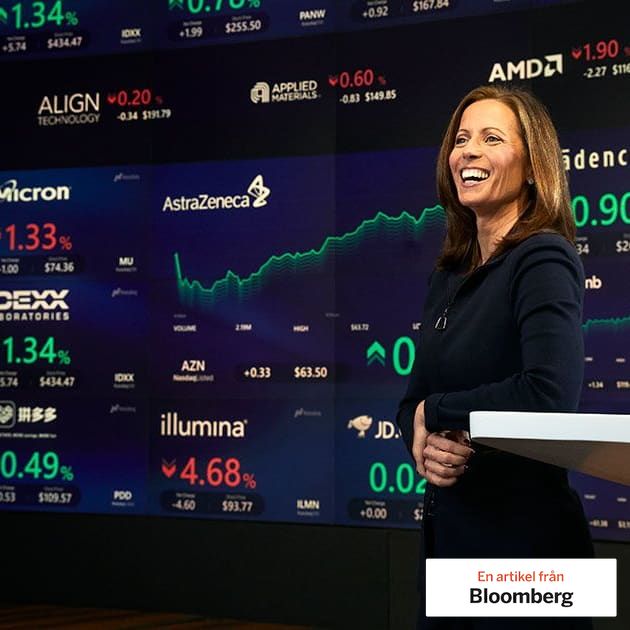
Nasdaq är världens näst största börs och handelsplats för de största techbolagen. Men de senaste sju åren har vd:n Adena Friedman målmedvetet utvecklat företaget till ett fintechbolag, skriver Bloomberg Businessweek.
Sedan 2017 har Friedman genomfört ett dussintal uppköp och strategin har i huvudsak belönats av marknaden – Nasdaqs aktie har stigit över 130 procent under Friedmans ledarskap. Det senaste köpet, hennes i särklass största, skickade emellertid ner aktiekursen med 12 procent. Oron handlar om köpeskillingen som finansierades med ett lån på över 5 miljarder dollar.
 Bloomberg
Nasdaq Leans Into Tech in Quest to Become More Than an Exchange
CEO Adena Friedman’s recent $10.5 billion Adenza deal underscores a strategic shift from simple stock market to fintech company.
When most people think of Nasdaq, they think of big tech stocks: It is, after all, the world’s No. 2 stock exchange and home to the likes of Amazon.com, Apple, Facebook, Google and Microsoft. But when Adena Friedman looks at the company, she thinks fintech. To make that vision a reality, Friedman, who became Nasdaq’s chief executive officer in 2017, has completed at least a dozen acquisitions, culminating in the $10.5 billion takeover of financial software house Adenza on Nov. 1.
Shareholders weren’t enthusiastic, pushing Nasdaq stock down by 12% the day the deal was announced in June. While investors have largely embraced Friedman’s overall strategy of shifting away from simply running an exchange—Nasdaq shares have jumped more than 130% on her watch—some analysts pointed to the steep cost of this latest purchase, with a valuation roughly 18 times Adenza’s sales. Nasdaq took on more than $5 billion in debt, almost doubling its debt-to-earnings ratio, spurring S&P to downgrade its credit rating. Others fret about the power the transaction hands to the seller, Thoma Bravo LLC. The private equity firm got a 14.9% stake in Nasdaq, giving it a seat on the board and making it the company’s No. 2 shareholder.
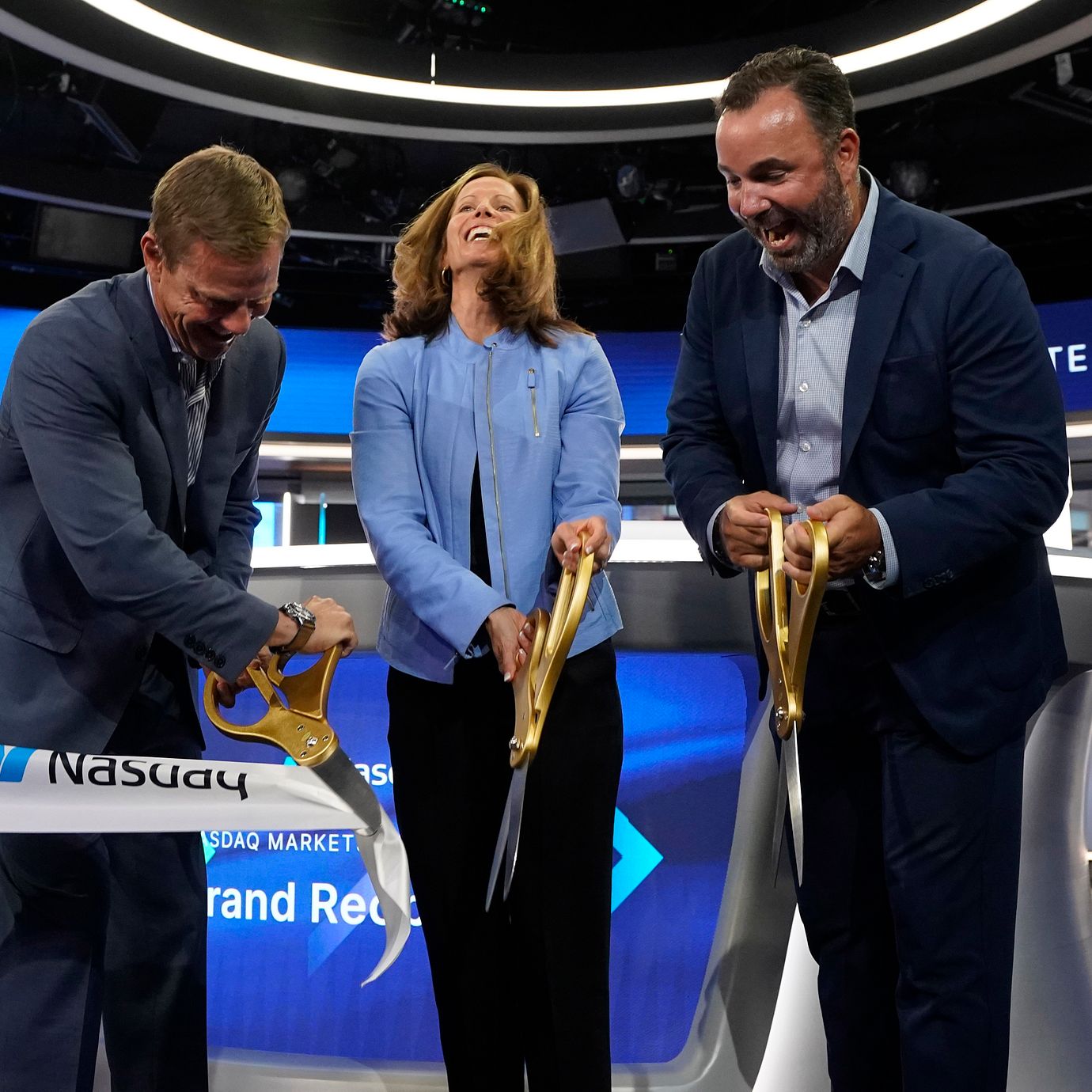
Now Friedman has to prove Nasdaq’s biggest-ever acquisition is worth the trouble.
She says that while fees from listings and trading on the exchange have long represented a shrinking share of revenue, it’s important to accelerate the transition. The Nasdaq exchange is an important calling card that gives the brand immense credibility, but its core business is highly dependent on the ups and downs of the market. For instance initial public offerings, the exchange’s primary avenue to new business, fell 84% in 2022, to just 118 IPOs, and this year they’re on a similar trajectory. Activities outside the legacy trading business have accounted for about 71% of sales this year. By adding Adenza, which makes software to manage investment risk and automate communications with regulators, Nasdaq expects that percentage to approach 77%. “We have been on a seven-year journey to evolve people’s understanding of Nasdaq,” Friedman says. “It requires a lot of conversation, a lot of action. We still have work to do.”

The market’s concern is that under Nasdaq, Adenza won’t be able to maintain the annual growth of roughly 15% it has clocked in recent years. Thoma Bravo partner Holden Spaht, who holds the firm’s seat on Nasdaq’s board, acknowledges that the current share price reflects that skepticism. But he says the deal will pay off for both sides. “I haven’t heard anyone argue that after the Adenza acquisition, the quality of Nasdaq’s profit won’t go up,” Spaht says. “At some point the market will realize it.”
Friedman says she questioned the initial pitch from her team because Adenza, a mashup of two niche companies— Calypso Technology and AxiomSL—that Thoma Bravo bought and merged in 2021, has scant brand recognition. “Is this just my name with a ‘z’?” she quipped. “Is that why you like the asset?” But she says she quickly concluded that Adenza might bring a huge number of customers for Nasdaq’s existing products such as software that can ferret out financial crime. Analysts at S&P say there’s little overlap between Nasdaq’s current client list and the 60,000 people at banks, brokers, insurers, investment funds and corporations who use Adenza’s software, so there should be plenty of possibilities for cross-selling. And since the firms that buy those programs tend to sign up for long-term contracts, there’s less volatility in the revenue stream.
Just as the two sides were negotiating the deal in March, the US financial system descended into crisis. Silicon Valley Bank and two other regional lenders were forced to shut down as depositors sought to withdraw billions of dollars, a chain of events that was widely blamed on insufficient regulatory oversight. Nasdaq’s team saw this as validation for their pursuit: Banks big and small use Adenza’s software to ensure compliance with the rules and to report to regulators. And as the rules change, the technology adjusts and helps exchanges, fund managers and central banks track their progress.
The problem Nasdaq faces is making that business as recognized as its older, public-facing marketplace, and that will first require a successful integration of Adenza’s software systems and its 2,000 employees. To help ensure the former, Friedman is folding the business into a revamped financial technology division, headed by Nasdaq President Tal Cohen. For the latter, the company has been holding get-togethers such as an evening out at Swingers, an indoor mini-golf club in Manhattan.
“And this will be a defining deal for her tenure as CEO”
The Adenza acquisition, adding a substantial business in regulatory reporting to Nasdaq’s offerings of exchange technology and risk management, marks a dramatic increase in the scale of Friedman’s ambitions. It was almost four times the size of her second-biggest purchase, Verafin Inc. That deal three years ago gave Nasdaq software that helps financial firms investigate and report instances of money laundering, fraud and market manipulation. And in 2017, Nasdaq paid $705 million for eVestment, which helps investors analyze and manage assets. “This is her vision, transforming the company into a financial technology provider,” says Kyle Voigt, an analyst at Keefe Bruyette & Woods. “And this will be a defining deal for her tenure as CEO.”
At the same time, Friedman has offloaded divisions that didn’t fit her strategy. Since she took over, Nasdaq has sold a public-relations and digital media business, a minority stake in clearinghouse company LCH Group and a US fixed-income business. Taken together, the asset sales and the acquisitions have helped Nasdaq reduce capital expenditures on its traditional business to 40% of the total, from 90% when Friedman took over, according to Owen Lau, an analyst at Oppenheimer & Co. The CEO “started carving out the noncore business and put more money into nontrading entities,” Lau says, “pivoting from just an exchange.”
Friedman says her inspiration for the fintech strategy came while she was serving as Nasdaq’s president. Then-CEO Robert Greifeld had told her to focus on everything but trading to develop a better understanding of the company’s potential range of businesses. After extensive discussions with customers, she says she heard a repeated refrain: Everyone was worried about dealing with regulators and minimizing the risks of fraud and financial crime. Nasdaq, they told her, was a tech leader with deep ties to the markets, but it wasn’t helping solve the biggest challenges in finance. “They saw us as good executors,” Friedman says. “They just wanted us to do more.”
For more articles like this please visit us at bloomberg.com