AI-agenter hotar resejättar: ”Finns inga skyddsvallar”

Resegiganter som Booking.com, Expedia och Airbnb rustar för ett teknikskifte där AI-agenter kan boka resor direkt åt användare – utan att gå via plattformarna.
Hotet kommer från aktörer som Open AI och Google, vars autonoma agenter kan söka, jämföra och boka resor i webbläsaren.
– Jag är inte dum nog att säga att jag inte är orolig. Det finns inga skyddsvallar, säger Glenn Fogel, vd för Booking.
Hotellbranschen välkomnar dock förändringen, då AI-agenter kan minska beroendet av reseplattformar och deras provisioner, skriver Financial Times.
 Financial Times
Online travel platforms prepare for rise of artificial intelligence ‘agents’
Booking.com, Expedia and Airbnb face threat of a technology that could bypass them as people make travel arrangements.
The world’s largest online booking platforms are preparing for the advent of artificial intelligence “agents”, signing partnerships with groups such as OpenAI in an effort to counter technology capable of arranging travel for customers without tapping their services.
Booking.com and Expedia are taking steps to deploy new AI-enabled features underpinned by models from OpenAI to automate services and launch new tools, including trip planners.
Airbnb has rolled out an AI-enabled customer service agent to handle customer queries, while it plans to launch more “agentic” functions on its platform next year.
The moves come as makers of AI agents — autonomous bots that can take actions on behalf of users — develop technology designed to make travel arrangements for users based on their unique preferences.
This could upend the $1.6tn global travel market, allowing more hotels and airlines to be accessed directly. That would disrupt the business model of dominant online travel agents that rely on the commissions and fees they can charge those businesses.

“We don’t have to do what OpenAI, Google, Grok or Meta are doing . . .[all of whom] are having to invest incredible amounts of money to build these models,” said Glenn Fogel, chief executive of Booking Holdings, which owns the Priceline and Booking.com platforms.
“Our belief is that as long as we . . . work closely with them that we will be able to participate in a way that provides a great return for our customers and our partners,” he added.
Start-up Anthropic in late 2024 began rolling out an AI agent dubbed “computer use” that can take actions in browsers, while rivals including OpenAI and Google launched their equivalent this year.
The technology’s potential has been heralded by the hotel sector, which has long complained about fees — that can range between 15 and 20 per cent — imposed by online travel platforms.
HOTREC, a European hotel industry group, said AI agents showed “clear potential” to reduce hoteliers’ reliance on OTAs but warned that it could also replicate what it described as a “dependency cycle”. The lobby group argued that existing online platforms operate by using opaque ranking models and offer its members limited visibility around the return made on fees they charge to boost the visibility of properties.
Airbnb chief Brian Chesky told investors in early August that the platform would become “more personalised and more agentic” next year
Max Niederhofer, partner at Heartcore Capital, an investor in travel start-ups such as GetYourGuide, said agentic AI would help widen the possible range of providers that travellers use to find properties.
“Fundamentally, [OTAs] are parasitic . . . If [hotels] don’t have any commission to pay, that’s 20 or so per cent they can use to give [customers] other things like a better room,” he said. “Online travel agents’ ‘take rates’ are at risk.”
A senior executive at a global hotel chain said Booking and Expedia had spent more time in outreach in recent months amid concerns that AI tools would cut them out of the process when customers sought to book accommodation.
“There was a natural inclination and still is among investors that travel loses in an AI first world,” said Eric Sheridan, analyst at Goldman Sachs, who noted that concerns about the technology were weighing on online travel agents’ share price alongside soft US consumer demand.
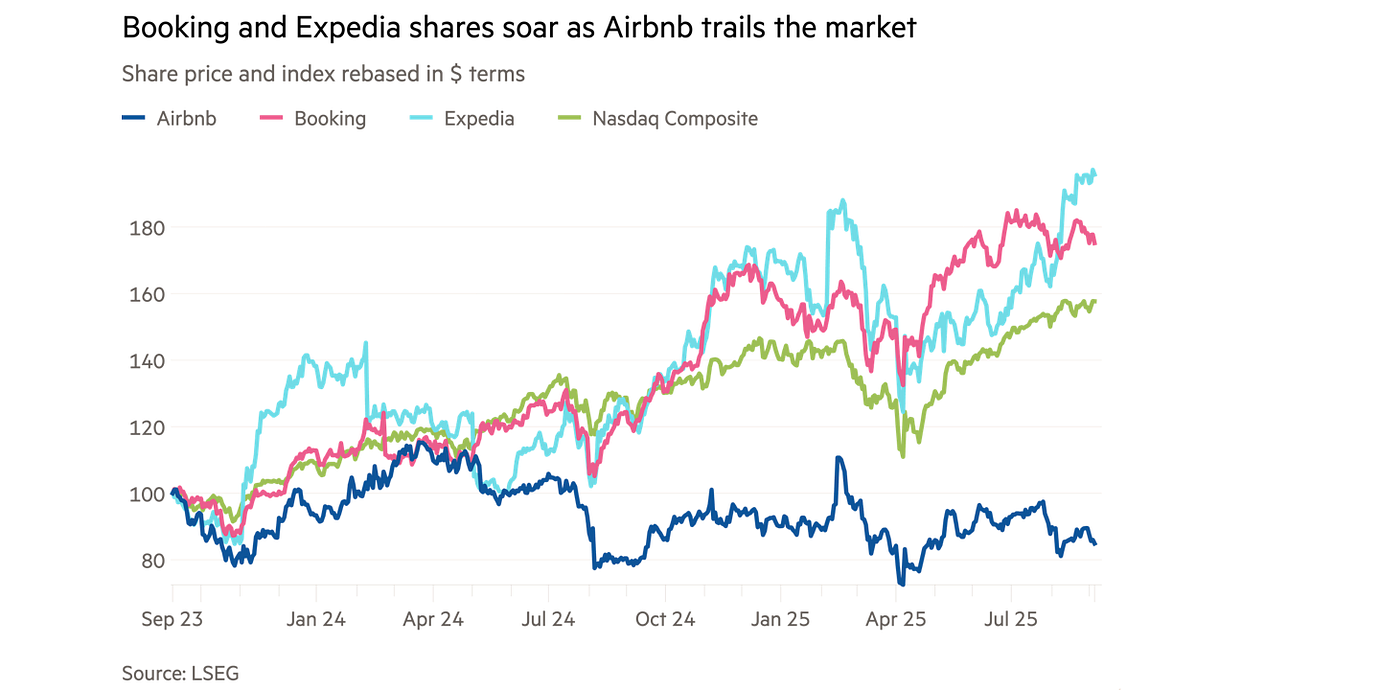
Booking and Expedia have tracked closely with the performance of the tech-heavy Nasdaq Composite this year, but have not posted the same astronomic performance seen elsewhere in the wider tech market. Airbnb shares are down nearly 6 per cent this year.
OTAs have sought to damp these concerns by highlighting the customer support infrastructure and vast datasets including user preferences and a ready-made inventory of properties that underpin their services. They argue that replicating this would constitute a significant time and resource drain for major technology companies.
“We have a lot of data on travel behaviour [that shows] what our travellers want,” said Jochen Koedijk, Expedia’s chief marketing officer. “What sells and what doesn’t sell. That’s the really big value proposition. It’s not easy to build an online travel agency.”
Yet Fogel acknowledged that the nascent technology still fed into his own “paranoid view of the world”. “You’re always worried that you’re going to fall off the map,” he added.
Booking.com reached an agreement with OpenAI in 2023 to build an array of tools including an “AI Trip Planner” that utilises the start-up’s models. The planner uses Booking’s own property, pricing and availability data to fine-tune the model to its customers’ needs. Rival Expedia integrated OpenAI’s models in the same year and is already deploying the ChatGPT maker’s “Operator” agent system.

Airbnb chief Brian Chesky told investors in early August that the platform would become “more personalised and more agentic” next year. “It will not only tell you how to cancel your reservation, it will know which reservation you want to cancel. It can cancel it for you . . . It can start to search and help you plan and book your next trip,” he said.
Unlike ecommerce group Amazon, major online travel agents have not blocked scrapers designed to pull content for AI-enabled search engines and agents such as Operator and Perplexity’s Comet browser.
Fogel said Booking Holdings would not rule out the possibility of blocking scrapers in the future. “We believe at this stage of development it is good to have conversations . . . This doesn’t mean that we won’t block in the future,” he said.
OTAs maintain that agentic AI is still early in its development. Researchers found late last year that OpenAI’s GPT4 model was able to successfully complete complex travel planning tasks only 0.6 per cent of the time.
“I am not foolish enough to say that I’m not worried about it,” said Fogel. “There’s no such thing as a moat.”
©The Financial Times Limited 2025. All Rights Reserved. FT and Financial Times are trademarks of the Financial Times Ltd. Not to be redistributed, copied or modified in any way.