Fler afrikanska länder vägrar mineralexport – vill ha jobben
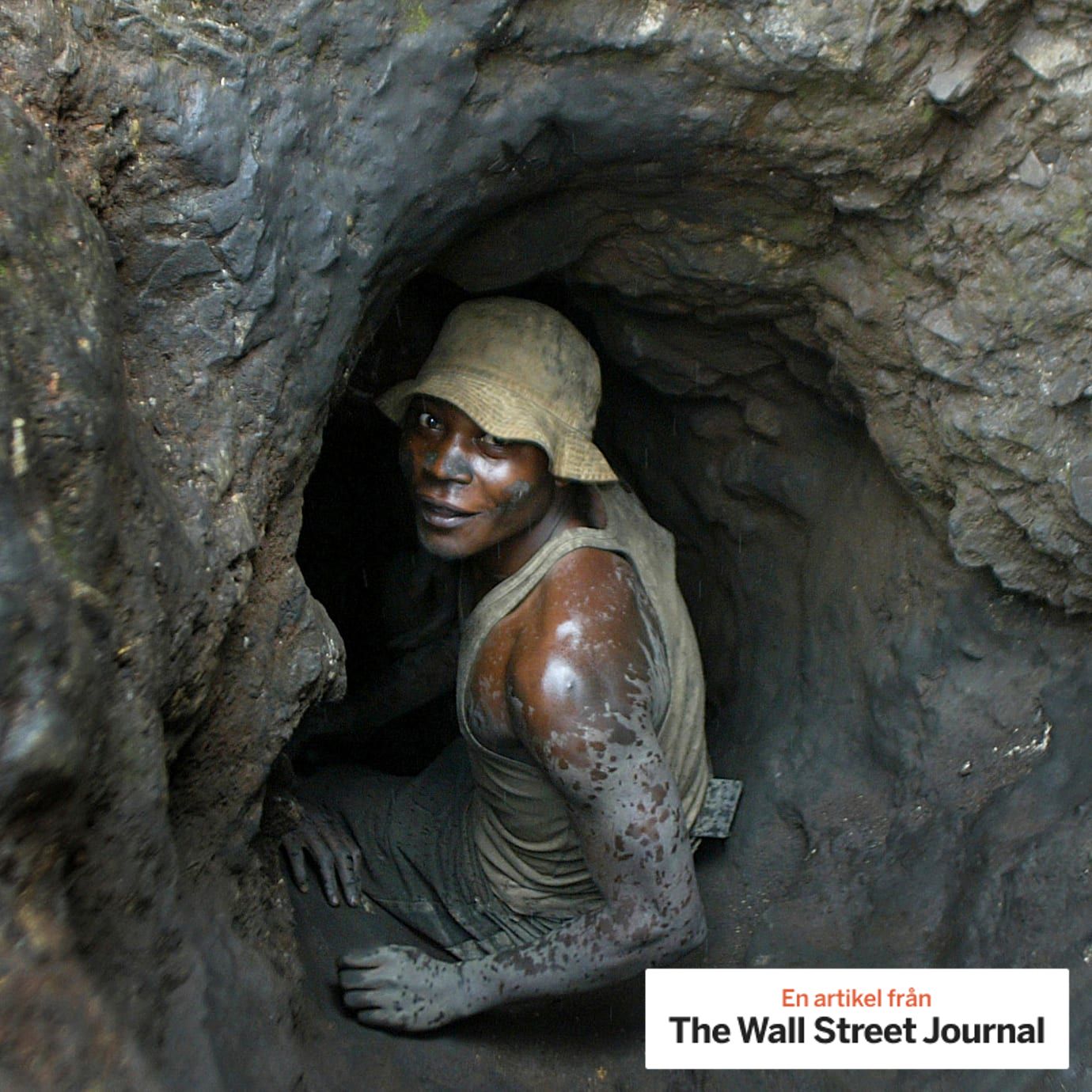
Kampen om tillgången till så kallade kritiska mineraler i Afrika hårdnar. Men samtidigt som efterfrågan på exempelvis litium och kobolt ökat explosionsartat har nästan hälften av kontinentens länder begränsat eller helt stoppat exporten. De vill inte längre bara utvinna råvarorna utan också tillverka varor som batterier och solpaneler, skriver Wall Street Journal.
– Om man gör det rätt så kommer resursnationalism hjälpa de här länderna upp i värdekedjan, skapa jobb och locka till sig internationella investeringar och utveckla lokala ekonomier, säger den brittiska exdiplomaten Thomas Reilly till tidningen.
 The Wall Street Journal
Africa Wants Its Critical Minerals to Yield Jobs, Not Just Dollars
More countries are imposing export restrictions to help develop their own industries.
KAMPALA, Uganda—Trump administration officials seeking deals for critical minerals in Africa are in for a surprise: Governments here are increasingly reluctant to export raw ore, betting instead they’ll keep more jobs and revenue if they insist on processing the material at home.
Nearly half of Africa’s 54 countries—from Angola to Zimbabwe—have restricted or banned raw-material exports over the past two years, according to the Organization for Economic Cooperation and Development.
Zimbabwe, Africa’s top producer of lithium, a key electric-vehicle battery component, says it plans to ban exports of the raw mineral in 2027. Already its government has been pressuring mining companies to build processing plants there, creating 5,000 new jobs and increasing export earnings from the mineral to $600 million in 2023, from $70 million in 2022, according to the mines ministry.
“Our ultimate objective is to produce batteries and solar panels,” Zimbabwe’s mining minister, Winston Chitando, said in a speech last month. “In the long term, we will get there.”
Global demand for lithium tripled between 2017 and 2022, while the appetite for cobalt swelled by 70% during the same period, according to the International Energy Agency. In the U.S., the market for lithium batteries is projected to rise nearly sixfold by 2030 to reach $52 billion, according to a Boston Consulting Group analysis.
Such strong demand gives African raw-material exporters new leverage, and they are trying to use it to jump-start domestic industries.
“More and more African countries are keen to secure the benefits of the global demand for critical raw materials”
“More and more African countries are keen to secure the benefits of the global demand for critical raw materials,” said Thomas Reilly, a former British diplomat now a senior adviser with the Washington-based law firm Covington & Burling. “Resource nationalism, if done right, will help these countries to move up the value chain, creating jobs, attracting more international investment and developing local economies.”
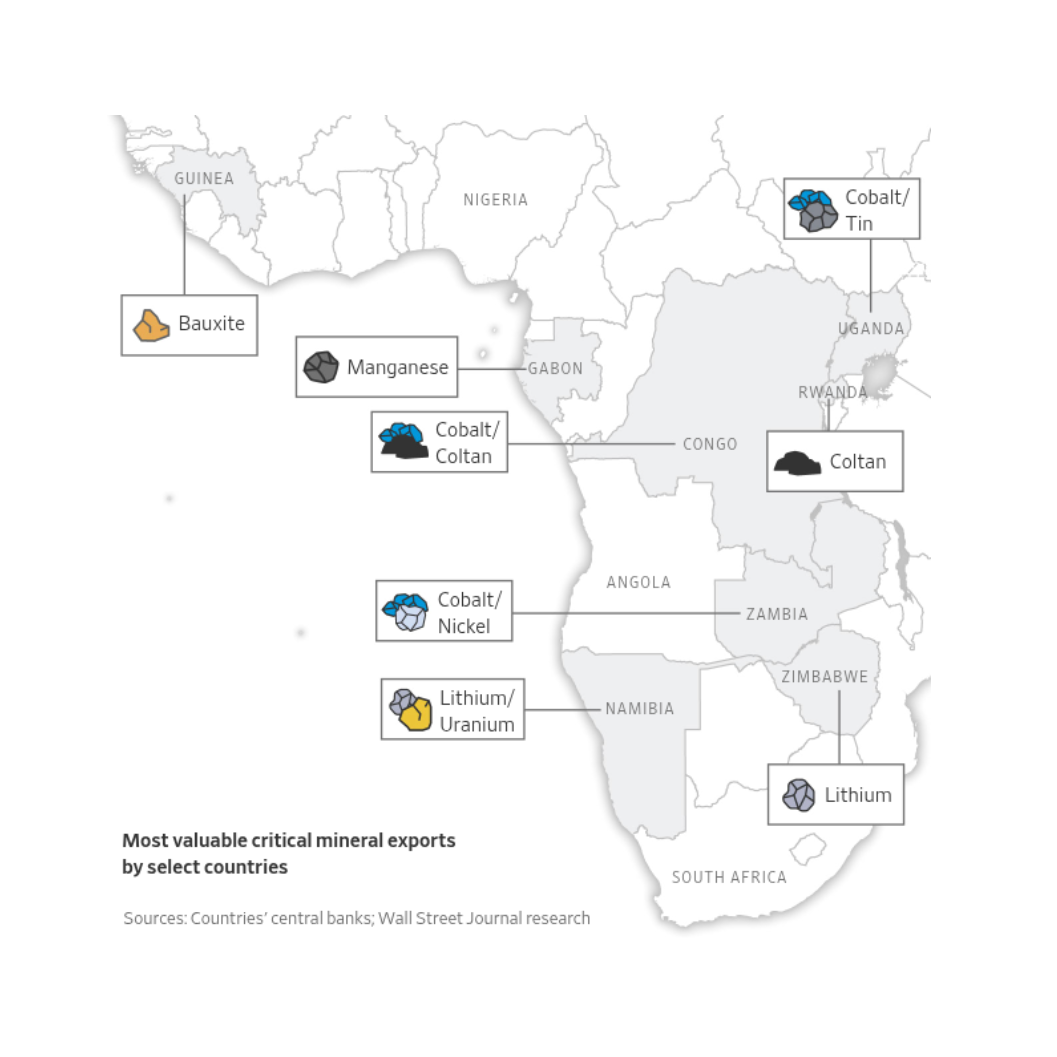
Countries such as Guinea, Uganda and Namibia have introduced new rules outlawing the export of mineral ores. Others, including Ghana, Rwanda and Zambia, are expanding factories to process minerals within their borders. In Rwanda, which last month signed a U.S.-brokered deal to stop sponsoring rebel groups in the lawless eastern regions of the Democratic Republic of Congo, officials say they’d like to serve as a processing hub for Congolese minerals.
Export restrictions have already disrupted the flow of unprocessed minerals including manganese, lithium and bauxite to smelters in Asia and Europe, and the process-it-at-home trend could disrupt the Trump administration’s drive to secure more of Africa’s critical minerals for the U.S.
The U.S. has been seeking deals to invest into critical minerals sectors of a number of African countries. Its role in brokering the deal between Congo and Rwanda was motivated in part to improve American access to critical minerals. But while restrictions on the export of unprocessed minerals may not deter the Trump administration’s push for mining deals, the trend may complicate negotiations with some producing countries, said François Conradie, an analyst with South Africa-based Oxford Economics Africa.
“I don’t think the U.S. will slow down,” he said. “The big question is: What can the U.S. offer that will justify a change of position for the producing countries?”
A State Department spokesperson didn’t answer questions about whether the raw-material export bans would affect Trump’s commercial aspirations.
African policymakers say if they play it right, they can use their countries’ mineral wealth to improve the living standards for some of the world’s poorest people
“We are open to mutually beneficial economic partnerships on critical minerals to complement our domestic-production goals,” the spokesperson said.
With more export bans on the horizon, Chinese and Western companies are rushing to set up new mineral-processing plants across the continent. These new plants will test whether investors, who usually locate processors in Asia, can succeed in Africa, where skilled labor is in short supply and much of the infrastructure is creaky. Indonesia, which banned unprocessed nickel exports in 2020, has since attracted huge investments from China and now dominates global nickel production. But much of the value was captured by Chinese companies, according to Commodities Research Unit, a London-based business-intelligence firm.
Some analysts believe African nations stand to benefit more from the investments.
“Investors who bring not just money but also technical know-how and align with local development goals may find strong opportunities in this new landscape,” said Nj Ayuk, head of the African Energy Chamber, a South Africa-based energy think tank.
Sinomine Resource Group, a Chinese state-owned mining company, is building a $300 million lithium-processing plant in Zimbabwe. In Ghana, China’s state-owned Ningxia Tianyuan Industry Co is building a $450 million refinery to produce high-grade manganese. Zambia and Congo are on the lookout for investors to bankroll a plant to manufacture electric-vehicle batteries.
African policymakers say if they play it right, they can use their countries’ mineral wealth to improve the living standards for some of the world’s poorest people.
Africa’s copper belt, for instance, which straddles the border between Congo and Zambia, holds 50% of the world’s cobalt deposits and significant deposits of copper and platinum, yet more than 70 million residents in the two countries live in poverty. Africa exports 75% of its crude oil, which is refined elsewhere and often reimported at significantly higher prices as petroleum products. The continent exports 45% of its natural gas, while 600 million Africans have no access to electricity, according to the International Energy Agency.
When Zimbabwe initially announced a ban on the export of unprocessed ore in 2022, mineral smuggling across the country’s porous borders soared
During the launch of construction of a joint Russian-Malian gold refinery in Mali’s capital, Bamako, last month, the country’s military leader, Gen. Assimi Goïta, said Africa as a whole had to break this long dependence on exporting raw materials.
“The establishment of this gold refinery is a reaffirmation of our economic sovereignty,” Goïta said at the construction site of the 200-ton-a-year plant, jointly owned by the Malian government and Russia’s Yadran. “It enables us to better capitalize on revenues from gold and its byproducts.”
Gabon, home to 25% of the world’s manganese reserves, plans to stop exporting the raw mineral starting in 2029. Manganese is critical in the manufacture of steel and electric-vehicle batteries, and Gabon’s President Brice Oligui Nguema senses an opportunity to build its economy by processing its reserves domestically.
Export restrictions, however, sometimes backfire.
When Zimbabwe initially announced a ban on the export of unprocessed ore in 2022, mineral smuggling across the country’s porous borders soared. Many small-scale miners, struggling to keep afloat, started selling stockpiled ore to bigger Chinese players at giveaway prices. Zimbabwe, which says it loses $1.8 billion every year to mineral smuggling, eased the ban after a few months.
There are also risks for investors.
Last month, Niger’s government took over the Somaïr uranium mine from its French majority shareholder, Orano, following months of disputes over the size of its stake. In neighboring Mali, the government took over ownership of a gold mine from Canada’s Barrick Gold in April, following a longstanding tax dispute.
“The downside of this kind of new scramble for African mineral resources for Western companies is that they may end up losing out,” said Reilly, the Covington & Burling lawyer. “The stakes are already high and they will get higher.”