Fler förbjuds lämna Kina – markerar slut på tillväxtpakt
Efter massakern på demonstranterna på Himmelska fridens torg 1989 upprättade Kinas kommunistparti ett informellt socialt kontrakt: I utbyte mot ekonomisk tillväxt skulle befolkningen inte utmana makten.
Reformerna blev en framgång. Kinas ekonomi har växt astronomiskt och befolkningen har fått det mycket bättre.
Många har också levt efter devisen att man är trygg så länge man håller sig borta från politiska frågor. Men det stämmer inte längre, skriver forskningsassistenten Calleigh Pan i The Diplomat.
Efter coronapandemin har ekonomin börjat skaka. För att förebygga social oro har Kommunistpartiet nu börjat ägna sig åt ”förebyggande disciplinering” av politiskt ointresserade medborgare. Ett exempel på det är att allt fler hindras från att resa utomlands, från statsanställda till vanliga förskollärare.
 The Diplomat
China’s Exit Bans Are Breaking a Decades-Long Social Contract
The widening use of exit bans marks a decisive shift in China’s governance model under Xi Jinping.
The concept of exit bans is not new in China, and limitations on travelling abroad for even high-ranking government officials are commonplace. With the recent media coverage surrounding the rising number of bans on businesspeople from leaving the mainland, more people are justifiably becoming more concerned about their human rights. However, what is even more alarming is the broadening of such exit bans to ordinary citizens who are not big business tycoons or public officials.
As The New York Times reported earlier, exit bans are now being implemented throughout wide swathes of society. The people being affected come from all walks of life, including kindergarten teachers, doctors, and even government contractors. They are told to hand in their passports, all in an effort by the central authorities to impose greater “political discipline and ideological loyalty.”
This widening use of exit bans reflects a shift within China’s governance model. For decades, the Chinese Communist Party (CCP) maintained an unspoken understanding with its citizens: as long as they remained complacent and did not challenge the authority and rule of the state, they could enjoy a certain amount of personal and economic freedom. To understand why the current expansion of exit bans is so alarming, one must revisit the origins of this “social contract” forged under Deng Xiaoping’s administration.
The Social Contract that Drove China’s Growth
After the Tiananmen Square crackdown on June 4, 1989, Deng Xiaoping and the CCP were convinced that a form of informal “social contract” with the people was urgently needed in order to pacify the populace and get the country back on its feet. This “understanding” would be that the government will open up the strictly-controlled, state-run economy to provide the people with more economic freedoms, opportunities, and a clearer path toward prosperity, while the people would agree not to challenge the authority of the state. With the plan set as official policy, Deng spearheaded the wide opening of China’s economic and trade policies.
The CCP pursued the 24-character policy: “stabilize the position, observe calmly, take all in stride, never take the lead, and hide our capacity to bide our time,” known as taoguang yanghui for short.
This basic framework enabled Deng to crystallize the idea that the CCP’s legitimacy and survival depended on the country’s ability to deliver a better economic and financial environment for its people in order to maintain stability. By transitioning the economy from a planned Stalinist economy into a mixed economy, and establishing Special Economic Zones (SEZs) like Shenzhen, China attracted massive foreign investment and fostered an export-driven growth model, especially after joining the World Trade Organization in 2001. As Western capital continued to pour in, it fueled China’s rise into becoming the world’s manufacturing hub.
Ultimately, this opening-up policy has proven successful. The country’s economy has experienced astronomical growth: “GDP growth has averaged over 9 percent a year, and almost 800 million people have lifted themselves out of poverty” since China’s economic reforms in 1978. Thus, people were finally given the opportunity to work and be able to earn their way toward a better life.
This balance endured into the Hu Jintao era, when the CCP still tolerated limited personal freedoms of expression for those who remained politically obedient. Despite pervasive censorship, everyday life remained relatively predictable, and traveling abroad for everyday people was rarely politicized.
Under Xi’s New China: A Social Contract Rewritten in Fear
However, under Xi Jinping, especially over the last few years, there has been an observable shift in the CCP’s priorities and governance model.
After decades of “institutionalized collective leadership,” where standard operating procedures like fixed terms of office, term limits, and a mandatory retirement age were introduced by Deng, Xi has transformed the CCP into a more personalist regime. From hollowing out institutional checks, such as the removal of term limits in 2018, and merging key party, state, and military functions into newly created “governance committees,” chaired by Xi himself, China has become a state dominated by one man.
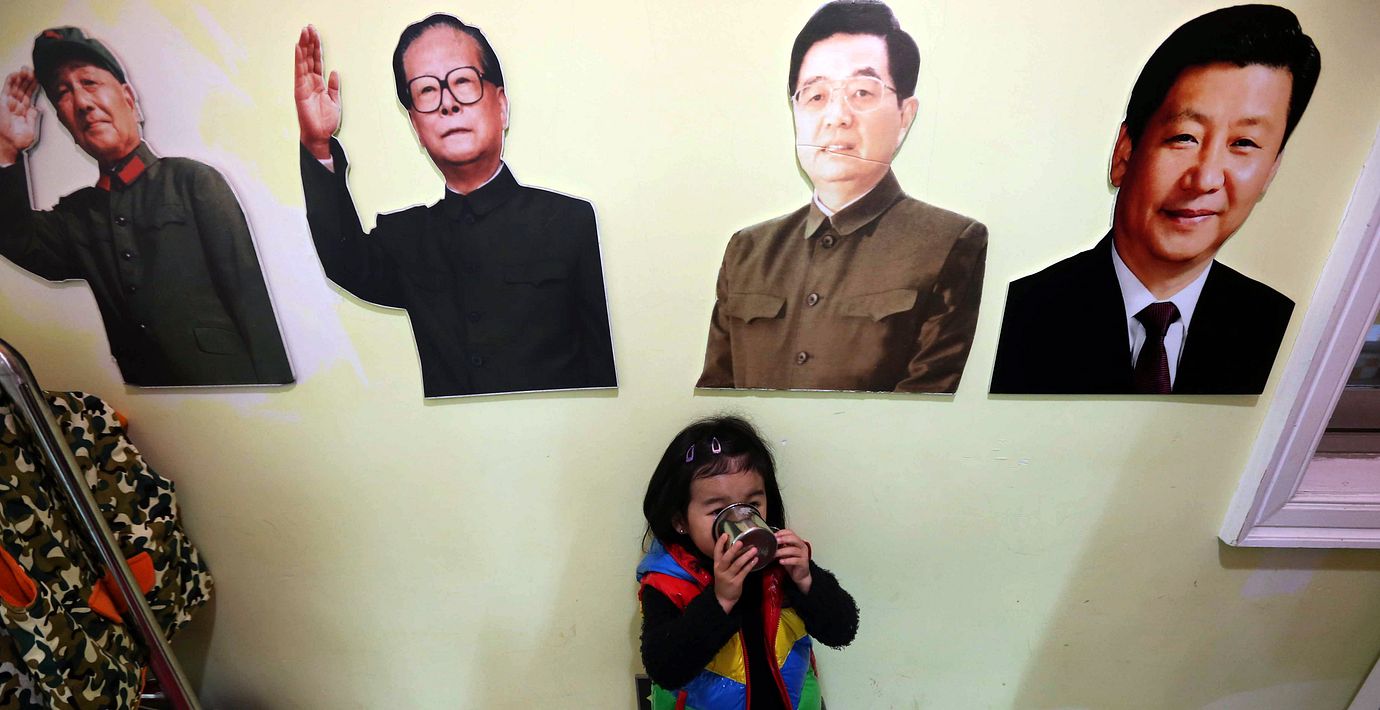
Furthermore, through extensive propaganda, mandatory education, and political campaigns, Xi continues to promote his ideology, formally known as “Xi Jinping Thought on Socialism with Chinese Characteristics for a New Era.” Now, ideological conformity and personal loyalty to Xi outweigh institutional norms or economic rationality.
Furthermore, the timing of these intensified restrictions also reflects the CCP’s anxiety over mounting socioeconomic pressures. The COVID-19 pandemic and the CCP’s subsequent “zero-COVID” policies triggered widespread economic turmoil, including high levels of unemployment, business closures, collapsing housing markets, and the exodus of foreign capital. These trends shook the financial security of both elites and ordinary citizens. Given fading prospects and extreme hardships at home, many, especially the elites, have sought to move assets abroad or emigrate. Thus as a response, the state has to tighten controls to stop the outflow of talent and capital.
The exit bans represent the physical manifestation of this. The CCP has not only expanded its use of exit bans – down to restricting even local kindergarten teachers – but also tightened general limits on the outflow of capital and inflow of information. This all-encompassing, top-down policy implementation shows that Xi is growing ever more paranoid and insecure. He is willing to sacrifice economic stability to impose a more intrusive political control over the masses, even on those that are generally deemed “non-threatening.”
Xi’s increasingly isolationist policies and attempts to “decouple” from the West risk further alienating foreign investors
The CCP’s legitimacy, once founded on rapid growth and rising living standards, now leans on fear and obedience. By restricting citizens’ mobility and limiting foreign contact, Xi seeks to prevent the exodus of capital, an influx of ideological “pollution” from the West, and the country’s elites from fleeing, all of which are symptoms of deepening paranoia that prioritizes control.
This shift also highlights a fundamental contradiction: while China’s rise was built on the openness and its integration into the global neoliberal order, Xi’s increasingly isolationist policies and attempts to “decouple” from the West risk further alienating foreign investors and eroding the very economic base that sustained the country’s growth and, relatedly, the party’s legitimacy.
China’s tightening control over its own citizens mirrors a broader authoritarian trend, where the state’s increasing isolationism reflects its waning ability to command loyalty through prosperity or governance.
When Even the Apolitical Are Not Safe
Many Chinese citizens have assumed that staying away from political topics would ensure their safety. While that may have been true before, it no longer holds. Nowadays, being at the margins of political participation in China does not guarantee immunity from the scrutiny of the state apparatus nor its repressive policies.
The CCP’s surveillance and control mechanisms now extend far beyond the political elites or dissidents. Driven by both ideological and economic insecurity post-pandemic, the paranoia has expanded to encompass teachers, contractors, doctors, and public employees. This marks a fundamental transformation in how the CCP governs: from targeted repression of the politically defiant to pre-emptive disciplining of even the politically indifferent.
As the CCP closes its borders on its own citizens, the implicit promise of economic opportunity in exchange for political obedience is breaking down. What remains is no longer a social contract, but a social constraint.
© 2025 The Diplomat. Distributed by Tribune Content Agency.