Kina hjälper Irak att producera mer olja
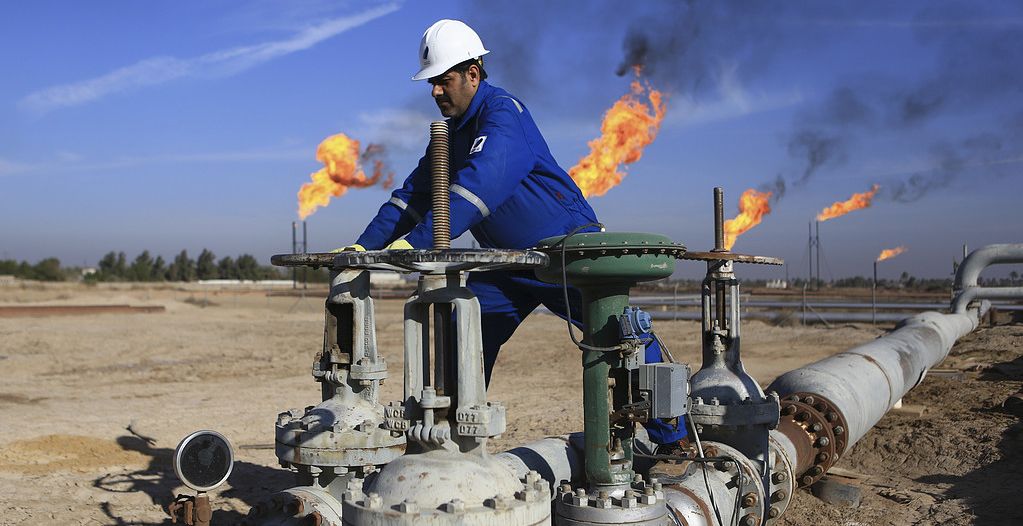
Irak har slutit avtal med statliga kinesiska Zhenhua Oil om att utveckla den södra delen av det stora oljefältet öster om huvudstaden Bagdad. Det uppgav en talesperson för oljeministeriet på söndagen, rapporterar Reuters.
Målet är att oljefältet med Kinas hjälp ska kunna leverera 40 000 fat per dag inom fem år.
bakgrund
East Baghdad Field
Wikipedia (en)
East Baghdad Field is a group of oil fields, located east of Baghdad, Iraq. East Baghdad is proven to hold 8 billion barrels (1.3 billion cubic metres) of recoverable reserve and believed to have a production potential of 400,000 barrels per day (64,000 m3/d). The oil field was discovered in 1976 and is 11 kilometres (6.8 mi) wide and 64 kilometres (40 mi) long.
In December 2009, despite previous negotiations with Japan's Petroleum Exploration Company, JAPEX, there were no bids to work on the oil field. Iraq's Ministry of Oil will likely work the site instead.
bakgrund
Iraks oljereserver
Wikipedia (en)
Oil reserves in Iraq are considered the world’s fifth -largest proven oil reserves, with 140 billion barrels. The sources for this oil is primarily located in the Shiite Muslims-majority and Arab Sunni Muslims-dominated areas on the other hand are comparatively lacking.
As a result of military occupation and civil unrest, the official statistics have not been revised since 2001 and are largely based on 2-D seismic data from three decades ago. International geologists and consultants have estimated that unexplored territory may contain vastly larger reserves. The majority of Iraq's proven reserves of oil comes from the following cities: Basra (Being #1), Baghdad (Being #2), Ramadi (Being #3), and finally, Ba'aj (Being the last oil rich city).
A measure of the uncertainty about Iraq's oil reserves is indicated by widely differing estimates. The U.S. Department of Energy (DOE) estimated in 2003 that Iraq had 112 billion barrels (17.8×10^9 m3). The United States Geological Survey (USGS) in 1995 estimated proven reserves were 78 Gbbl (12.4×10^9 m3). Iraq's prewar deputy oil minister said that potential reserves might be 300 Gbbl (48×10^9 m3). The source of the uncertainty is that due to decades of war and unrest, many of Iraq's oil wells are run down and unkept. Repairs to the wells and oil facilities should make far more oil available economically from the same deposits. Iraq may prove to contain the largest extractable deposits of oil in the entire Middle East once these upgrading and facility improvements have advanced.
After more than a decade of sanctions and two Gulf Wars, Iraq’s oil infrastructure needs modernization and investment. Despite a large reconstruction effort, the Iraqi oil industry has not been able to meet hydrocarbon production and export targets. The World Bank estimates that an additional $1 billion per year would need to be invested just to maintain current production. Long-term Iraq reconstruction costs could reach $100 billion or higher, of which more than a third will go to the oil, gas and electricity sectors. Another challenge to Iraq's development of the oil sector is that resources are not evenly divided across sectarian lines. Most known resources are in the Shiite areas of the south and the Kurdish north, with few resources in control of the Sunni population in the center.
In 2006, Iraq's oil production averaged 2.0 million barrels per day (320×10^3 m3/d), down from around 2.6 Mbbl/d (410×10^3 m3/d) of production prior to the coalition invasion in 2003. Iraq's reserve to production ratio is 158 years. After the end of the invasion the production increased on a high level, even though there is an invasion from the so-called ISIL the production in March 2016 stood at 4.55 million barrels a day. Which seems to well become a new all-time peak year for Iraq if OPEC talks about freezing or reduce production held in April 2016 will not lead to a reduction. The old peak was 1979 with 171.6 million tons of oil compared to 136.9 million tons produced in 2011 and 152.4 million tons in 2012.
Omni är politiskt obundna och oberoende. Vi strävar efter att ge fler perspektiv på nyheterna. Har du frågor eller synpunkter kring vår rapportering? Kontakta redaktionen