Möt Wall Streets elitgrupp av kaffeprovare: ”Väldigt svårt”
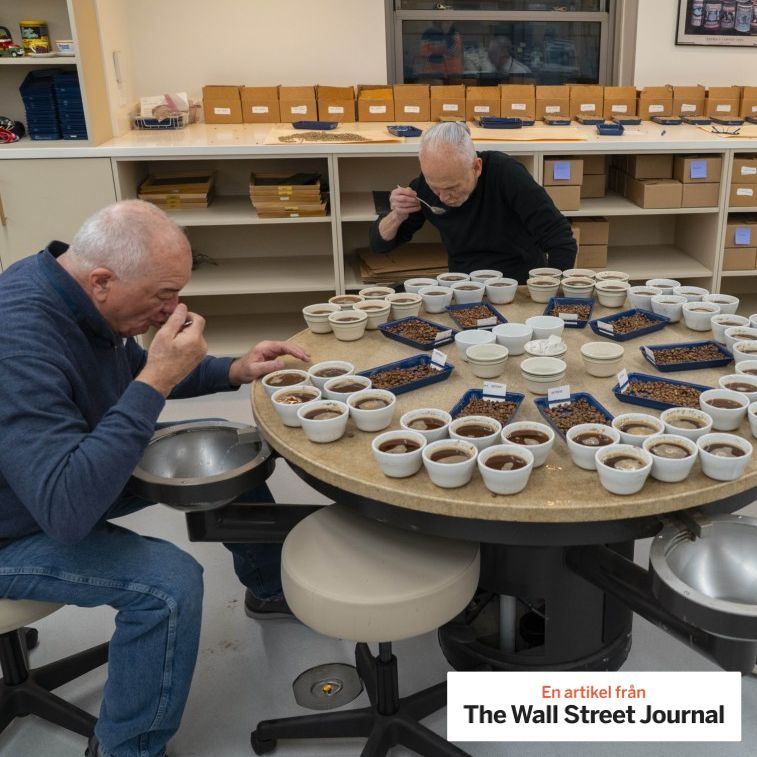
På åttonde våningen i New York-börsen sitter en liten skara experter och sniffar bönor, slurpar högljutt och spottar i metallskålar. Det kan låta som en udda ritual, men deras omdömen hjälper till att sätta terminspriset på arabica och påverkar därmed kaffemarknaden världen över.
Få unga vill dock ta över som kaffetestare, skriver Wall Street Journal. Och av dem som försöker brukar bara 5 till 8 procent klara nålsögat.
– Det är ett väldigt svårt prov, medger Terrance Sullivan, kaffeprovare sedan 41 år.
 The Wall Street Journal
Wall Street’s Elite Team of Coffee Tasters Who Keep the Global Market Running
The pros who sit around and sniff beans and slurp coffee help set prices for arabica. They’re struggling to find new recruits.
The people who gather in this small room on the eighth floor of the New York Stock Exchange look like a group of middle-aged caffeine addicts.
They sit around what resembles a school science lab sniffing coffee beans and slurping coffee so aggressively that there’s loud music playing to drown them out.
But these aren’t junkies with bad manners. They’re part of an elite team of graders who help keep the commodities market running. Their ratings help set U.S. futures-market prices for arabica, and in turn, the global coffee industry. And they’ve arguably never been more valuable.
That’s because the flow of young talent that keeps the grading system running is slowing to a drip. For one thing, young people are opting to work at private-equity firms, high-frequency trading desks and other glitzier jobs where coffee serves as fuel, not product. And even among high-earning commodities traders, coffee is seen as less glamorous than oil and natural gas.
But perhaps the biggest impediment is that the test to become a grader isn’t getting any easier. The four-day exam, given roughly once every five years including this week, has a razor-thin pass rate. John DeMuria, chief executive of coffee supply-chain company Coastal Commodities, and a grader of 35 years, said he failed the first time he tried.
“It’s not like the CPA exam,” he said. “Once you fail, you have to go back and start over. If you pass certain parts, it doesn’t count the second go around.”
DeMuria is in good company. Only about 5% to 8% of test takers will typically pass each time the test is administered, according to Stacy Moeller, who runs the grading room as senior commodity operations analyst for NYSE parent Intercontinental Exchange, or ICE. The pass rate for California’s notoriously difficult bar exam in February 2025 was 64%.
“It’s a very tough test,” says Terrance Sullivan, who has been a coffee grader for 41 years. His brother is a grader and his son is taking this April’s exam.
Tasting the coffee properly requires slurping it with gusto, hence the music
The aging pool of graders is the latest problem for a coffee business hit over the past year by tariffs, crop failures, rising labor costs and worries about the Iran war. Speculative trading that contributed to price surges has also ramped up in recent months.
Many of the people in ICE’s grading room are in their 50s or older, says DeMuria. Some are retirees, while others, after clocking in at around 6:30 a.m. ET to grade coffee, will head to their full-time jobs, often in the coffee industry.
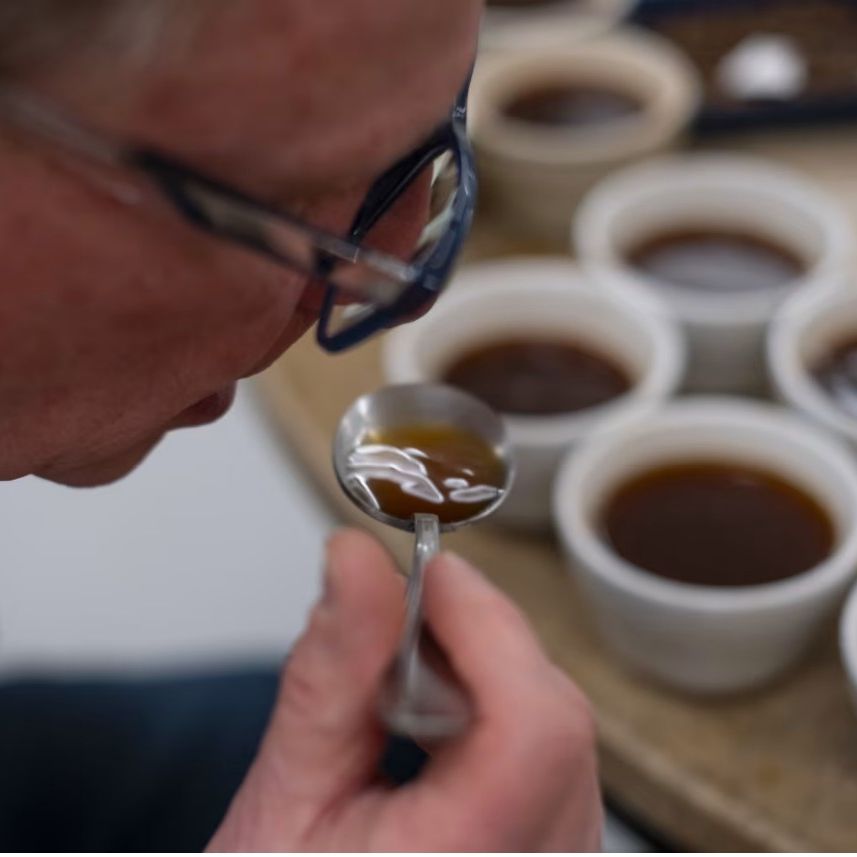
The walls of ICE’s grading room are covered with posters of coffee. The current roster of 38 graders sit around spinning tables that are ringed with cups of coffee and trays of beans. Armed with spoons, they test the samples in a rapid-fire process of slurping and spitting into metal sinks they call “spittoons.” Tasting the coffee properly requires slurping it with gusto, hence the music to mask the sounds of dozens of people slurping and spitting.
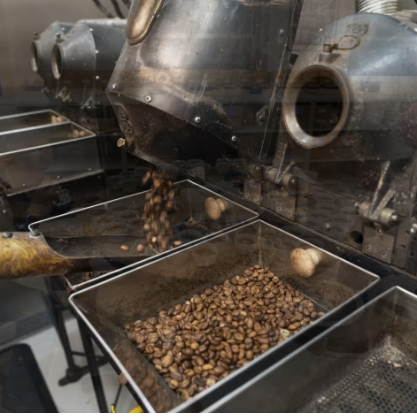
Those wanting to be a part of the klatch must first prove their abilities in a three-stage test. The first part is a written portion, where prospective graders are tested on ICE’s rules and regulations regarding coffee grading. In the second portion, which is more than three hours long, they are tested on their ability to grade the coffee based on factors such as smell and color.
If they fail, at any stage, they must start from the beginning to retake it.
If they do pass those two portions, they are brought back to the grading room, sometimes months later, for the final “cupping” exam—smelling, tasting and spitting coffee in front of proctors to determine whether there are defects that make them unusable.
If they fail, at any stage, they must start from the beginning to retake it
This month’s test kicked off Monday. Getting selected requires a strong application, including references and at least five years of experience working in the industry. Working at a trading desk, as a grader at a coffee company or at a warehouse counts. Being a barista “absolutely” does not, says Moeller.
Despite the worries, there is an unusually high number of candidates this year due to buildup from the pandemic. There were only about 20 candidates the last time the test was administered. Matt Ryan, ICE’s senior director of global soft commodities, says that the swell of interest has him hopeful that there could soon be a much-needed group of young talent headed to the grading room.
“It’s exciting to see that turnover happen,” said Ryan. “For a while in the business, I was feeling young in my 50s.”