Netflix kväver lokala film- och tv-makare

Trots stora internationella framgångar för sydkoreansk film och tv, sjunker de koreanska produktionsbolagens aktier på börsen – ett av landets största är ner 25 procent medan Sydkoreas jämförelseindex har stigit 10 procent.
Problemet stavas Netflix. Den amerikanska aktören dominerar många lokala marknader runtom i världen. Statliga krav på återinvestering i lokal produktion hjälper inte eftersom Netflix dammsuger även den marknaden.
– Regissörer vill slå internationellt. Det kan de bara genom Netflix, säger Jeongin Hong på koreanska SLL, till Bloomberg.
 Bloomberg
The Netflix Effect Chills Foreign Content Creators
Producers and governments grapple with the mixed blessings of the world’s leading provider of premium streaming video.
Despite a wave of international interest in South Korean film and television, the stock prices of many of the country’s production companies have been in a slump. Shares of Studio Dragon Corp., one of South Korea’s largest producers, have plunged about 25% this year despite the company having produced The Glory, one of Netflix Inc.’s most popular titles, while Korea’s stock benchmark has risen 10% over the same period. CLSA Securities Korea downgraded Studio Dragon in May, citing concerns about its “insufficient bargaining power.”
The problem, as some people in South Korea’s entertainment industry see it, is the overwhelming importance of a single channel to distribute their content. “As a studio and as a producer, I’m a little concerned that Netflix has been the only channel global audiences can watch Korean series on,” says Jeongin Hong. Hong’s firm, SLL, signed a multititle licensing deal with Netflix soon after the streaming service made its debut in South Korea in 2016, then went on to produce some of its biggest hits, including All of Us Are Dead, the fourth-most-watched non-English language series in Netflix’s history.

Having expanded his company’s output, Hong worries that Netflix has amassed too much power. It has twice as many customers in South Korea as the No. 2 streaming service, TVing, and is the only global player with a major presence in the market. This dynamic has enabled Netflix to be picky about the projects it chooses and to dictate the terms. Shares in ContentreeJoongAng Corp., the majority owner of SLL, have declined almost 20% this year.
Many TV producers and regulators have long worried that US-based companies such as Netflix and Amazon.com Inc. would decimate local-TV networks, dominating every major market and smothering homegrown players before they can develop, as has happened in social media. Netflix now accounts for 33% of streaming video subscribers in South Korea and for 42% of premium-video viewership in Southeast Asia, according to Media Partners. It also accounts for 30% or more of customers in the UK, France and Sweden, according to Midia Research.
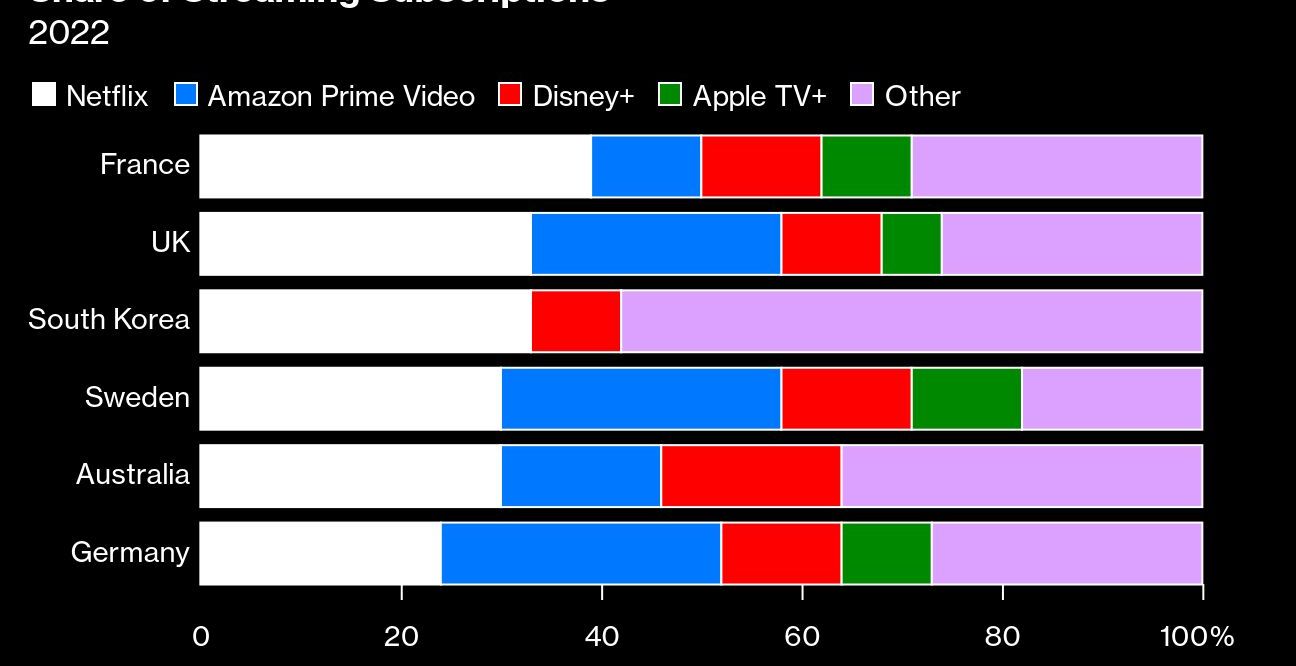
Many countries have sought to preserve their TV and film industries by requiring all streaming services to invest in local programming. No nation has been more of a protectionist than France, which has mandated that the services invest at least 20% of their revenue from within the country into local programming. France has also stipulated that three years must pass before theatrical releases can appear on a streaming service, though last year it reduced that window to 15 months.
The law in France has forced Netflix and its peers to increase their output of local originals in a short period of time. Other countries have similar, if less onerous, regulations. This year, Canada passed a law that will require streaming services to support local content; the rule has yet to go into effect. Australia is contemplating a similar measure. Netflix declined to comment for this article, but the company has said it doesn’t oppose laws requiring minimum investments in local content, so long as they’re not overly restrictive about the form that investment takes.

For decades, South Korea has had rules in place intended to protect the local film industry from foreign competition, and the distribution of US content in the country has at times led to tension in trade negotiations and local protests in theaters showing US films. But Korea’s recent experience shows the limitations of laws requiring foreign companies to invest locally. The problem isn’t that Netflix doesn’t want local content. Instead, the concern is more that its reach gives it an edge over local distributors when it comes to acquiring shows and movies, enabling it to take much of the value of South Korean content back to California. “Directors want international fame and international coverage,” says Hong. “That can only come from Netflix.”
The streaming service has long dismissed talk of its market power. While rival executives in the US such as FX Networks LLC chief John Landgraf used to fret about a looming Netflix monopoly, the company accounts for just 7% or 8% of TV viewing in the US, its largest market. Its corresponding market share in other major markets is also in the single digits. Netflix has noted that it faces competition from Walt Disney Co. and Amazon and also cites YouTube, TikTok and video games as major rivals. South Koreans spend far more time watching YouTube than Netflix, according to Media Partners Asia.

Attempts to protect local entertainment industries could backfire in many places, says Michael Geist, a Canadian professor who’s one of that country’s leading experts in internet and e-commerce law. Netflix and its peers are already investing billions of dollars in local programming and could pull back from less profitable countries at a time when investors are pressuring them to increase profit margins.
Cuts by US media companies such as Disney and Warner Bros. Discovery Inc. may drive filmmakers deeper into Netflix’s arms, one of few streaming services, along with Amazon, seeking to increase its investment in local productions. For producers in places like South Korea, the impact of this largesse is complicated. Earlier this year, Netflix said it would spend $2.5 billion in the country over the next few years. Shares in South Korean companies gained on the news, only to slump in the following weeks.
--With assistance from Youkyung Lee.
For more articles like this please visit us at bloomberg.com
For more columns from Bloomberg Opinion, visit http://www.bloomberg.com/opinion