Robotrevolutionen är här – aktierna som kan bli vinnare
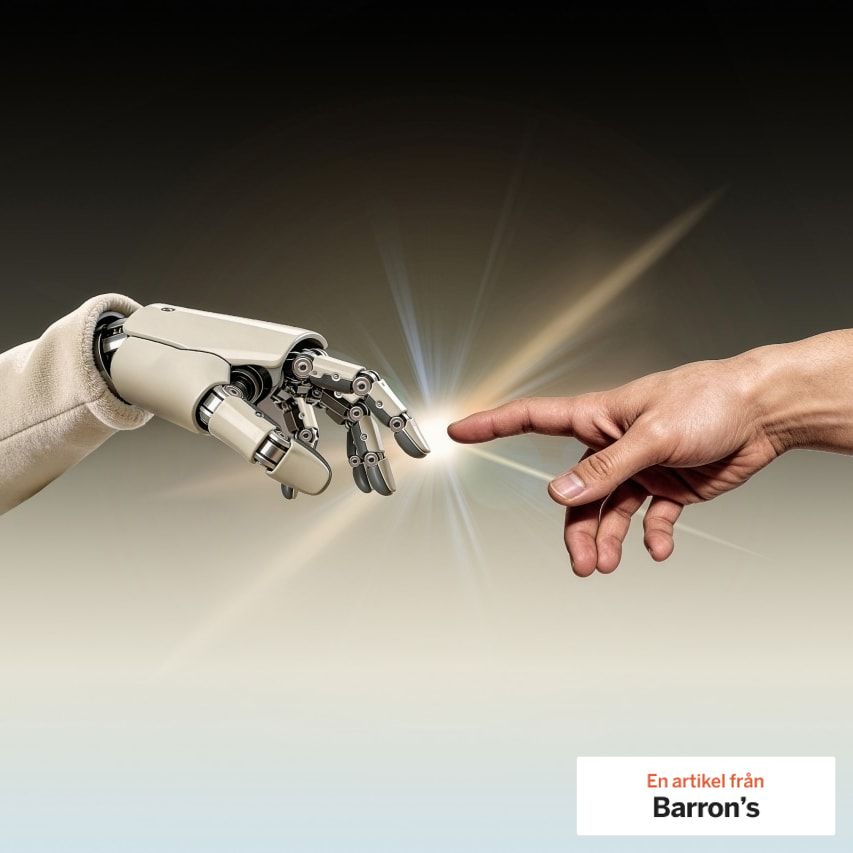
Självlärande humanoida robotar är på väg att bli verklighet. Tesla, Hyundai och Boston Dynamics ligger långt fram i utvecklingen, och investerare ser redan robotteknik som nästa stora tillväxtområde.
Marknaden kan nå 25 000 miljarder dollar till 2040, enligt Morgan Stanley.
– Robotar som ser ut och beter sig som människor är inte längre en science fiction-fantasi, säger UBS-analytikern Phyllis Wang.
Nvidia lyfts fram som en nyckelspelare tack vare sina AI-chip, skriver Barron’s, som pekar ut flera aktievinnare på trenden.
 Barron's
The Robot Revolution Is Real. Tesla, Hyundai, and More Stocks to Play It.
Like something from a galaxy far, far away, robots are getting closer to their big takeover.
Once the domain of science fiction, autonomous robots—think C-3PO from Star Wars or Baymax from Big Hero 6—are getting closer by the year. At 2025’s CES electronics conference, there were a handful of humanoids, none of which seemed to catch the world’s attention. At January’s conference, robots, including Boston Dynamics’ Atlas, a 6-foot-2-inch automaton weighing in at just under 200 pounds with a digital smiley face, were the stars. Chip companies lined up for a shot at best supporting actor, with Nvidia, Qualcomm, Intel, and Advanced Micro Devices pitching their wares as robotics solutions.
Even with peak robot decades away, automatons will be an increasingly important part of a stock portfolio
Wall Street is positively giddy. Artificial intelligence is still the market’s next big thing, and robots are the next phase of AI. Unlike the industrial models that follow fixed instructions or consumer products like the Roomba, which uses simple sensors to vacuum a floor, the new creations use AI models to “learn” their tasks. They can pack boxes, sort parts for assembly, and do household chores. Morgan Stanley’s Adam Jonas even recently ditched the auto beat for “embodied AI,” i.e., robots.
While robots are already working in factories and warehouses, home use is still a long way off. Part of the problem is scale—no robot is being truly mass-produced just yet, and cost estimates are little more than guesses. A NEO robot from 1X, meant for home use, can be reserved for $20,000. Tesla CEO Elon Musk believes that it will cost $20,000 to produce its Optimus robot, designed for commercial use, once “we reach about a million units per year of sustained production.” Even when they are available, robots still can’t do everything they should be expected to do. The NEO robot will be initially teleoperated by a human as it learns to do things on its own.
Investors might not have to wait as long for a payoff. Even with peak robot decades away, automatons will be an increasingly important part of a stock portfolio. Embodied AI will bolster trends that are already in place—the demand for AI chips, data connectivity, increasing power production, and the U.S. manufacturing renaissance, among them. It will take years for the industry to mature, but investors are looking at a multitrillion-dollar industry that can rival cars or smartphones.
Robotics will help “usher in the third Industrial Revolution, driving $25 trillion of combined robot revenues by 2050,” says Jonas.
The current industry is dominated by the likes of German-based Kuka, which is owned by China’s Midea Group ; Swiss-based ABB, which is selling the business to SoftBank Group ; and Japan’s Fanuc and Yaskawa Electric. These are mainly industrial robots, fixed to the ground and handling parts, cutting metal, and welding, among other tasks. These aren’t the robots you are looking for. While they make for a nice business—the companies sell about 500,000 units a year—their growth is tied to industrial production and somewhat limited by the slow-growing auto industry, the biggest customer for industrial robots.
The New Robots
The robots that have everyone excited can walk out of the factory. They aren’t programmed to do a carefully constrained repetitive motion. They are being programmed to complete tasks that had once been the purview of humans and have AI brains learning inside AI-created virtual worlds, with capabilities expanding exponentially. “The changes introduced by AI are absolutely real,” says Zachary Jackowski, the general manager of Boston Dynamics’ Atlas robot unit.
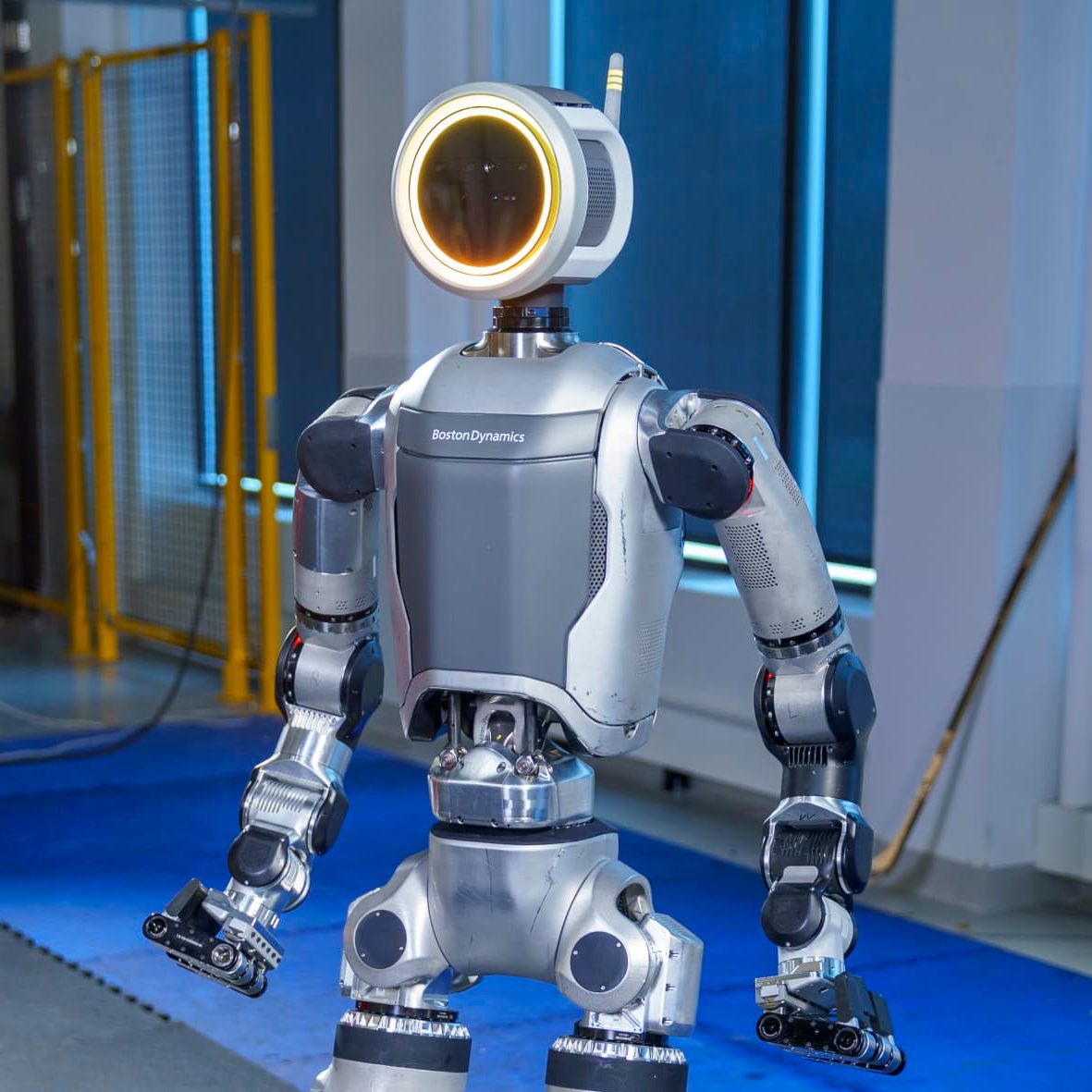
And now the race is on. Atlas, which is billed by Boston Dynamics as the world’s most dynamic robot, has a cartoonlike LED ring for a face and can see 360 degrees, lift 110 pounds, and operate in temperatures ranging from minus 4 to 104 degrees Fahrenheit. Boston Dynamics, which is majority-owned by Korea’s Hyundai Motor, doesn’t disclose pricing but says that customers typically save enough money over two years to justify the expense.
Tesla’s Optimus, which stands about 5 feet 8 inches tall and weighs 125 pounds, has evolved from dancing in a suit, to serving drinks while controlled remotely, to learning kung fu. Tesla is working on generation three of Optimus and hopes that it will autonomously perform simple repetitive tasks, while making life easier for humans. Tesla recently announced that it would discontinue its Model S and X electric vehicles, converting the capacity to a robot manufacturing line.
“Optimus 3 really will be a general-purpose robot that can learn by observing human behaviors, so you can, like, demonstrate a task or literally verbally describe a task…and it will be able to do that task,” Musk said on Tesla’s January earnings call. “It is awesome.”
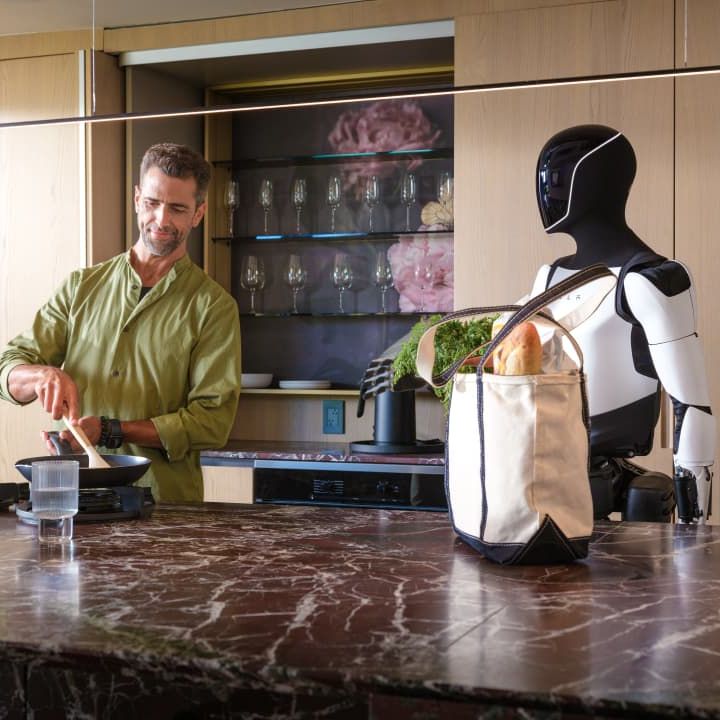
Other entrants include Figure AI’s F.03 robot, introduced in October, which stands about 5 feet 8 inches tall and weighs about 135 pounds, with a carrying capacity of 44 pounds. The company positions it a little like Rosie from The Jetsons, taking “care of household tasks like laundry, cleaning, and doing dishes, all autonomously.” CEO Brett Adcock hopes to test F.03 in homes by the end of the year.
Agility’s Digit robot, with its rectangular eyes and pincers for hands, looks a little more like science fiction and a little less like a human replacement. Standing about 5 feet 9 inches tall, it can carry 35 pounds and is already in use at select warehouses, including those operated by GXO Logistics and Amazon.com. The company can produce some 10,000 robots per year at its manufacturing facility in Salem, Ore.
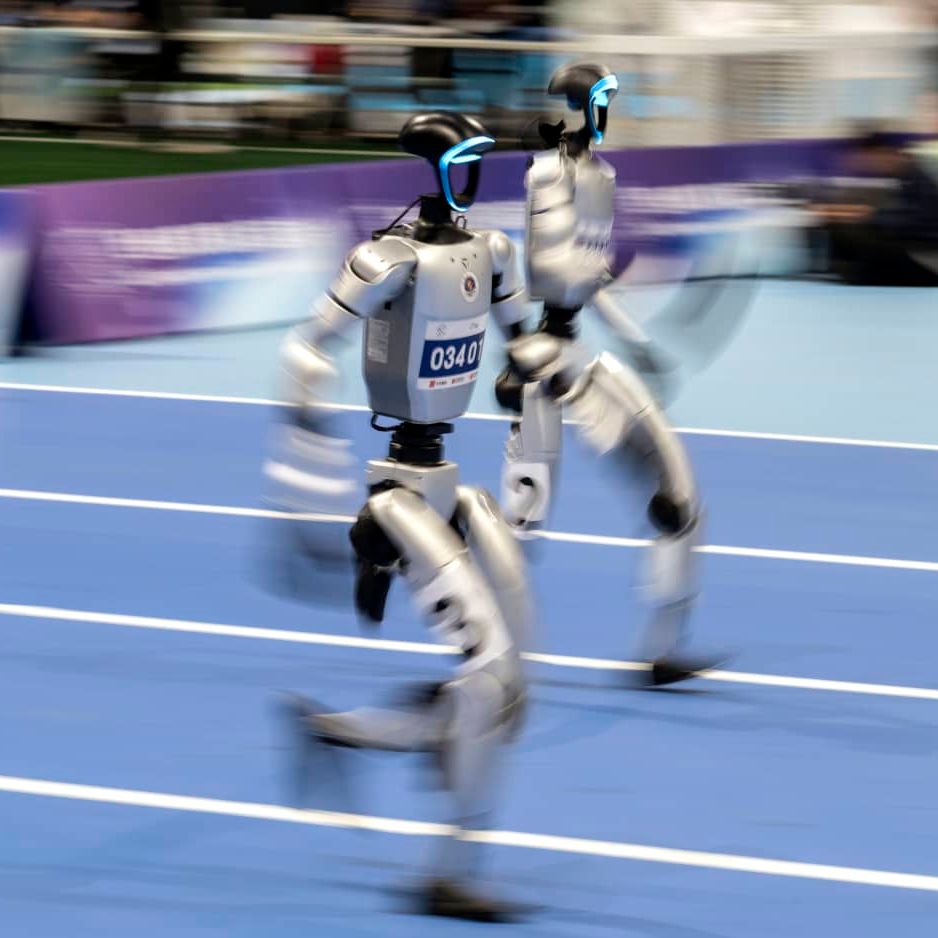
China isn’t sitting still. It hosted the first World Humanoid Robot Games in Beijing last August, and its brands, including Unitree Robotics and UBTech Robotics, provide serious competition for U.S. manufacturers. “This is the first time since the 20th century where the U.S. is facing stiff competition from another power that has formidable strengths not only in technology, but also in terms of economic strength and military strength,” says Maria Vassalou, head of the Pictet Research Institute.
Wall Street sees an enormous opportunity in robotics. RBC analyst Tom Narayan projects some 350 million robots sold annually, at an estimated $25,000 each, by 2050, pointing to a $9 trillion market. Morgan Stanley’s Jonas projects a $25 trillion market by 2040, though his estimate includes cars, drones, humanoids, and other form factors. Even one of the least optimistic analysts, UBS’ Phyllis Wang, projects a global population of 300 million humanoid robots by 2050, implying an addressable market of $1.4 trillion to $1.7 trillion. The potential is obvious. “Robots looking and behaving like humans is no longer sci-fi fantasy,” says Wang.
The numbers are wild and, to some extent, pie-in-the-sky. But the same could have been said of other new technologies, including EVs and robo-taxis. It took about 20 years to go from the U.S. Department of Defense’s initial 2004 Darpa Grand Challenge to a surprisingly smooth ride around San Francisco or an easy morning commute using Tesla’s Full Self-Driving product. It won’t take 20 years for fully operational robots to arrive. Self-driving cars are, as Musk puts it, robots on wheels. And the same technology that Tesla and Alphabet ’s Waymo use to train AI drivers will power the new robots.
No one has created a robot equivalent to a Tesla Model 3—a product that is useful, affordable, and desirable. They are coming, though. The Model 3 was introduced five years after the lower-volume Model S, which came four years after the very-low-volume Roadster. The AI already works. Before large language models, robots were trained by very smart people telling the robots exactly what to do. Now, the robots train themselves in virtual worlds. The smart people now work on how to improve training. That mode of operation has already yielded “physical” AI that interacts with the real world.
The biggest holdup is cost and manufacturing. The current generation of humanoid robots costs roughly $100,000 to $200,000 each, and the ability to manufacture at scale doesn’t exist. To go from the equivalent of a 2008 Roadster to a Model 3 in robotics, the cost of AI computing needs to fall, and the entire supply chain needs to be built up. Boston Dynamics has relationships with Alphabet’s DeepMind and Nvidia, while Hyundai, its owner, is an expert at high-volume, high-precision manufacturing and coordinating far-flung supply chains. As a result, Atlas should be available for the home and workplace sooner than many others.
Where to Invest
The challenge for investors is playing a technology that is still early in the hype cycle. While two exchange-traded funds— KraneShares Global Humanoid & Embodied Intelligence Index, or KOID, and Global X Robotics & Artificial Intelligence, or BOTZ—were created to capitalize on the trend, they aren’t ideal choices. Two large positions in KOID are the rare earth metals producers MP Materials and Lynas Rare Earths —robots need electric motors and other components that require the metals—as well as auto-parts maker Aptiv and Nvidia for its semiconductors. Nvidia is the largest position in BOTZ, followed by Fanuc and ABB, which make old-fashioned factory robots.
Nvidia is a good option because robots need chips and training, says Ivana Delevska, portfolio manager of the Spear Alpha ETF, or SPRX. Nvidia’s Groot AI robot model, Jetson Thor robot brain, and Cosmos virtual training platform put it in a pole position to supply aspiring robot makers. Robots aren’t a new growth driver, however, but an extension of its current ones. “You are pretty well protected from their base business, and then if and when robotics does materialize, you’ll get the benefit,” says Delevska, adding that she expects robotics to be a $1 trillion market in the next 10 years, with Nvidia serving as its “backbone.”
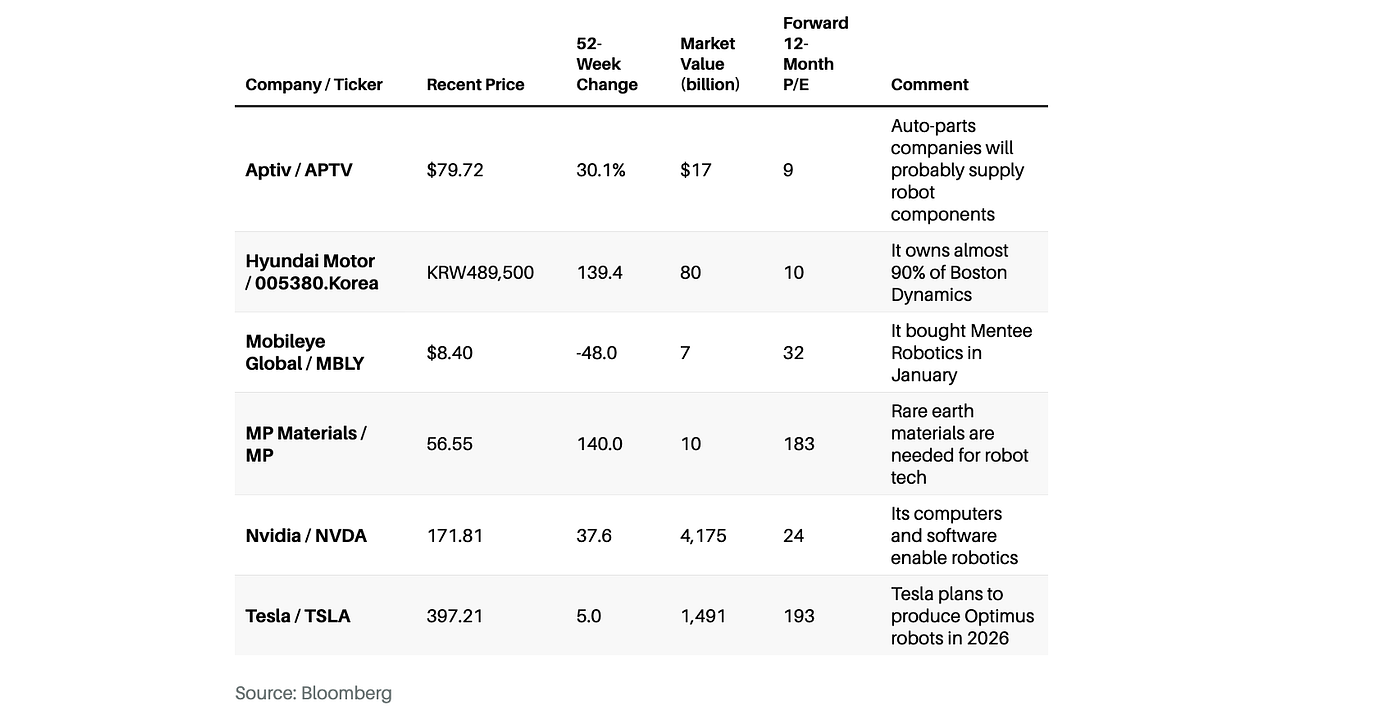
Robots will also be a tailwind for other chip companies, and suppliers of sensors, actuators, bearings, magnets, motors, batteries, and more, says Jonas. UBS analyst Amit Mehrotra points to multi-industry stocks as a possible beneficiary. He has Buy ratings on Honeywell International, Zebra Technologies, Cognex, and Teledyne Technologies, which all make industrial automation parts that would be used in robots, as well.
Mobileye Global is also worth a look. The self-driving-car technology company bought robot start-up Mentee for $900 million on Jan. 6, and the stock could use a boost. Shares declined 3.3% on Jan. 22 after Mobileye gave relatively disappointing guidance for 2026 due to concerns about the company’s autonomous-driving business. “While the acquisition introduces risk and near- to medium-term dilution, the strategic upside is significant,” says Canaccord analyst George Gianarikas, who has a Buy rating and $24 price target on the stock. “The humanoid sector is increasingly competitive, with a surge of American and Chinese start-ups; however, Mobileye’s proven autonomous technology offers a distinct advantage.”
Auto makers, though, might be the best place to look for robot bets. They have sensors, actuators, batteries, metals, and the manufacturing know-how to build robots. Tesla is the most expensive stock in the S&P 500 index —it trades for 200 times estimated 2026 earnings—and is valued at $1.5 trillion because it’s viewed as an AI/robotics stock these days, not an auto maker. While robots and robo-taxis generate little revenue and earnings, the combination of robot potential, Musk’s history, and lack of alternatives means that investors have given it the benefit of the doubt, though new money should wait for a better entry price.
In another 65 years, robots will be building more of the car, and probably themselves, too
Hyundai is charting a course from pure-play auto maker to an embodied-AI company. It owns 88% of Boston Dynamics, a hidden asset that isn’t yet generating earnings or cash flow. Currently valued at about $25 billion, Boston Dynamics accounts for about 25% of the company’s $86 billion market value. Excluding the Boston Dynamics stake, Hyundai stock trades for about 7.5 times its estimated 2026 earnings, above the average of six times over the past five years. A sustainably higher multiple could be in the offing if the company can go from a slow-growth auto maker in a competitive and cyclical business to a maker of robots.
Even General Motors and Ford Motor could morph from sluggish car companies into something far more dynamic. After all, GM installed the first industrial robot, Unimate, in 1961 to unload a material press. In another 65 years, robots will be building more of the car, and probably themselves, too.
Legacy auto makers won’t be responsible for the AI brains or training, but their manufacturing and supply-chain expertise will be needed to drive the robot revolution. Ultimately, it’s an opportunity that could one day dwarf the auto business—and a chance to escape the purgatory they have been in for decades.
“We do not have the right supply chain for robotics [yet]; we have pieces,” says Ayanna Howard, a senior member at the Institute of Electrical and Electronics Engineers. “The closest would be cars—cars have sensors, they have actuators, they have batteries, they have metal.”
And everything needed to be a player in the robot race.