The Rich Investor Club Is Getting Crowded
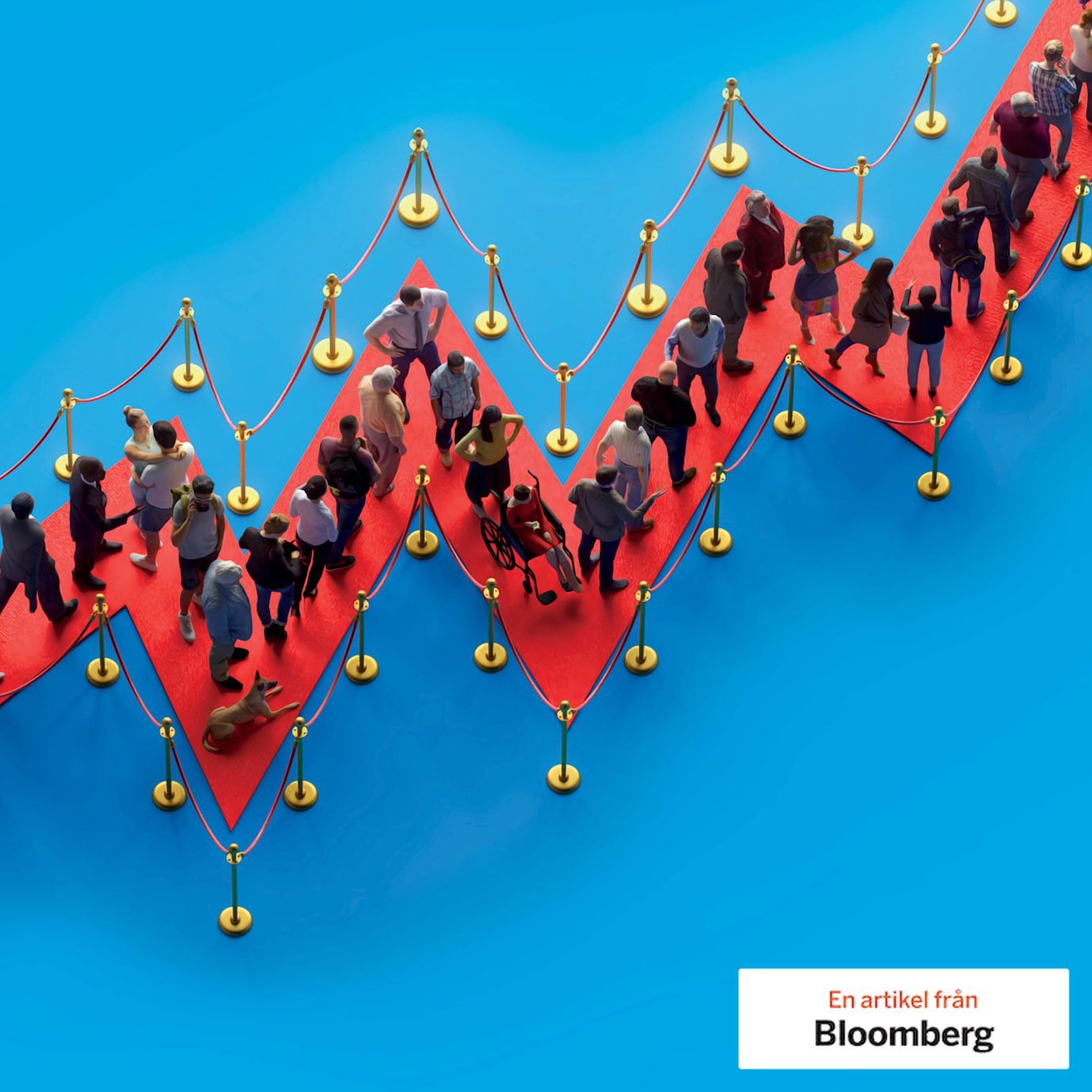
Fler amerikaner än någonsin kvalificerar sig nu som ”ackrediterade investerare”, vilket betyder att de får investera i mer riskfyllda och mindre reglerade marknader.
Reglerna har inte ändrats sedan 1982 och i dag uppfyller vart femte hushåll i USA kraven.
Riskkapitaljättar som Blackstone och KKR jublar och ser en chans att få in pengar från den här sortens rika privatsparare. Men de som vill investera måste vara försiktiga – det finns högre risker och pengarna kan vara låsta under lång tid, skriver Bloomberg.
 Bloomberg
Vill du läsa artikeln på svenska?
Läs den översätta versionen här:
The Rich Investor Club Is Getting Crowded
More US households than ever qualify as accredited investors. Asset managers are thrilled, but democratization has downsides.
Attention, individual investors: You may be eligible for a status upgrade.
Thanks to recent rising markets—paired with elevated inflation and some very vintage rules—the number of Americans who qualify as “accredited investors” has skyrocketed to an all-time high. Accreditation gives individuals access to riskier, less regulated assets. This includes private markets that have long been the domain of endowments, pension funds and other “smart money” types. It opens doors to the historically exclusive echelons of private equity, credit and real estate placements. But this expansion of access, with its tantalizing promise of greater returns, comes with a key question: Is it worth joining a club that would have you as a member?
Current rules for investing in private markets date back to 1982. They were intended to give a small subset of supposedly more sophisticated, demonstrably flusher investors access to private or limited offerings. Young, small firms need capital but can be too risky for the average person to back. So the US Securities and Exchange Commission stipulated that, to be accredited, an individual would either need to make more than $200,000 a year or have a net worth of more than $1 million. Those thresholds gave the government confidence that even if an individual made a bad investment, they’d likely have the means to recover.

But the thresholds haven’t been updated since Ronald Reagan was president. Now roughly 1 of every 5 American households could be an accredited investor. In the early ’80s the figure was 1 of every 50. If the accredited investor thresholds were updated to reflect today’s dollars, the income requirement would jump to well over $600,000 and the net worth to more than $3 million. What’s more, some of the ostensible growth in net worth is linked to the boom in workplace retirement accounts that investors can’t readily access without a penalty.
Just as more Americans are finding themselves eligible to invest in private markets, private market opportunities are opening for them. It’s not a coincidence: The world’s largest alternative asset managers, which have lately seen their sources of institutional funding dry up, are setting their sights on the individual investor.
“It’s very much a democratization,” says Or Skolnik, a partner in consulting firm Bain & Co.’s private equity and alternative investors practice. “It’s not yet a full, equal playing field between, say, the most sophisticated sovereign wealth fund and the individual investor. But we are on the path, and it’s gone much faster than folks have anticipated.”
“It’s very much a democratization [...] it’s gone much faster than folks have anticipated”
The numbers explain the speed. According to research by Bain, individual investors hold some 54% of the $300 trillion in global assets under management but represent just 16% of assets managed by so-called alternative funds, which include hedge funds and private equity. And investors who make it into the accredited club and points just beyond—those with assets between $1 million and $5 million—allocate only about 1% of their net worth to private equity and similar investments.
The asset-hungry industry sees an opening and is charging toward it. Blackstone, Apollo, KKR and other large asset managers are seeking high growth, but with institutional money less available, they want—need—money from wealthy investors. New products and platforms are popping up widely. Blackstone Inc. arrived early, as far back as 2017, with the likes of the Blackstone Real Estate Income Trust, known as BREIT. The alternative manager has raised more than $4 billion for the Blackstone Private Equity Strategies Fund, a new private equity fund for wealthy individuals. Competitors are circling, with KKR & Co. and Apollo Global Management Inc. among the biggest names. Many products so far require a financial adviser as an intermediary, and some have additional investment requirements, but a platform called Moonfare allows individual investors willing to allocate a minimum of $75,000 to invest directly in alternative assets.

Advisers to the affluent describe something of a FOMO effect on clients at a time when startups are no longer so quick to go public.
“People playing on a golf course or going to cocktail parties in the ’90s would come to me and say, ‘Hey, what’s your favorite stock?’ ” says Robert Picard, head of alternative investments at wealth management firm Hightower Advisors. “Today what’s actually happening is, at those same cocktail parties, people are not talking necessarily about stocks. They’re talking about ‘Which fund are you investing in? Which private investments are you doing? What deals are you in? Are you in the latest SpaceX round?’ ”
Advisers get the excitement. The deal with private markets is generally that you swallow liquidity constraints and greater risk for potentially higher returns than those in the public markets. Still, in a space where reporting rules are more lax, it’s hard to assess both performance and composition. That helps explain why one of the biggest disses in the industry right now is to call a fund “breadcrumbs”: the leftovers the smart money didn’t want, packaged up for retail suckers. Fees for such investments are often very high compared with those for widely available investments such as exchange-traded funds.
“I hope advisers and clients are discerning, because I think some of these opportunities can be good,” says Noah Damsky, principal at Marina Wealth Advisors in Los Angeles. “But I think a lot of them, they can be a lot of breadcrumbs.”
“If it’s going to play on their emotional or mental health, I just wouldn’t even do it”
There’s also the psychology to contend with. Private funds generally don’t report results with the same rapidity as stocks. “If you have a bad month, it stings for that full 30 days,” says John Bovard, owner of Incline Wealth Advisors in Cincinnati.
And liquidity limitations mean clients may invest their money today but not be able to access it for years, given that many private funds limit investors’ right of withdrawal to a small percentage of assets over time. This was illustrated recently when Blackstone’s BREIT limited withdrawals for months, after a rush of investors tried to take out their money amid a slumping real estate market. The fund is now meeting redemption demands.
This has led Bruce Colin, a wealth manager in Rancho Palos Verdes, California, to steer clear of private investments for some clients who might struggle with the mere idea of not being able to access their money for long periods of time. “If it’s going to play on their emotional or mental health, I just wouldn’t even do it,” he says.
--With assistance from Benjamin Stupples.
More stories like this are available on bloomberg.com
©2024 Bloomberg L.P.