Vadslagning på högvarv inför valet, men hotas av domstol
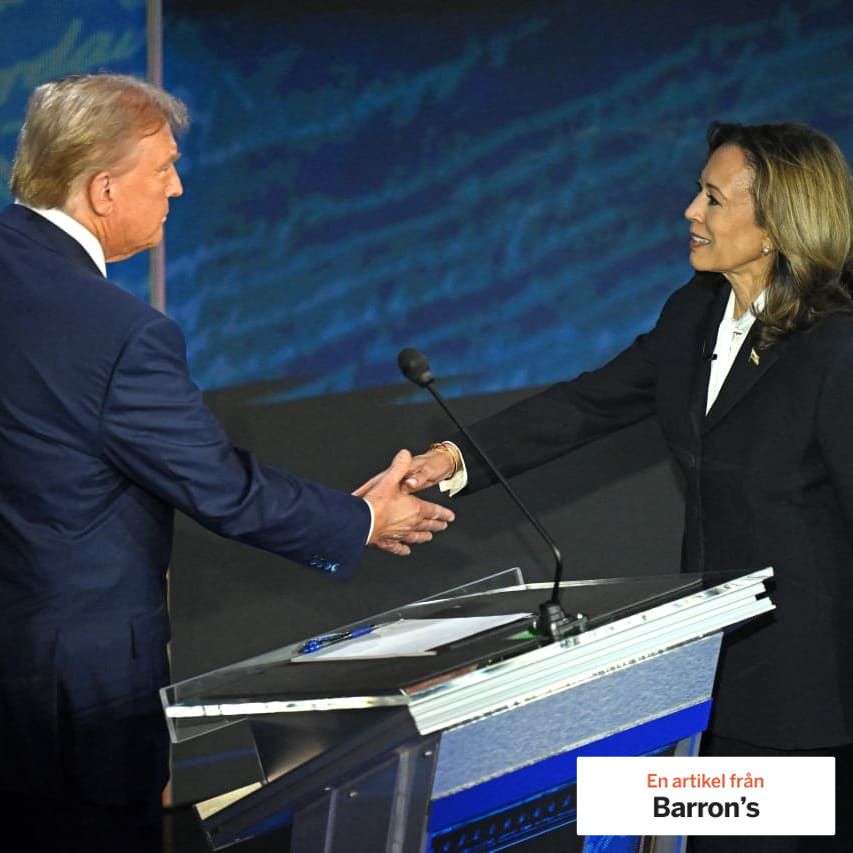
En enda firma har redan omsatt omkring en miljard dollar på vadslagning om årets presidentval i USA. Inom kort väntas dock ett domstolsbeslut som kan sätta stopp för all fortsatt politisk vadslagning, skriver Barron’s.
Den amerikanska myndigheten CFTC, som reglerar derivatmarknaden, ligger bakom anmälan och hänvisar till risken för manipulation. Förespråkarna, däribland en mottagare av ekonomipriset, påpekar dock att bettingsajterna är överlägset bäst på att förutse valresultat.
 Barron's
Trump-Harris Betting Markets Are Nearing $1 Billion in Bets. They Could Be Shut Down Soon.
The 2024 U.S. election could be a new high water mark for political betting markets—or the beginning of the end for the prediction exchanges.
The future of the online platforms appears to rest in the hands of an appellate court, which is poised to decide whether the Kalshi betting exchange can begin taking wagers amid legal and regulatory challenges by the Commodity Futures Trading Commission.
A growing cohort of online bookmaking ventures allows gamblers to place cash bets on political outcomes, such as who will be the next U.S. president.
Backers say they tap the wisdom of wagering crowds to forecast political winners and losers faster and more transparently than pollsters could ever hope. Opponents fear they create openings and incentives for political manipulation that threaten the integrity of elections.
The debate is playing out as the Washington, D.C., Court of Appeals weighs the legal merits of the marketplaces. Last Thursday, a panel of three judges heard oral arguments on whether to reverse its stay on an earlier District Court decision that allowed New York-based Kalshi to begin accepting the bets.
A ruling could come at any time.
“From the CFTC’s perspective, this case will determine whether there will be ‘election gambling’ on U.S. futures markets,” the law firm WilmerHale wrote in a briefing on the case last week.

Kalshi has asked the court to let it begin taking bets ahead of the November elections, while the appeals process continues. Kalshi users can currently wager on outcomes that aren’t tied to electoral results, such as how much the Federal Reserve will cut interest rates this year and whether Nintendo will release a new game console.
Platforms currently taking bets on election results, such as Polymarket and PredictIt, do so under special conditions that have placed them in a legal gray area. Polymarket is allowed to accept crypto bets from non-U.S. gamblers, while PredictIt has limits in place on the size and number of bets.
Some big investors appear to be banking on the exchanges’ ability to draw in big sums. Kalshi’s financial backers include venture capital giant Sequoia and the top executives of Charles Schwab and KKR , who contributed to a $30-million funding round in the company.
Polymarket is backed by investors that include Peter Thiel’s Founders Fund and Vitalik Buterin, co-founder of the Ethereum blockchain platform, who joined a $45-million investment round.
Polymarket has drawn in nearly $1 billion in bets on this year’s U.S. presidential matchup, with millions more wagered on other political outcomes, such as which party will win control of the U.S. House and of the Senate.
“I don’t think anyone has solved how you make money with these markets”
The markets appeared to get legal signoff on Sept. 12 when U.S. District Judge Jia Cobb said the CFTC had exceeded its authority when it barred Kalshi from taking wagers on political outcomes.
The CFTC regulates financial derivatives, which include the exchange-traded contracts for political bets. The commission opposed Cobb’s ruling and immediately filed an appeal. That led to the court’s injunction and last week’s hearing to determine Kalshi’s immediate future.
After Cobb issued her ruling in favor of Kalshi on Sept. 12, investing platform Interactive Brokers announced that it, too, would accept wagers on outcomes of political races. The appeals court issued its stay on Cobb’s ruling before any bets were placed on Interactive Brokers’ site.
As the legal case plays out, a separate debate continues on the business case for political prediction exchanges.
Pratik Chougule, executive director with the Coalition for Political Forecasting, says the exchanges may struggle to earn much revenue outside marquee presidential elections.
“I don’t think anyone has solved how you make money with these markets,” Chougule says.
Kalshi has sought to shift the regulatory winds in its favor, spending $700,000 on federal lobbying from January 2021 through June 2024, nearly all of it aimed at the CFTC, according to data from political-spending tracker OpenSecrets.

Polymarket and PredictIt have had squabbles with the CFTC that predate Kalshi’s.
In 2022, Polymarket reached a $1.4 million settlement with the agency, which had alleged that the firm was operating an unregistered exchange. As part of the settlement, Polymarket amended its terms of service to bar U.S.-based users from wagering on the site. The company didn’t admit to any wrongdoing in its settlement.
PredictIt, which is based within Victoria University in New Zealand, is in the midst of litigation with the CFTC over the 2022 withdrawal of a previously issued clearance to accept limited bets as a data-gathering tool for academic research. The agency accused it of taking bets on outcomes of events beyond its stated political and economic focus. PredictIt was permitted to continue operating during the court proceedings.
Kalshi’s case goes back to September 2023, when the firm was denied CFTC approval for users to trade “event contracts” on its exchange that predicted control of Congress. Cobb’s decision overturned that ruling.
As part of its appeal, the CFTC has said wagers could incentivize political meddling or allow campaigns to overstate their candidates’ apparent popularity by placing their own favorable bets.

Similar arguments have been made by legislators including Sens. Jeff Merkley (D-Ore.), Elizabeth Warren (D-Mass.), and Chris Van Hollen (D-Md.), who have urged the CFTC to decide against Kalshi’s plan and have since called for an explicit ban on such political betting markets.
“When big bets are cast on elections and dark money can smear candidates, you have the perfect combination of factors that can undermine trust in our democracy,” Merkley said in a statement after Cobb’s decision in Kalshi’s favor. “The court’s ruling to overturn the CFTC’s decision—which blocked election gambling—is stunningly reckless.”
The exchanges have the backing of some high-profile academics and thinkers, including Nobel-Prize-winning economist Robert Shiller, author PhilipTetlock, and Peterson Institute fellow Justin Wolfers, who joined other colleagues in writing a comment letter to the CFTC in favor of letting Kalshi take bets.
“Polling error has increased in recent years, polarization is at an all time high, fake news is rampant,” they wrote, adding that “a market-based mechanism for forecasting the outcome of the midterms would be a vastly superior alternative to polling and punditry, and would thus foster a healthier and more reasonable debate around the electoral process.”
“There’s nothing else out there that can give us feedback with the speed and efficiency of these markets”
Election Betting Odds, a website co-led by broadcast veteran turned Libertarian activist John Stossel, posts data indicating that its aggregate data from betting markets going back to 2016 have been predictive of final results, and that its success rate is nearly tied with that of high-profile pollster Nate Silver.
Betting odds posted by Polymarket and PredictIt are frequently featured alongside results from traditional polls in stories by media outlets, including Barron’s.
Academic researchers have been less definitive about the predictive power of betting markets. A 2012 study by Columbia political science professor Robert Erikson, for example, found that they largely track polls, even when those polls fail at predicting final outcomes.
Chougule, of the Coalition for Political Forecasting, says betting results on the exchanges lack precision because they’re skewed by the type of gambler that opts to use each platform.
Harris, he notes, is consistently seen as having better odds on PredictIt, which tends to attract an urban-dwelling professional-class user base, than on Polymarket, which is dominated by “crypto bros who are more likely to select Trump.”
Still, he said, the exchanges offer unmatched immediate feedback on how users see news events impacting candidates’ chances.
“They’re going to be directionally right for the most part,” he says. “There’s nothing else out there that can give us feedback with the speed and efficiency of these markets.”