WTO-chefen optimist men ”tar inte lätt” på tullkriget
Försäkringskostnader, fraktkostnader och bränslekostnader har ökat och containerkostnader har i vissa fall mer än fördubblats. Samtidigt har flera länder infört exportkontroll, tullar eller statsstöd för att gynna inhemsk industri.
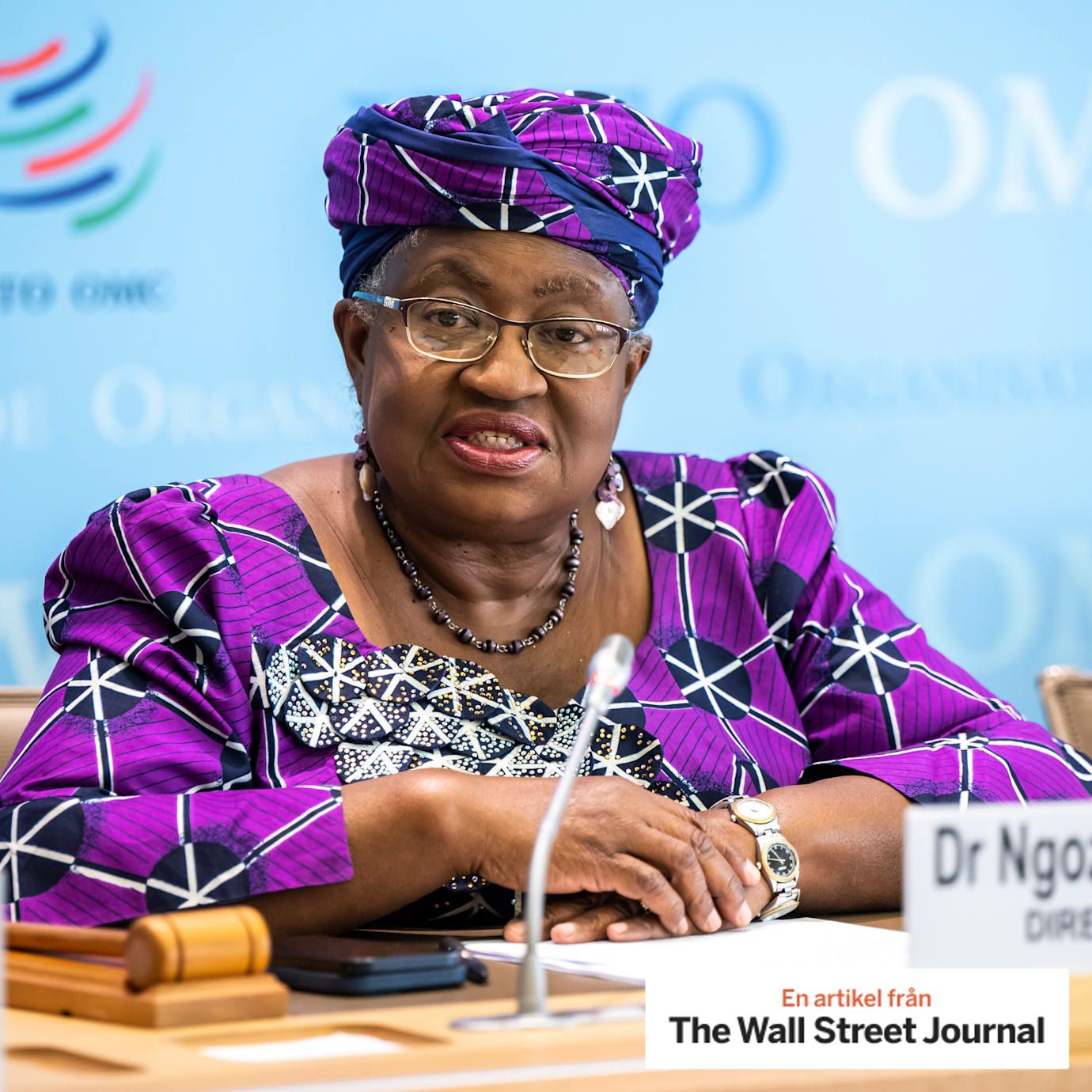
Ändå är WTO-chefen inte pessimistisk. I en intervju med Wall Street Journal framhåller Ngozi Okonjo-Iweala näringslivets förmåga att anpassa sig till nya förutsättningar. Hon säger samtidigt att WTO inte tar lätt på de pågående handelskonflikterna och att organisationen ser över ramverket för internationell handel.
 The Wall Street Journal
Trade to Be Resilient in Face of Route Disruptions, Election Risks, WTO Chief Say
Ngozi Okonjo-Iweala says businesses are quick to learn lessons and adjust to supply-chain interruptions.
Ngozi Okonjo-Iweala, the director-general of the World Trade Organization, said the framework for how global trade agreements are reached should be reviewed for possible improvements, while expressing optimism that the business community can adjust to new challenges.
Established in 1995, the WTO is a forum of member governments that negotiate trade agreements, settle disputes and monitor implementation of rules. Okonjo-Iweala, a former World Bank senior official and two-time finance minister for Nigeria, spoke to The Wall Street Journal at the World Economic Forum in Davos, Switzerland, earlier this month. Here is an edited version of that conversation.
”Ultimately, the aim of trade is to put people at the center of trade and make sure that it enhances people’s living standards”
WSJ: We have a number of situations around the world where trade routes are being interrupted due to conflict. What are your concerns around the long-term effect of these disruptions?
Okonjo-Iweala: It does disrupt supply chains and this is leading to our concern that it may increase the cost of trade. Already, insurance costs have gone up, freight costs have gone up, fuel costs have gone up, container costs [have] more than doubled in some cases. This makes the cost for the consumer even higher. Ultimately, the aim of trade is to put people at the center of trade and make sure that it enhances people’s living standards. But [trade] it is very resilient. I think that some supply chains have built in redundancies. So they have higher inventories. So this is helping to mitigate some of the impact from the disruption.
The vulnerabilities that were seen during the pandemic, I think, certain companies have learned from that. “Just in time,” [delivery] may have to be “just in case.” Everyone is always constantly scenario planning because it’s the bottom line; they’re also quick to learn lessons, and to try to adjust. So the impact may be mitigated by these companies doing “just in case” inventory.
WSJ: Some member countries are turning to export controls, subsidies and tariffs to promote domestic industries, and the WTO is the governing body used to solve those disputes. Is the WTO taking a broader look at these issues?
Okonjo-Iweala: When we look at WTO members, the U.S. the EU, others may complain about industrial subsidies in China, China itself complains about agricultural subsidies elsewhere. We have some ongoing work looking into the entire subsidy landscape, including industrial subsidies, agricultural subsidies. We don’t take it lightly. We have an agreement, the agreement on subsidies and countervailing measures that was put in place before even China joined. Let’s see whether some of our agreements are still fit for purpose. Do we need to review and reform them to fit the terms and circumstances we’re in? So that’s the kind of reform and forward leanings approach we should take. If we’re able to review this and change them to fit the times, that’s what we’re looking at.
WSJ: How could the U.S. election, as well as elections in other countries affect the global trading system?
Okonjo-Iweala: I think the way I approach it is not to be fearful, but to consider the reforms that the trading system will need, that would respond to concerns of the membership of the WTO, and emphasize the benefits being delivered by this system, and if they are undermined, would severely damaged trade in the world.
People take the world trading system for granted. The multilateral trading system is almost like the air you breathe, because trade is so resilient…75% of world trade now is taking place [under] those tariff terms and conditions that were established at the WTO. They’ve been holding for 75 years.
Unilateral actions by any party that says, ‘I’m going to do X or Y,’ means that any other country can take unilateral actions. And that will be chaotic for business.
The majority of world trade is based on predictability and stability. What we are going to do is work on maintaining that, and reminding people of the benefits and then trying to do those reforms.
WSJ: How are you going to deal with a leader in the U.S. or anywhere else who says they’re not going to follow the rules and agreements set forth by the WTO? How will you deal with other members who may want help combating those efforts?
Okonjo-Iweala: One good thing about the WTO, we actually have mechanisms, where members can address each other’s complaints and concerns, and try to resolve them before they become a dispute. And these mechanisms are working well. And I’m hoping that if that happens, the members of the WTO who are concerned, we’ll be able to address the members with whom they have these concerns and resolve them. I would hope they will have this dialogue, use the committee process to voice their concerns and the impact this will have on trade…and have it resolved.
I’m not fearful, I’m not pessimistic, because I know that the impact this will have on world trade will be tremendous. And there will be some self-correcting mechanism. That does not mean that for certain sectors, as we’ve seen, there may be particular sectors or particular goods where something happens. But a movement overall, to try and put unilateral measures on everything is just going to upend the world of trade, honestly, and that will not be good all around. I think the business community will see that, and I think they’re perfectly capable of speaking up for themselves and what this will do to business in the world.