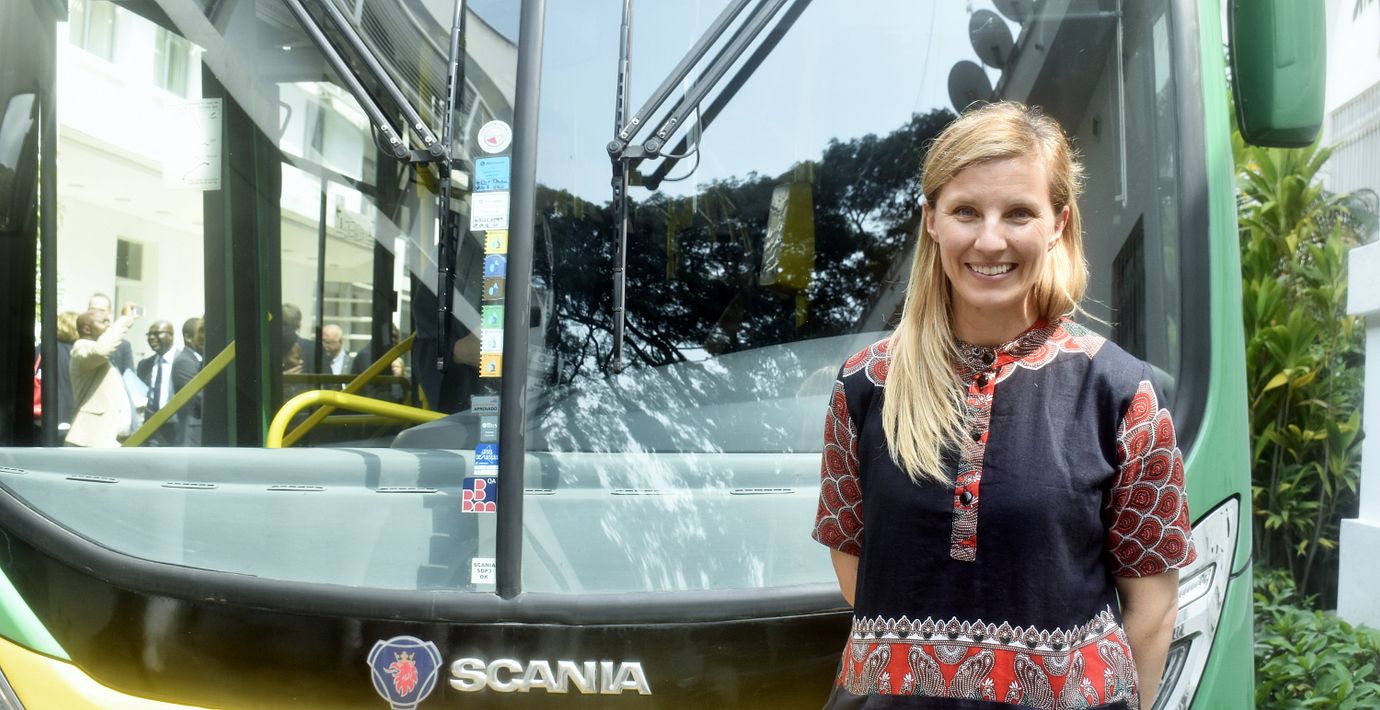
Bogota byter bussar – kan bli svensk miljardaffär
Colombias huvudstad Bogota ska byta bussflotta och upphandlingen om 1 500 nya fordon, där två tredjedelar ska vara ledande bussar, beräknas vara värd upp mot tre miljarder kronor, skriver DI som hänvisar till en branschbedömare.
Scania är en stor leverantör till Bogotas trafiksystem och kommer delta i upphandlingen, precis som Volvo.
– Det är en stor upphandling som är viktig för Volvo, säger Volvo Bussars presschef Helena Lind.
Även tyska Mercedes-Benz väntas bli en av konkurrenterna om det lukrativa kontraktet.
bakgrund
Transmilenio
Wikipedia (en)
TransMilenio is a bus rapid transit (BRT) system that serves Bogotá, the capital of Colombia. The system opened to the public in December 2000, covering Av. Caracas and Calle 80. Other lines were added gradually over the next several years, and as of 2012, 12 lines totalling 112 km (70 mi) run throughout the city.
Was inspired by Curitiba's Rede Integrada de Transporte (Integrated Transportation Network). TransMilenio consists of several interconnected BRT lines, with raised floor stations in the center of a main avenue, or "troncal". Passengers typically reach the stations via a bridge over the street. Usually, four lanes down the center of the street are dedicated to bus traffic. There are both express and local buses, the latter stopping at every station to pick up passengers. The outer lanes allow express buses to bypass buses stopped at a station.
Users pay at the station entrance using a smart card, pass through a turnstile, and wait for buses inside the station, which is typically 5 m wide. The bus and station doors open simultaneously, and passengers board by simply walking across the threshold. Like in a subway system, the elevated station platform and the bus floor are at the same height.
The buses are diesel-powered, purchased from such manufacturers as the Colombian-Brazilian company Marcopolo-Superior, German conglomerate Mercedes-Benz, and Swedish companies such as Volvo and Scania.
The buses are articulated and have a capacity of 160 passengers. In May 2007, a new, larger bi-articulated bus, with capacity for 270 passengers, was presented to the public.
TransMilenio buses are not equipped with transponders to give them priority at traffic signals; regret over this fact was voiced by the general manager of the system, Angelica Castro.
As of October 2014 up to 1,500 buses were circulating on the trunk line system and the fare was 2,200 Colombian pesos for a single trip (about EUR 0.70 or USD 0.75). Cards use a contactless smart card (MIFARE) system, and multiple trips may be purchased using one card.
An additional set of 410 regular buses, known as "feeders" (alimentadores, in Spanish), transport users from certain important stations to many different locations that the main route does not reach. Unlike the main TransMilenio buses, feeders operate without dedicated lanes, are not articulated and are green (regular TransMilenio buses are red). There is no additional fare to use the feeder buses.
TransMilenio stations at each end of a line have large bicycle parking facilities to facilitate cyclists using the system.
Omni är politiskt obundna och oberoende. Vi strävar efter att ge fler perspektiv på nyheterna. Har du frågor eller synpunkter kring vår rapportering? Kontakta redaktionen