Handelsavtalen är Trumps nya vapen mot Kinas inflytande
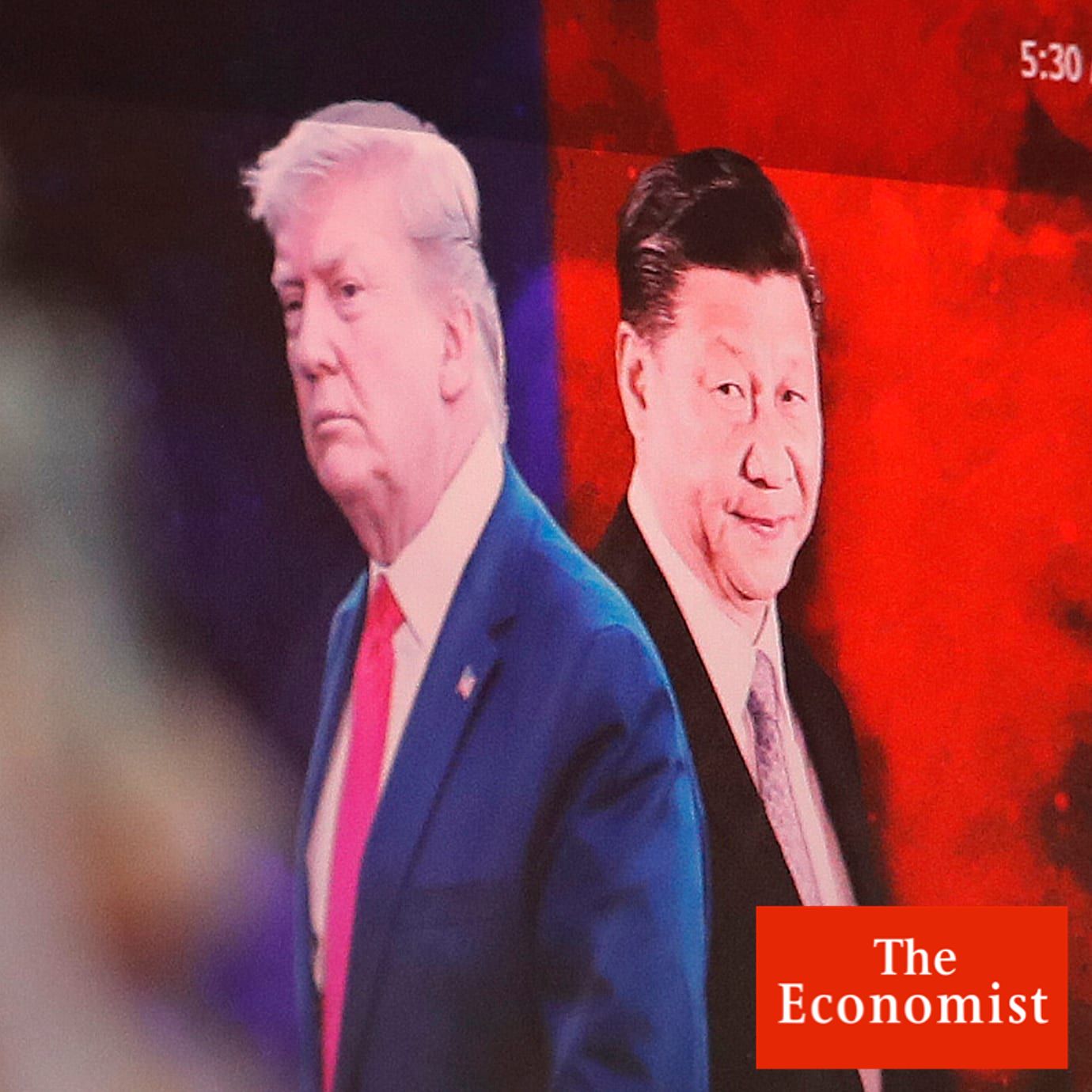
Donald Trump växlar upp i handelskriget med Kina – och låter andra länder ta smällen. Med nya avtal pressar USA nu länder som Vietnam, Japan och Sydkorea att välja sida. Den som gynnar Kina riskerar strafftullar på upp till 40 procent, medan lojala partners belönas med tullfördelar.
Genom att rikta in sig på Kinas roll i globala leveranskedjor skapar Trump ett nytt ekonomiskt vapen som kan få långtgående konsekvenser för världshandeln, skriver The Economist.
 The Economist
Trump’s trade deals try an innovative way to hobble China
To appease the world’s biggest market, countries must anger the world’s biggest trader.
In the first cold war between America and the Soviet Union, the two superpowers fought each other by proxy. Something similar is happening in America’s trade war with China. After conciliatory talks in Geneva and London, the two sides are no longer bashing each other with new tariffs. Instead, America is waging its war indirectly, through unfortunate third countries.
Its new deal with Vietnam and its fresh tariff threats issued to many other countries seem designed to reduce China’s role in their supply chain. Countries that had hoped to stay out of the new cold war now fear they are being forced to pick a side. To appease the world’s biggest market, they must anger the world’s biggest trader.
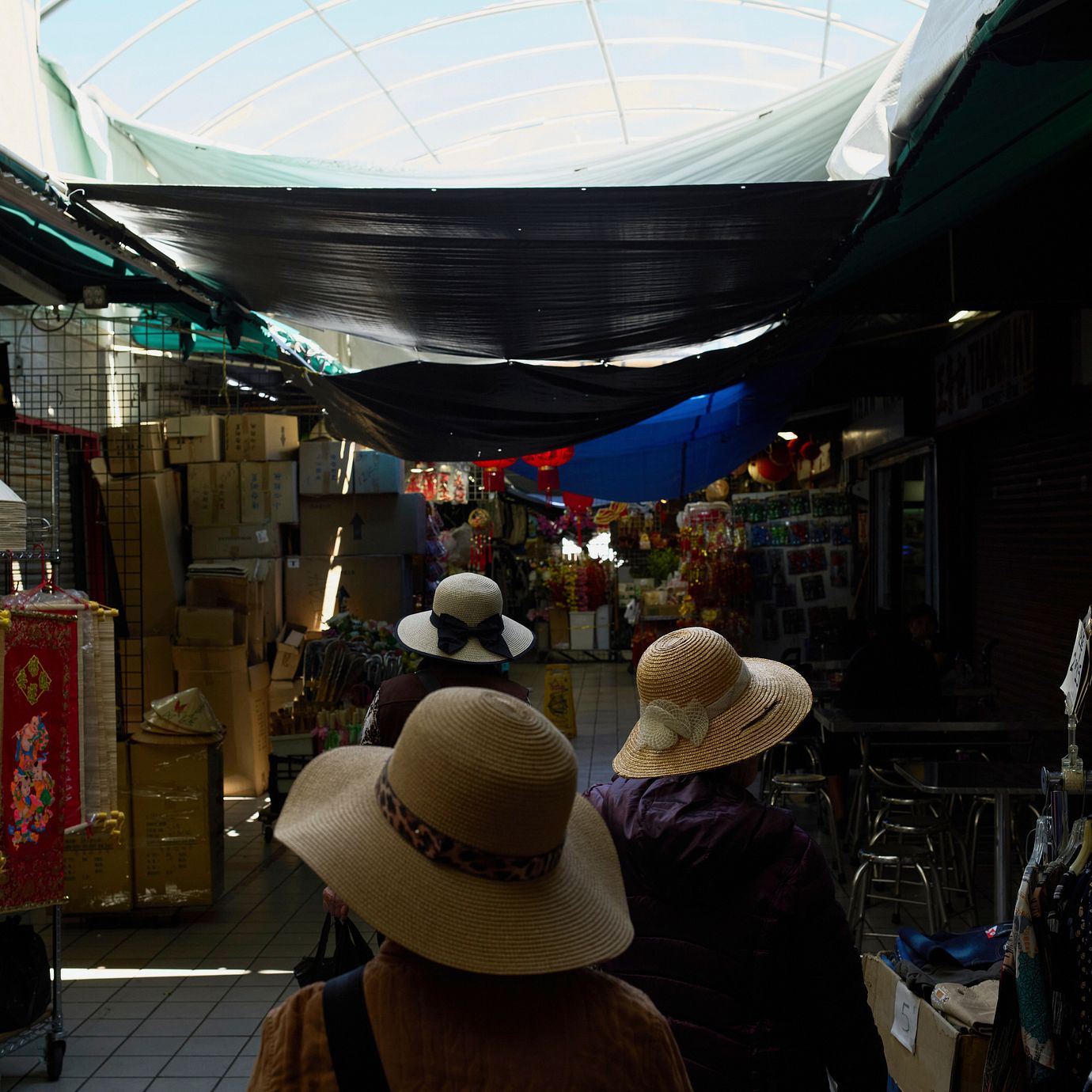
On July 7th Donald Trump, America’s president, sent letters to Japan, South Korea and a dozen other trading partners pushing back the deadline for their trade talks from July 9th to August 1st and tweaking the tariffs they will face if talks fail. Japan and South Korea, for example, will incur tariffs of 25%. Cambodia will be clobbered with tariffs of 36%; Myanmar and Laos face 40%. The letters also said that any goods “transshipped” from elsewhere would face the higher tariffs they were seeking to avoid. Although China was not named, no one was in any doubt about the elsewhere Mr Trump had in mind.
The president also threatened to place an extra 10% tariff on countries aligning themselves with the “anti-American policies” of the BRICS group, established in 2009 by China alongside Brazil, Russia, India and later South Africa. He has previously warned it not to try to dethrone the dollar as the world’s dominant currency.
America’s deal with Vietnam will apparently slap 20% tariffs on most of the Asian country’s goods. Ominously, it will also impose 40% tariffs on “any transshipping”. The deal follows one struck with Britain on May 8th. It promised to treat British aluminium, drugs and steel favorably if Britain ensured the security of its supply chains to America’s satisfaction. That is assumed to mean buying fewer inputs from China and allowing American scrutiny of Chinese-owned plants in the country.
Although China’s exports to America plunged by over 34% in May, against a year earlier, its overall exports continued to grow
Offering favours to one country if it imposes penalties on another is “something new” in trade negotiations, note Achyuth Anil at the University of Sussex and co-authors. The innovation has not escaped China’s attention. China firmly opposes any country making trade deals at the expense of its interests, the Ministry of Commerce has said. “China will not accept it and will take resolute countermeasures.” Countries must “remain on the right side of history”.
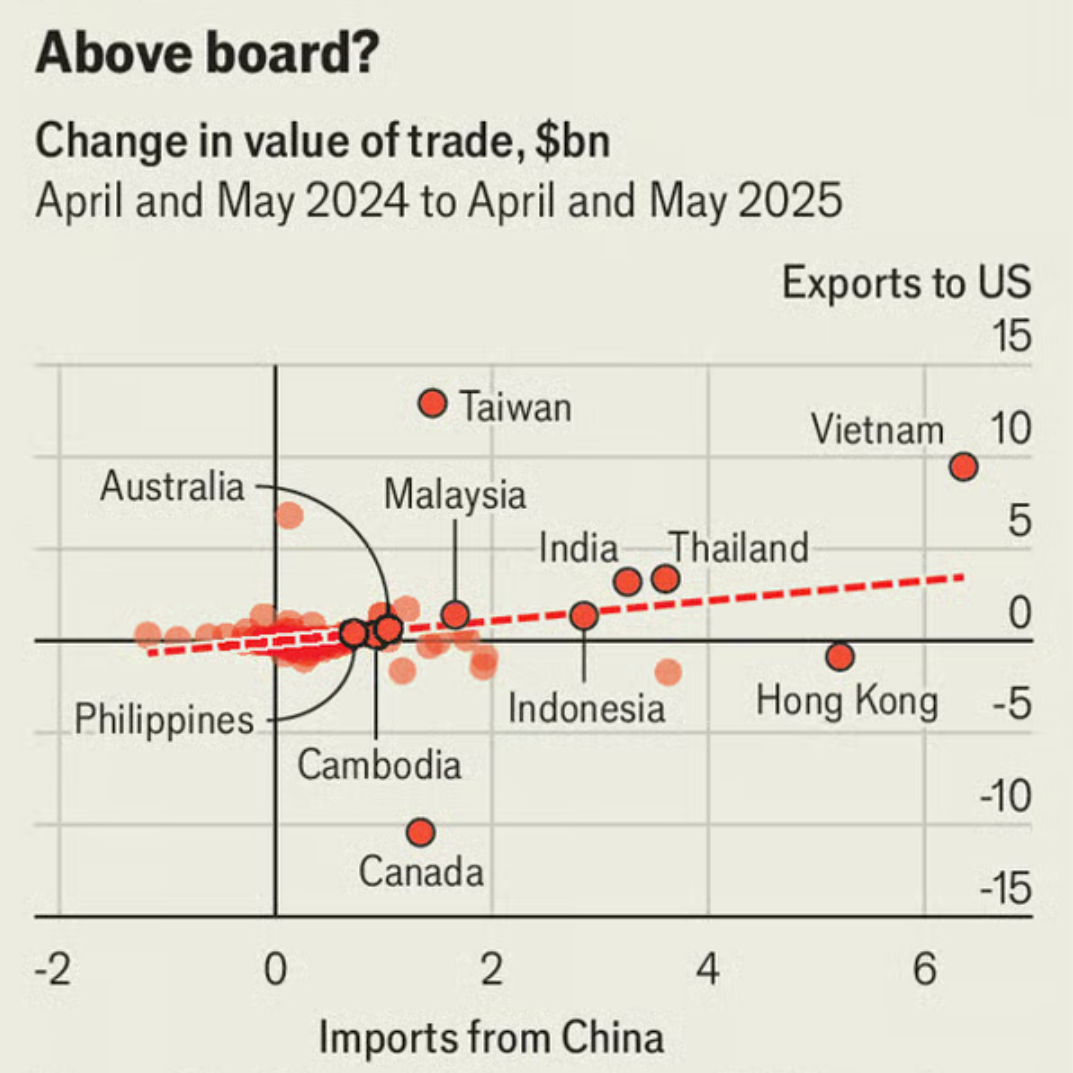
China does not yet know precisely what it is up against. Mr Trump’s team has not clarified what it means by transshipment. But it is clearly concerned China will try to evade the tariffs it faces by serving America’s market via other countries. During Mr Trump’s first trade war, China exported fewer products to America and more to countries like Mexico and Vietnam. These countries, in turn, exported more goods to America. A similar pattern recurred this year after Mr Trump imposed sweeping “reciprocal” tariffs in April. Although China’s exports to America plunged by over 34% in May, against a year earlier, its overall exports continued to grow. Many of the countries that bought more stuff from China also sold more to America.
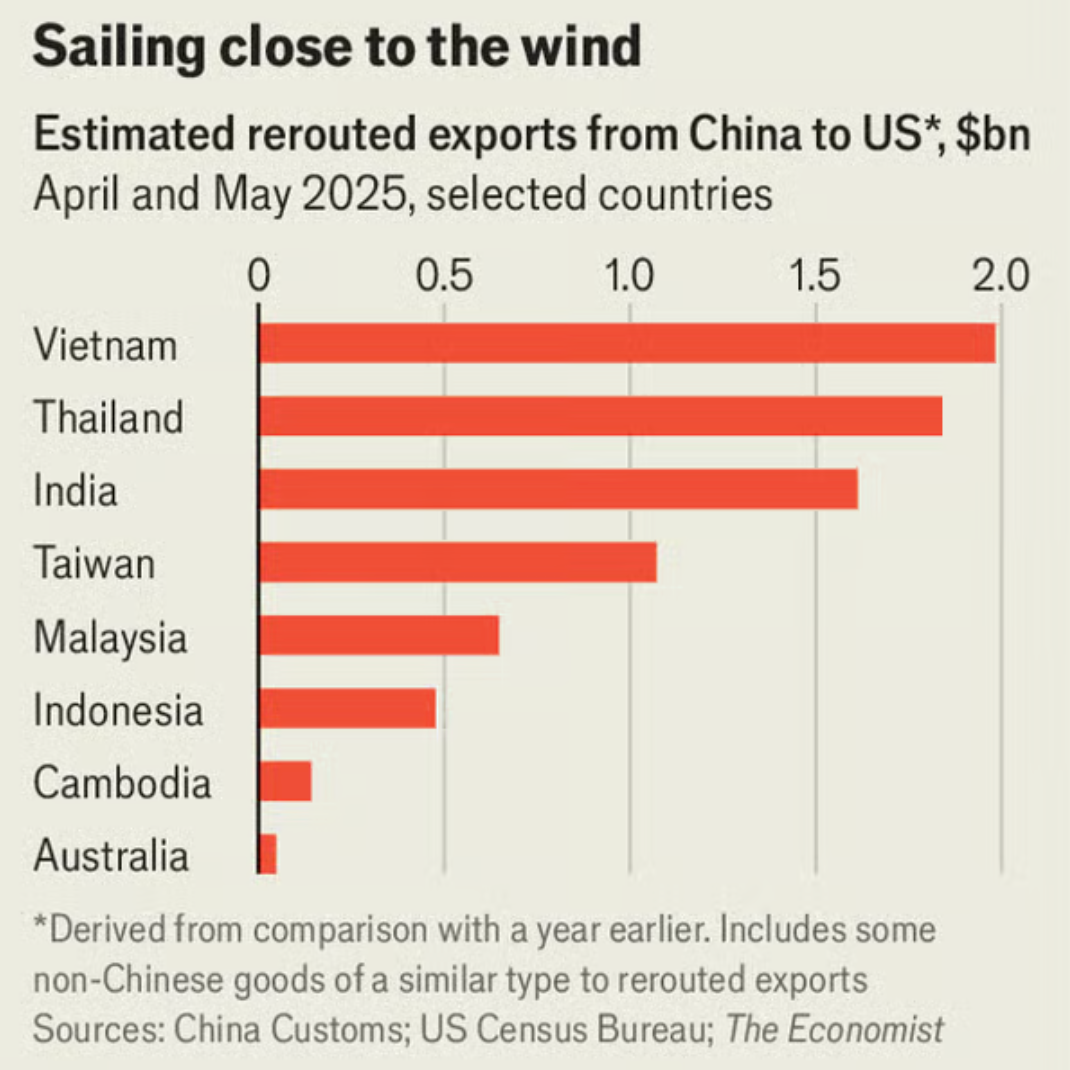
This is not itself proof of any tariff-hopping. Countries could be buying and selling unrelated goods. Those enjoying bumper exports to America might have bought other things from the world’s second-biggest economy. Australia, for example, exported $133m more in frozen beef to America in April and May than a year earlier. It also bought $186m more in lorries from China. Australian firms were not relabelling the trucks as beef.
Thus it pays to study the figures product by product. Cambodia sold an extra $26m of sweaters to America in April and May, having increased its sweater imports from China by over double that amount. Thailand sold $42m more car parts to America, having bought $114m more from China. We have added up all such extra exports. The totals were nearly $2bn for Vietnam, followed by Thailand ($1.8bn), India ($1.6bn) and Taiwan ($1.1bn).
Some of these flows may represent legal “trade diversion”, says Leah Fahy of Capital Economics, a consultancy. High tariffs could have priced Chinese firms out of the American market. Rivals in Thailand and Vietnam could have rushed to take their place, leaving a gap in these countries’ home market, which Chinese firms filled. In such a scenario, the goods arriving from China would not be the same ones leaving for America. They would just belong to the same statistical category. Nevertheless, it seems unlikely this kind of diversion explains all the extra exports.
America’s trade agreements often require that a certain percentage of a product’s value originates in a country before it can be said to be “made” there
The Trump administration is probably also worried about imports from Thailand, Vietnam and elsewhere that include parts, materials or components from China. Under existing rules, these goods are not considered Chinese so long as they have been “substantially transformed” elsewhere. What counts as a substantial transformation varies from product to product. Chinese flour is transformed when baked into a cake. The same is true of fabric cut and stitched into a shirt. Assembling Chinese parts counts if the assembly is “meaningful and complex”. In one case, America’s border authorities decided that a piece of exercise equipment had been substantially transformed from its Chinese parts, because the parts had to be welded, degreased, sprayed with clear coat, and assembled in as many as 255 steps.
Mr Trump may abandon this qualitative standard for a quantitative one. America’s trade agreements often require that a certain percentage of a product’s value originates in a country before it can be said to be “made” there. In this scenario, notes Ted Murphy of Sidley Austin, a law firm, Vietnam would face tariffs of 40% on goods that have been substantially transformed in the country, but still contain too much Chinese content in American eyes.
If the new threshold is demanding, the results could be troubling for Vietnam. The country’s manufacturers depend on China for parts and components, a reliance that has increased sharply since Mr Trump’s first trade war. China contributed 6% of the value of Vietnamese exports serving the American market for manufactures in 2017, according to Natixis, a bank. That figure had jumped to 16% by 2022.
Vietnamese officials must hope that Mr Trump has something narrower in mind: what Caroline Freund at the University of California, San Diego, calls “the China wash”. This refers to goods from China relabelled as “made in Vietnam”, even though they are largely unchanged. Peter Navarro, one of Mr Trump’s advisers, has complained that “China uses Vietnam to transship to evade the tariffs…They slap a made-in-Vietnam label on it and they send it here.” According to Mr Navarro, the China wash accounts for a third of Vietnam’s exports to America. A better estimate by Ms Freund suggests the share peaked at less than 8% in 2020, and has since fallen.
It is a bold idea to fight waste, fraud and abuse. Someone should suggest it to the president
Relabelling may annoy Mr Navarro, but it is also already illegal. Anyone engaging in it risks penalties far worse than a 40% tariff. Last year a Florida couple earned over four years in prison for illegally importing Chinese plywood, sometimes reboxed in Malaysia or Sri Lanka. They even had to pay the government for the cost of storing the wood until the case was resolved. During its talks with America, Vietnam vowed to crack down on such mischief. America is doing the same. In May the justice department put “trade and customs fraud, including tariff evasion” second on its list of priorities for white-collar crime.
Of course, the best way to prevent misdeclarations of origin is to remove the incentive to do it. If America charged the same tariff on a product no matter where it was from, exporters would have no reason to lie. Everyone would face the lowest tariff charged on anyone else. Or, to put in another way, every country would receive the same tariff treatment offered to the most favoured nation. It is a bold idea to fight waste, fraud and abuse. Someone should suggest it to the president.
© 2025 The Economist Newspaper Limited. All rights reserved.