”Jag testkörde nya Polestar – och saknade inte bakrutan”

Den nya modellen Polestar 4 bryter med en av bilens mest självklara detaljer: bakrutan. I stället får föraren lita på kameror, sensorer och en videoskärm utformad som en backspegel, skriver Wall Street Journal.
Tidningens testförare Dan Neil menar att moderna bilars backspeglar ofta är begränsade, och att Polestars system fungerar oväntat naturligt.
”När det gäller den saknade bakrutan är mitt råd: blicka inte bakåt.”
 The Wall Street Journal
Is the World Ready for a Car Without a Rear Window?
The Polestar 4 forgoes a conventional rearview mirror—or a rear window, period—and instead uses a video display and a rear-facing camera.
In most of the English-speaking world, a vehicle’s front glass panel is called a windscreen. Americans call it a windshield. What we refer to as a rear window is more widely known as a “backlight.” This archaism, from the era of horse-drawn carriages, gives you some idea of how long rear windows have been around.
But our test car—the fresh-faced, frighteningly fast 2026 Polestar 4—doesn’t have one. Foiling the visual expectations of a lifetime, the four-door’s glass roof joins the car’s sloping rear deck just over the rear axle, omitting a transparent panel of any kind. In this not-a-hatch design, the hinged trunklid is concealed among the geometric cutlines. Inside, the glass roof panel extends just over the rear headrests; beyond, the black fabric headliner lands in a shallow, empty space, like a darkened theater stage—that bit should be upholstered, in my opinion, like the cargo hold of a Jaguar E-Type.
Lacking a direct, over-the-shoulder view, drivers depend on the side mirrors, short-range ultrasonics, four short-range cameras (for 360-degree views) and one dedicated rear-facing camera, feeding imagery to a video display mounted at the top of the windscreen, disguised as a conventional rearview mirror.
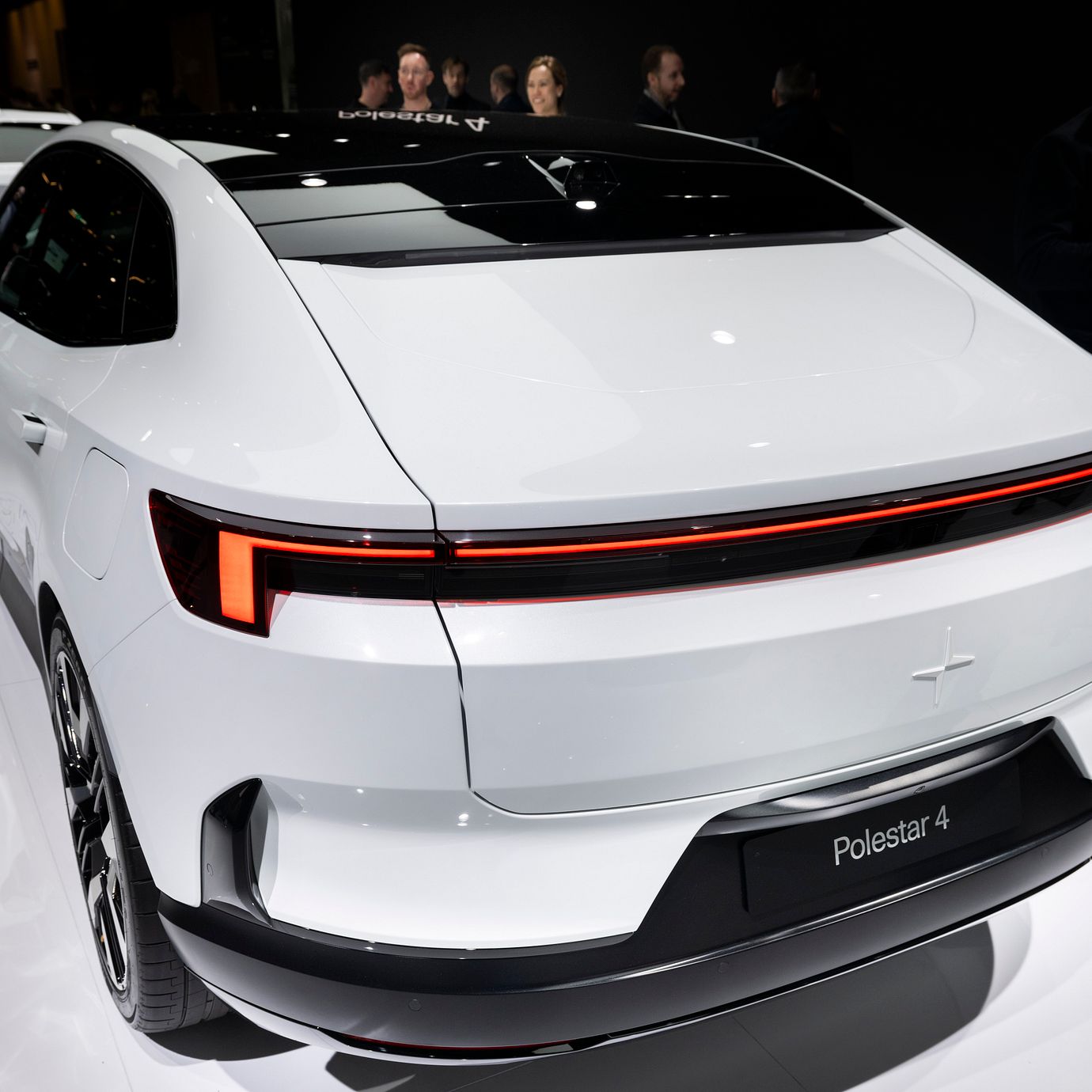
Going around the room, how are we feeling about the no-rear-window thing? If you really hate the idea, please indicate by shaking your fist at the sky. The objections start with the lack of a direct, confirming view rearward, which would seem to increase the risk of backing into, or over, something or someone. Why replace a proven technology—mirrors and glass—with chancy camera feeds and video displays?
In fact, a number of gains are to be had by deleting the backlight, starting with greater aero efficiency—critical, since the Polestar 4 is all-electric, and aero drag is the mortal enemy of range. A backlight sufficient to be useful would disturb the laminar flow of air rushing across the rear decklid, increasing shearing turbulence and drag at the back of the car.
But as a practical matter, the Polestar 4’s innovation only acknowledges what drivers already know. In many modern cars, the rearview mirror is all but useless, anyway. In a typical full-size SUV, the glass in the rear hatch is about 10 feet away from the rearview mirror, with two sets of headrests in between. The bottom of the backlight is roughly 5 feet off the ground, making a typical traffic cone invisible from closer than about 35 feet.
As for missing the rear window, my advice is, don’t look back
In sports cars, rearview mirrors have been essentially decorative for some time. Think of any car with “Ferrari” in the name. Any car with a mid-mounted engine. Marcello Gandini’s prototype for the car later known as the Lamborghini Countach LP400 (1974) called for a rear-facing periscope fitted in a dorsal channel in the roof. The periscope device never made it to production but the distinctive roof profile survived, earning the cars the nickname “Periscopio.”
The era’s contempt for rearview mirrors was captured in a scene from “The Gumball Rally” (1976) when Raul Julia’s character snaps the mirror off his Ferrari Daytona and throws it away. “The first rule of Italian driving,” he says. “What’s behind me is not important.”
Having spent a few days in what Polestar calls an “SUV coupe” I am here to report that drivers won’t miss the mirror. For one thing, the display is shaped like a conventional mirror, imbuing it with the comfort of the familiar. The imagery is convincingly mirror-like—reversed—with eye-like focal length, decent resolution and lowlight sensitivity, making it easy to trust when judging distances, with the help of graphical overlays and warning tones. It also has excellent auto-dimming algorithms.
So where am I supposed to check my lipstick, mister? On my phone? Oh…right.
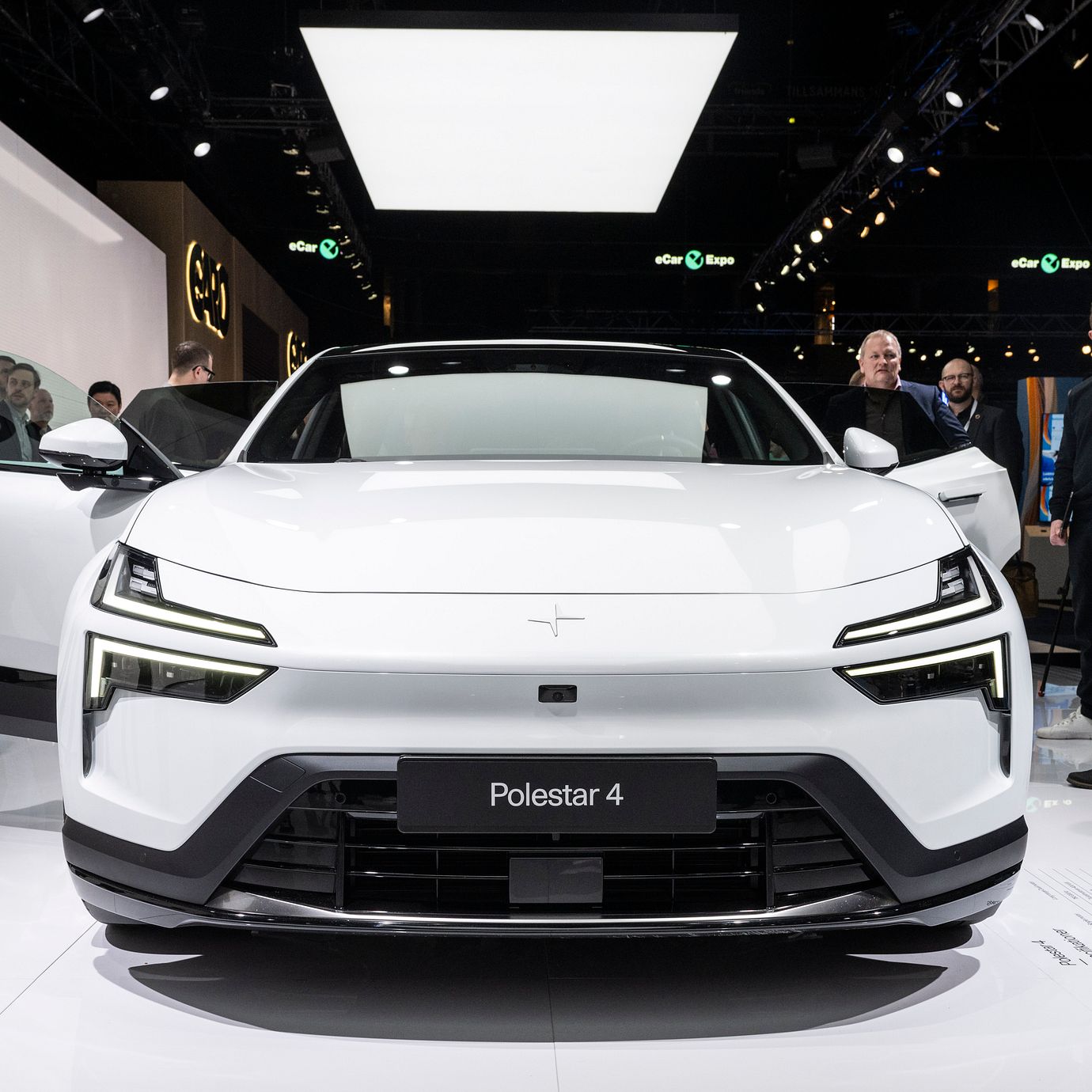
The Polestar 4 is called that because it is the fourth model from the Swedish-Chinese premium/luxury collab, born out of Volvo Cars’ performance subbrand. Describing it as an “SUV coupe” almost feels like a translation error. The design eschews signaling traditional utility in favor of a jocund modernism—call it orbital chic.
Our tester was dipped in a luminous aquamarine metallic paint ($1,300), paired with the Swedish Gold seat belts, brake calipers and tire stem caps. Exquisite. Among the worthwhile cosmetic upgrades: the body-matching lower moldings. What otherwise risks looking like a very fast piece of medical equipment now resembles a proper premium sedan.
The Polestar 4 starts at $56,400 for the rear-drive, single motor model, offering 272 hp and 310 miles of range. Polestar didn’t send that one. They sent what was effectively 4 squared. The Polestar 4 Dual Motor ($81,800, as tested) puts a liquid-cooled, permanent-magnet machine at each axle, summoning a combined 544 hp and a 506 lb-ft of torque, hefted into forward momentum by super-swole 22-inch forged aluminum wheels and looks-maxxing tires.
2026 Polestar 4 Dual Motor
Base price: $66,900
Price, as tested: $81,800
Powertrain: All-electric, with front and rear-axle mounted, liquid-cooled permanent-magnet motors; 100 kWh lithium-ion battery pack, with 400V charging system; permanent AWD
Horsepower/torque: 544 hp/506 lb-ft
Towing capacity: 3,500 pounds
Estimated EPA range: 255 miles
Length/wheelbase/width/height: 190.5/118.0/84.2/60.4 inches
Curb weight: 5,192 pounds
0-60 mph: 3.7 seconds
DC charging rate: up to 200 kW, 10-80% in 30 minutes
Cargo capacity: 18.6/54.2 cubic feet (behind 2nd/1st row)
While serene and well-mannered in daily driving, the 4 Dual Motor with the Performance Pack will be glad to slap you around. The holeshot acceleration is properly heady and roller-coaster-y, reaching 60 mph in 3.7 seconds. At highway speeds, the sedan’s sharp reflexes and deep reserves of squirt create significant moral temptation. If you are for some reason campaigning for a life-altering speeding ticket, this car will make it easy.
Alas, this avatar from the future arrives with the battery pack of yesteryear: a 100kWh unit with nickel-manganese-cobalt (NMC) cells and 400V charging. In the Performance variant, this pack metes out just 255 miles of range, officially. At the maximum charging rate of 200 kW, recharging from 10-80% times out at 30 minutes.
Geely Holding—the Chinese conglomerate that owns Volvo Cars and Polestar brands—already has next-generation LFP batteries and 800V charging in the field. The Polestar 4’s battery pack might as well have a sign that says, “Watch this space.”
As for missing the rear window, my advice is, don’t look back.