Köp Warner och Universal – trots AI-hot
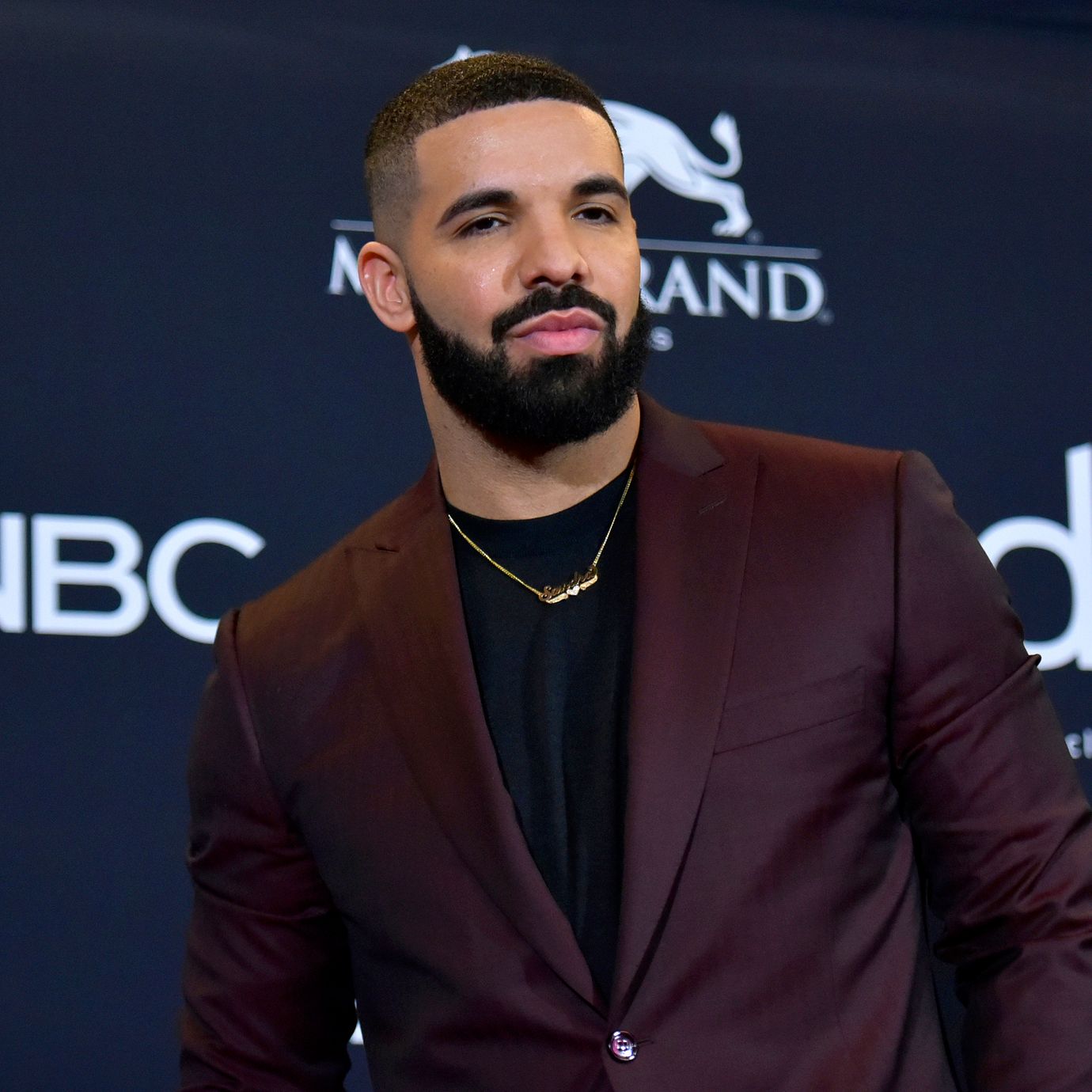
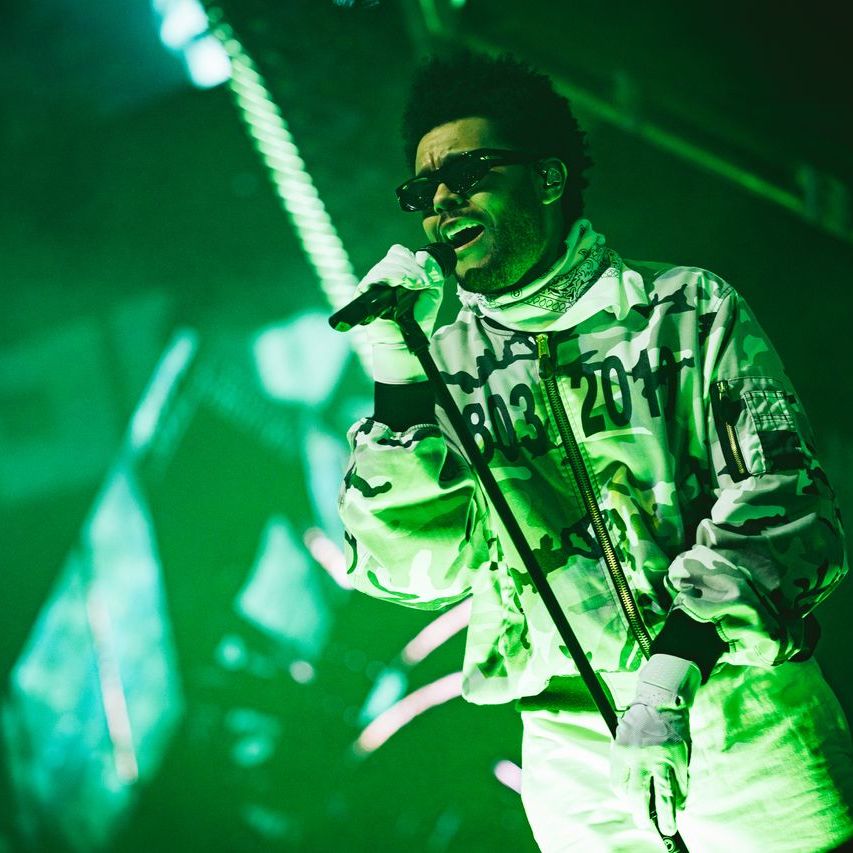
När låten ”Heart on My Sleeve” nådde lyssnarna lät det som ett samarbete mellan Drake och The Weeknd, men ingen av artisterna låg bakom låten. För det gjorde AI.
Den snabba AI-utvecklingen har tillsammans med dåliga annonstider satt press på bolag i musikbranschen. En rädsla för att AI ska flytta pengar bort från musikproducenter har spridit sig.
Men oron är överdriven och de investerare som lyssnar in nu kan gynnas om några månader, skriver Barron’s i en aktieanalys som köpstämplar Universal och Warner.
 Barron's
AI Crushed Music Label Stocks. Why ‘Fake Drake’ Won’t Kill Them.
In April, a catchy new duet was uploaded to music-streaming services by an anonymous user. Listeners who tuned in heard Drake’s voice pumping through their headphones, crooning, “I got my heart on my sleeve with a knife in my back. What’s with that?” Fellow megastar The Weeknd seemed to agree with Drake’s romantic struggles. His voice cried out, “I put her in the past.”
The two Canadian singers may have been telling the truth about love, but their supposed collaboration wasn’t technically real. Neither artist had contributed his voice to the song, called “Heart on My Sleeve.” It was built with artificial intelligence, the software that’s already remaking the tech and media world.
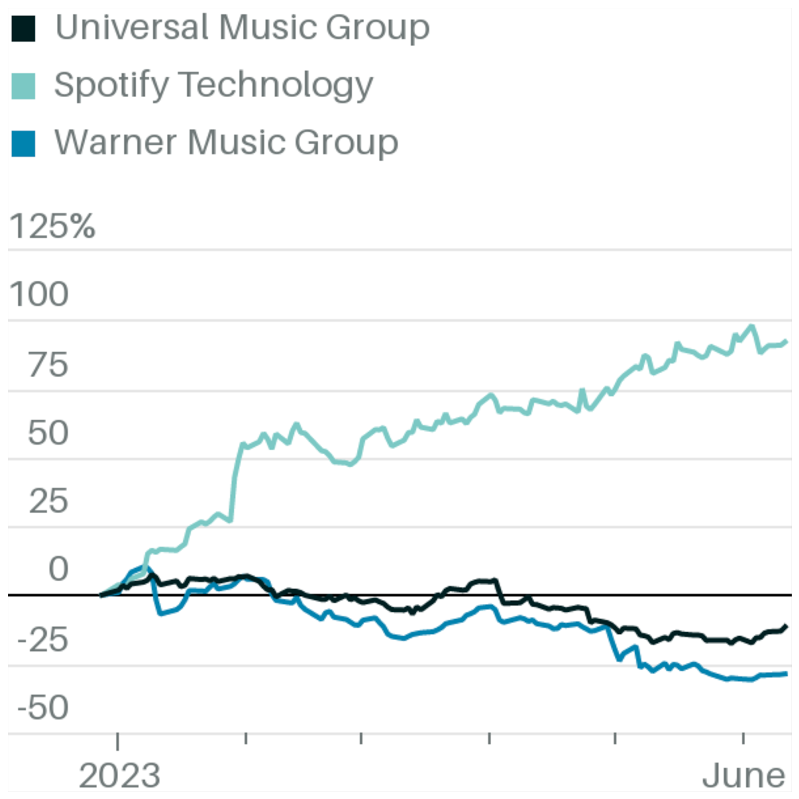
The rise of AI has the music industry on edge, and has contributed to a drop in the stocks of some key companies. Universal Music Group (ticker: UNVGY), which represents Drake and The Weeknd, is down 10% this year despite statistics showing that people are streaming much more music this year than last. Rival Warner Music Group (WMG) has fallen more than twice as much.
AI is dangerous to existing industry players, and appears to be weighing on their stocks, because it can divert money away from musicians and music labels and toward people using technology to mimic them. Its emergence comes at a tough time for some of the industry’s big players. A decline in advertising rates and concerns about a slowdown in the growth rate of streaming-music subscriptions have already been weighing on the shares of music labels.
Taken together, that sad playlist of problems has left the stocks trading near their lowest price/earnings ratios since going public. Investors who tune in now, however, could well benefit in the months ahead. Most important, there’s a real possibility that Spotify Technology (SPOT) will raise subscription prices for consumers, and the labels will negotiate better contracts with streaming services. That could reignite the labels’ growth. And over the longer term, the threat of AI to music may prove to be less than feared. The humans behind the robots still have an incentive to play by the old rules, supporting music’s current financial structure.
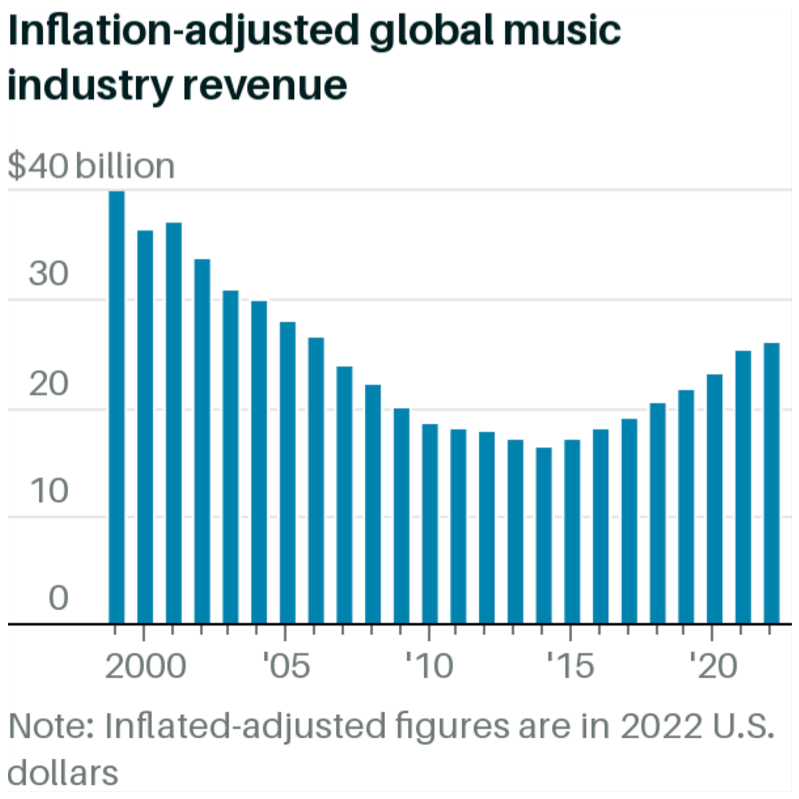
There’s a strong case that the industry can perform much better financially. Culturally, music shows no sign of slowing down. Total global music streams passed one trillion at the end of March, a month faster than last year. Taylor Swift is selling out 50,000-seat arenas every night, at a cost-per-seat that can run into the thousands of dollars. But in comparison with other kinds of media, music’s central role in society isn’t reflected in its financial metrics. Any hardworking drummer or bassist could have told you years ago that they were being shortchanged. Today’s mispricing goes beyond the artists. The recorded-music industry pulled in $26.2 billion last year, less than two-thirds its 1999 revenue in inflation-adjusted terms, even as music has become more accessible than ever.
The economics of music are likely to change soon. The price—and value—of recorded music are on the rise, and the stocks should gain, too.
“The stocks reflect a very low level of confidence that the streaming-music industry, in aggregate, has significant pricing power from here”
“The stocks reflect a very low level of confidence that the streaming-music industry, in aggregate, has significant pricing power from here,” says Michael Morris, an analyst at Guggenheim Securities who expects the labels to rebound.
Three labels dominate the industry, earning money from recorded music and publishing rights. Netherlands-based Universal is the biggest player, home to an array of artists, from Taylor Swift to Irving Berlin. Its shares trade at 23 times the company’s expected earnings over the next four quarters, a discount to its average valuation of 26 times. Sony Group (SONY), home to Miley Cyrus, is second, but gets less than 15% of its revenue from music, so it isn’t a pure-play on music. Warner, which represents chart-topping singer-songwriter Ed Sheeran, is the third largest. It trades at 25.5 times, versus its historical average of 37 since it went public in 2020.
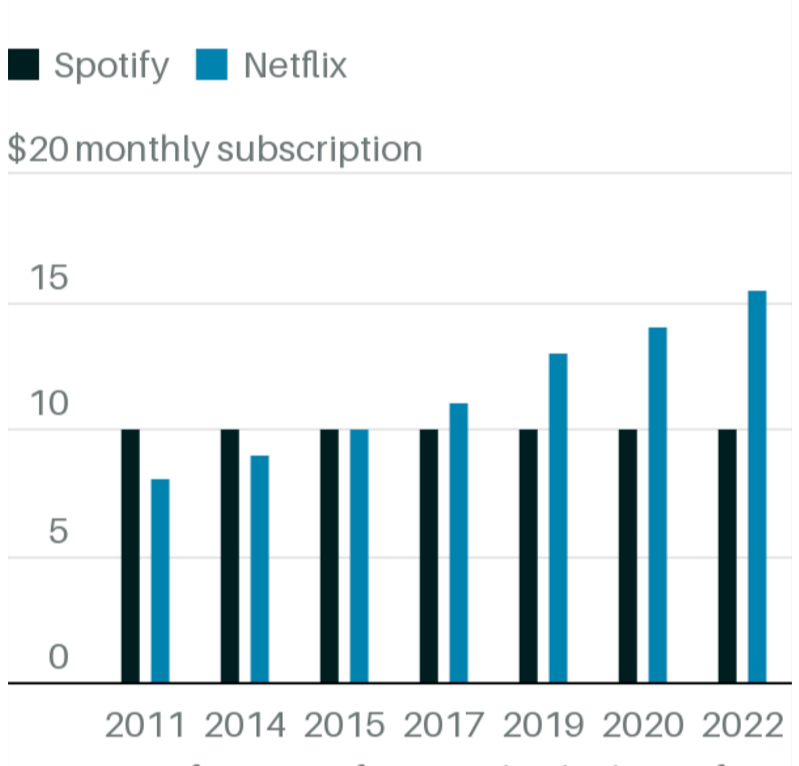
Morris thinks both Universal and Warner stocks can rise 20% in the next year. He expects Spotify to hike prices, joining other streaming services such as Apple (AAPL) that recently raised them. Although Spotify already raised prices in some markets, it has kept the price of its individual monthly subscription in the U.S. at $9.99 since 2011. Morris argues that the labels and streamers “can make beautiful music” together, because the labels also benefit when the size of the total financial pie grows. Roughly 70 cents of every streaming subscription dollar goes to labels and other rights holders, so an extra dollar or two spread across tens of millions of Spotify or Apple subscriptions every month leads to large margin benefits.
Just adjusting for inflation, the price of a music-streaming subscription should be $13.25 today, said new Warner Music Group CEO Robert Kyncl at a recent investor conference. And in comparison to video streaming, music services are 50% undervalued, Kyncl argued. Between 2011 and 2023—a period when Spotify has stuck to its $9.99 price—the most popular kind of Netflix subscription has gone from $7.99 to $15.49, Morris notes.
The labels don’t technically have a say in whether streaming services raise prices, but it’s clear that they’re discussing the issue in contract renegotiation talks. Asked about a price increase earlier this year, Spotify CEO Daniel Ek said, “We are constantly discussing with our rights-holder partners around various price increases that we would be doing.” The company didn’t respond to a request for comment on whether it expects to increase prices in the next year, but Ek appears positive about the idea, saying, “I feel really good about our ability to raise prices over time.”
Spotify itself would benefit from raising prices, though the stock already appears to include those benefits and then some. It has risen 90% this year as analysts have become more optimistic that the company can earn a profit following layoffs and other cost cuts. On average, analysts now expect Spotify to earn its first annual profit in 2024. But that milestone still looks tenuous—analysts’ estimates range from a loss of $2.64 to a gain of $3.19, averaging out to a gain of a penny per share. Meanwhile, Spotify’s push into podcasts now looks like an expensive bust, forcing the company to retrench. After its run-up this year, buying Spotify stock now is a risky proposition.
Beyond Spotify, the labels are likely to start receiving more money from other partnerships, too. TikTok, for instance, should soon start sending them a larger revenue stream as its deals with music labels are updated to take into account its increasing scale, analysts say. TikTok declined to comment on the rate discussions.
AI may one day be part of a positive case for music stocks. Labels have already used it to enhance songs and even to find promising artists they want to sign. It can theoretically even give new life to long-dead artists: Paul McCartney said this past week that he used AI and an old snippet of John Lennon’s voice to create a new Beatles album, set for release later this year. But for now, AI is viewed by Wall Street as a net negative because it introduces uncertainty into an industry that has enjoyed a prolonged period of competitive balance. The risk AI poses to music is similar to the general, unquantifiable risk of investing in a large tech company like Alphabet (GOOGL) when government regulators are scrutinizing its business: It’s a nagging worry, but leaves few visible dents in the larger positive case for the stocks.
AI is nothing new, of course. The music industry has been discussing and exploring it for at least five years. But the software’s capabilities have improved so much that it’s gaining more attention, and bringing novel legal questions to the fore. “Generative AI has just gotten so darn good in the past six months,” says Chris Mammen, a lawyer who chairs the U.S. intellectual property litigation group at law firm Womble Bond Dickinson. It’s no longer “metallic-sounding computer-generated tone poems. It sounds like stuff that humans can create.”
The rise of Fake Drake raises one of the most important legal questions: If a song is created by an algorithm that was trained on copyrighted music, is the resulting music also copyrighted? Drake himself called AI mimicry of his voice “the final straw,” in a vague Instagram post. His label, Universal, was much more direct, calling on streaming companies to remove songs trained on its artists’ music, which it said violated their copyrights. It also made a moral plea, asking “which side of history all stakeholders in the music ecosystem want to be on.” Whether or not morality is key to this debate, the legal questions are still very much open. Whether AI can be trained on the voices of artists will likely depend on court rulings expected to come down in the next year, Mammen says.
“AI has its benefits, but it’s got an awful lot of downsides. Music companies are recognizing this now”
If courts bless AI mimicry, it could eat into various revenue streams for music labels. For instance, stores now pay to license music they pump through speakers. Theoretically they could stream similar-sounding tracks for considerably less, says Simon Dyson, a music analyst at research firm Omdia. “AI has its benefits, but it’s got an awful lot of downsides,” he says. “Music companies are recognizing this now.”
Mammen sees other potential risks if courts allow AI software to train on copyrighted music. A tech firm making high-quality AI music could partner directly with a streaming service, bypassing the artists and labels. “Rather than paying royalties, the cost of content is whatever server time is necessary to generate the new music,” he says.
That scenario sounds similar to the AI doomsday scenarios facing other industries—computers with the power of sentient beings stealing the generative force of humanity. It isn’t out of the question, but there’s still no clear path for AI music to take on a life of its own. “I would still call this a very human phenomenon,” says Alex Mitchell, CEO of Boomy, which uses AI trained on the company’s music to help people create their own songs.
“Whoever creates AI-generated content will have to share some of the revenue with the IP owners”
Since humans are in the driver’s seat, they’re still operating on familiar incentives. Universal CEO Lucian Grainge said on the company’s latest earnings call that he expects the companies that stream his artists’ music to police improper content. Even if the streaming services had the option to pump out Fake Drake all day, their customers still would want access to the real thing, so the streamers are incentivized to keep the labels happy. Already, French streaming service Deezer (DEEZR.France) has announced that it’s developing software to spot AI-developed “deepfake” songs. Spotify has pledged to “strike a balance between allowing innovation, and of course, protecting artists.”
AI songs may well proliferate, but if they’re trained on copyrighted music, creators will likely have to pay up for access. “I think that’s how this is going to be fixed,” Jeronimo Folgueira, Deezer‘s CEO, says in an interview. “Whoever creates AI-generated content will have to share some of the revenue with the IP owners.”
The labels are also discussing another way to ensure that they’re properly compensated for their ownership rights, which could apply to AI, too. Streaming contracts now put all streams in one large pile and pay out royalties based on each artist’s share of the total pile. That means that a recording of rain falling that people stream 100 times in a row to help them sleep gets 100 times as much credit as a musician’s song played once on a road trip. A rise in the sheer number of song uploads—to a recent 120,000 a day, according to entertainment data provider Luminate—has eaten into the market share of the major labels. The labels want their artists to get premium credit in the revenue split, similar to the way a cable operator gives more money from the cable bundle to ESPN than to a low-ranking channel. Grainge considers most AI to be part of the “junk” content that takes money away from the high-quality stuff Universal owns. “Any way you look at it, it’s oversupply, whether or not AI-created. [That’s] simply bad—bad for artists, bad for fans, and bad for the platforms themselves,” he says.
Fake Drake may get the publicity today. The real guy is still going to be making money tomorrow.