Linqto lovade andelar i Space X – nu kämpar investerare för att rädda sina pengar
Tusentals privatinvesterare har fått sina investeringar frysta efter att den amerikanska plattformen Linqto gått i konkurs, skriver Bloomberg. Företaget lockade med löften om andelar i heta onoterade bolag som Space X och Anthropic, men tog genvägar genom tveksamma upplägg.
Harvardforskaren Ben Bates menar att riskerna i fonder för onoterat ofta underskattas och att upplägget ändå lär fortsätta.
– Det är full fest just nu eftersom det inte har varit så många stora smällar, säger han.
 Bloomberg
Private Market Blowups Highlight Perils for Retail Investors
Massage therapist James Lakin didn’t even know it was possible for outsiders to buy stakes in private companies until a client told him that he could be approved to do so on a platform called Linqto. Now, he’s one of thousands of retail investors with frozen savings after the firm filed bankruptcy.
With trillions of dollars potentially flowing into private markets as restrictions on mom-and-pop investors are relaxed, Linqto finds itself at the center of a debate over the safeguards for amateurs putting money in hard-to-value assets that can be difficult to sell when things go wrong.
One risk is that the fund or the manager themselves gets into trouble when retail investors run for the exits. The private equity-focused Wildermuth Fund closed in 2023 following liquidity issues and was still unable to provide financial statements to its investors at the end of May. A Bluerock fund, meanwhile, ran into trouble when property value declines led investors to start demanding their money back.
“Like it or not, retail investors are going to continue dabbling in private markets”
Even when things go well, private market funds open to retail investors “understate their risks” and underperform compared with those sold only to the wealthy, Harvard Law School research fellow Ben Bates found in a recent paper. Despite the dangers, there is too much government and market momentum behind the push to get amateur money into private markets to stop it, he said in an interview.
“The party is really rocking right now because there haven’t been a lot of big blowups,” he said. “Like it or not, retail investors are going to continue dabbling in private markets.”
Regulatory Problems
Linqto’s downfall was triggered by regulatory problems, which led new managers to shutter the online platform because it was at risk of insolvency, court filings show. The decision came just weeks before President Donald Trump reversed a policy that had made it difficult for retirement savers to put money in private markets.
Historically, most retail investors were prevented from investing in private markets because they are required to have wealth of more than $1 million or annual income of at least $200,000 to be accredited to do so.
Those directions are also being weakened. The US Securities and Exchange Commission recently revoked guidance that warned closed-end funds not to sell to non-accredited investors if more than 15% of the assets were in private funds.

That could lead to trouble for managers since individual investors could rush for the exits, said Morningstar Inc. analyst Jack Shannon. By contrast, institutional investors are more likely to lock their money up for longer periods of time and less likely to be spooked by market gyrations.
Despite hurdles around selling to retail investors, Linqto told customers that they could buy stakes in some of the hottest private companies before the firms went public. That turned out to be wrong, the company admitted in a July court hearing, blaming previous management.
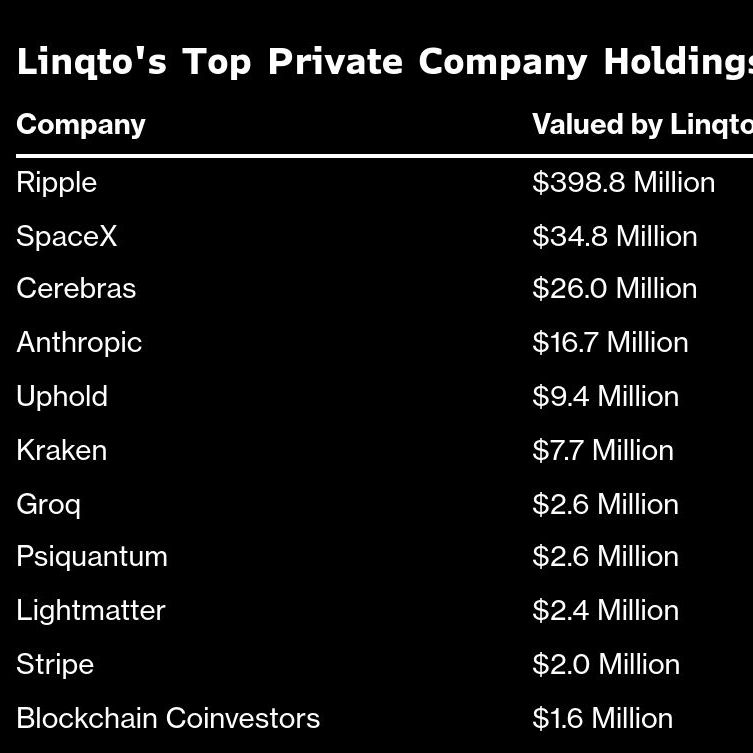
The firm had tried to get around the limits by setting up special purpose vehicles to buy shares in the companies and then selling units in the SPV to its customers. Among the positions claimed by Linqto in court papers are stakes in everything from Elon Musk’s SpaceX to AI researcher Anthropic PBC and cryptocurrency platform Ripple.
Amateur Investors
As many as half of Linqto’s 13,600 customers were amateurs, said Dan Siciliano, Linqto’s current chief executive officer. The former Stanford University law professor was brought in after federal investigators began probing the company.
Lawyers for Linqto claim non-professional investors like Lakin, who has joined a class action lawsuit against the company’s former CEO, should never have been allowed to put their money onto the platform.
Even though he had never bought stocks before, Lakin jumped in when the firm lowered the minimum investment to $2,500 from $5,000. When he went to sign up, the company asked some basic financial questions, including how much money he made.
“I answered honestly. I never claimed to be accredited,” he said.
Weakened Companies
Another big fear is that retail money will be at risk of losses from being sold stakes in companies that are typically more leveraged than their public counterparts and have to disclose far less about their financial health.
Already, PE and venture capital-owned firms are turning to bankruptcy, with the number of filings in the first half of this year on track to match or exceed the highest annual number in at least 15 years, according to S&P Global Market Intelligence. And the percentage of corporate bankruptcies filed by private firms has been going up. It’s already at 14% of the total so far in 2025, compared with 4% in 2010, the data show.
The counter argument tends to be that private assets provide market-beating returns with less volatility. Still, even experienced insiders are expressing concern about the outlook for at least parts of the industry. Thoma Bravo founder Orlando Bravo said in June that private equity had lost its way, while the head of the Kuwait Investment Authority described PE as “very troubled.”
Higher borrowing costs are one reason for the current morass, with many private equity and commercial real estate managers caught out by the sudden jump in interest rates after the pandemic. That prompted a surge in the number of investors asking for their money back from some products such as Bluerock’s Total Income+ Real Estate Fund.
Bluerock, meanwhile, wants to turn its troubled fund into a publicly traded vehicle after the liquidity mismatch emerged. If it does win enough support to list the fund, then holders will likely have to sell their stakes at a discount because so many people want to cash out and closed-end funds typically trade below net asset value, according to Shannon at Morningstar.
“It’s certainly not a good ending for investors,” he said.
The fund’s structure wasn’t built to withstand the sustained redemption requests being seen today, Bluerock CEO Ramin Kamfar said.
“We aren’t the first interval fund to consider listing in the face of extended redemption requests and we will not be the last,” he said in a statement. “We are confident that we will ultimately trade at NAV over time.”
Back at Linqto, customers have a good chance of being made whole, Siciliano said, but they may wind up with stakes in a new publicly-traded fund rather than shares in any of the private companies they thought they were buying.
Lakin said he would still probably look at buying into private companies despite his Linqto experience.
“You should never invest more than what you are willing to lose,” he said. “I do think it is kind of a bad thing they don’t allow for private equity to be bought and sold by unaccredited investors” since it is keeping poor people poorer, he said.
With assistance from Rheaa Rao.
More stories like this are available on bloomberg.com
©2025 Bloomberg L.P.