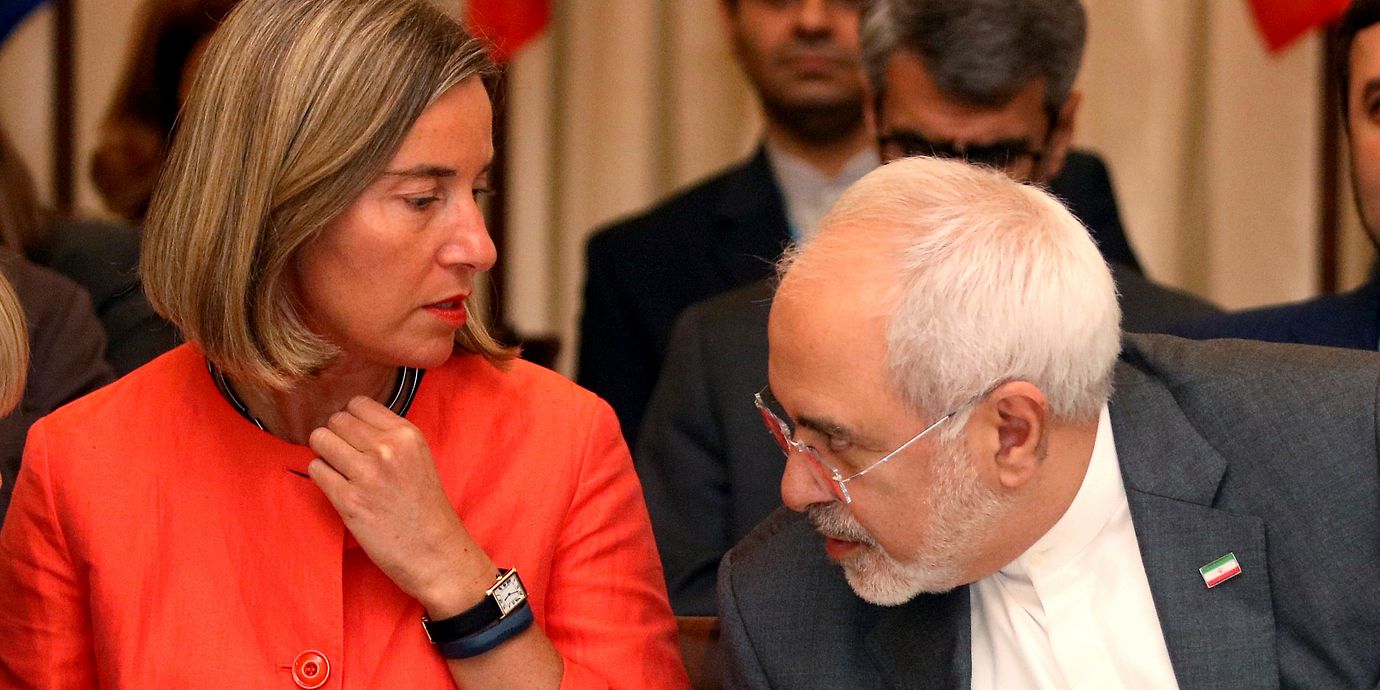
Mogherini: Har snart verktyg att kringgå Iransanktioner
EU har innan årets slut verktyg på plats för att kringgå de amerikanska sanktionerna mot Iran, uppger EU:s utrikeschef Federica Mogherini för Bloomberg.
– Det innebär att vi på ett legitimt sätt kan göra affärer med Iran, säger Mogherini.
Med ett nytt betalsystem som inte är beroende av amerikanska banker ska EU-länder fortsätta att verka med Iran i linje med det så kallade Iranavtalet, som skrevs under av EU och den förra amerikanska administrationen under 2015.
bakgrund
Iranavtalet
Wikipedia (en)
The Joint Comprehensive Plan of Action (JCPOA; Persian: برنامه جامع اقدام مشترک, translit. barnāmeye jāme'e eqdāme moshtarak, acronym: برجام BARJAM), known commonly as the Iran nuclear deal or Iran deal, is an agreement on the nuclear program of Iran reached in Vienna on 14 July 2015 between Iran, the P5+1 (the five permanent members of the United Nations Security Council—China, France, Russia, United Kingdom, United States—plus Germany), and the European Union.
Formal negotiations toward the Joint Comprehensive Plan of Action on Iran's nuclear program began with the adoption of the Joint Plan of Action, an interim agreement signed between Iran and the P5+1 countries in November 2013. For the next twenty months, Iran and the P5+1 countries engaged in negotiations, and in April 2015 agreed on an Iran nuclear deal framework for the final agreement. In July 2015, Iran and the P5+1 confirmed agreement on the plan along with the "Roadmap Agreement" made between Iran and the IAEA.Under the agreement, Iran agreed to eliminate its stockpile of medium-enriched uranium, cut its stockpile of low-enriched uranium by 98%, and reduce by about two-thirds the number of its gas centrifuges for 13 years. For the next 15 years, Iran will only enrich uranium up to 3.67%. Iran also agreed not to build any new heavy-water facilities for the same period of time. Uranium-enrichment activities will be limited to a single facility using first-generation centrifuges for 10 years. Other facilities will be converted to avoid proliferation risks. To monitor and verify Iran's compliance with the agreement, the International Atomic Energy Agency (IAEA) will have regular access to all Iranian nuclear facilities. The agreement provides that in return for verifiably abiding by its commitments, Iran will receive relief from U.S., European Union, and United Nations Security Council nuclear-related economic sanctions.
On 13 October 2017, U.S. President Donald Trump announced that the United States would not make the certification provided for under U.S. domestic law, but stopped short of terminating the deal. On 30 April 2018, the United States and Israel stated that Iran did not disclose a past covert nuclear weapons program to the IAEA, which was required in the 2015 deal.IAEA inspectors spend 3,000 calendar days per year in Iran, installing tamper-proof seals and collecting surveillance camera photos, measurement data and documents for further analysis. IAEA Director Yukiya Amano stated (in March 2018) that the organization has verified that Iran is implementing its nuclear-related commitments.On 8 May 2018, President Trump announced that the United States would withdraw from the agreement. Following the U.S.'s withdrawal, the EU enacted an updated blocking statute on 7 August 2018 to nullify US sanctions on countries trading with Iran.
Omni är politiskt obundna och oberoende. Vi strävar efter att ge fler perspektiv på nyheterna. Har du frågor eller synpunkter kring vår rapportering? Kontakta redaktionen