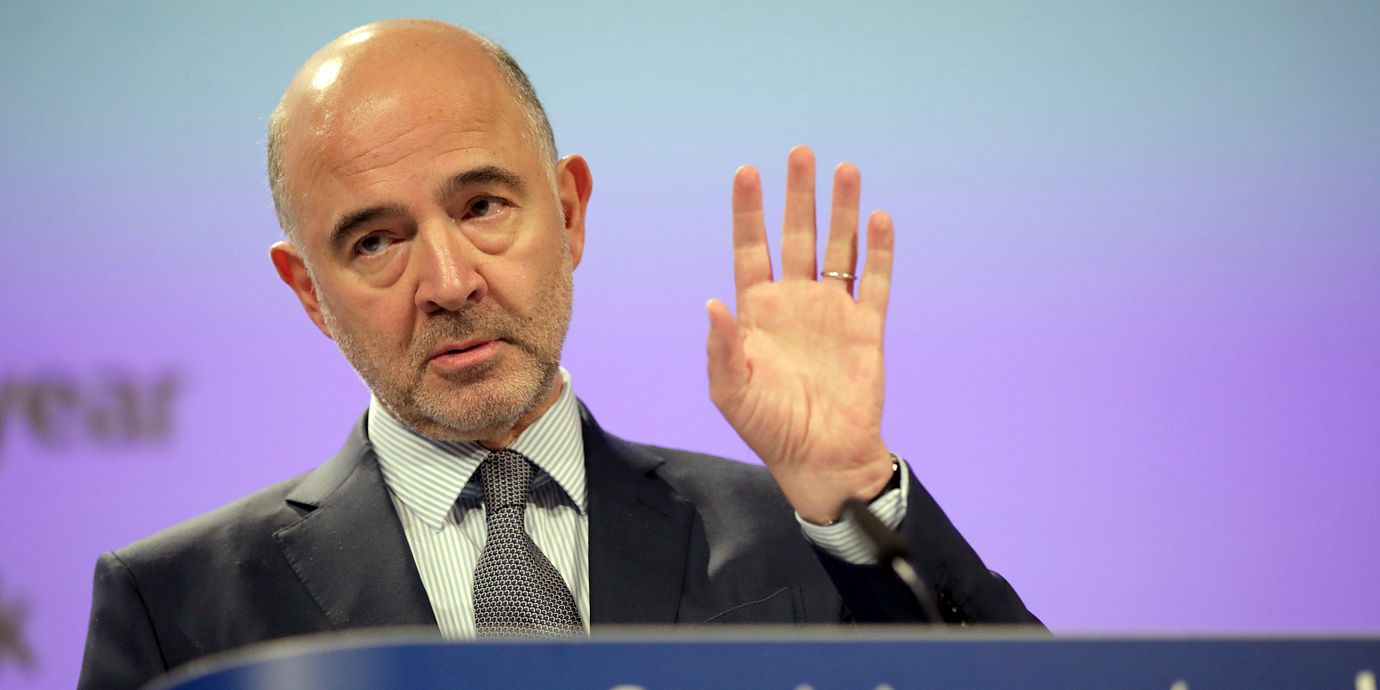
Moscovici: Samma regler för Frankrike som Italien
Frankrike omfattas av samma regler som Italien när det kommer till respektive länders budgetar, säger Pierre Moscovici, EU:s kommissionär för finansiella och ekonomiska frågor, till AFP.
– Reglerna är samma för alla, säger han.
Frankrike går mot ett budgetunderskott om 3,5 procent av BNP efter att president Emmanuel Macron gått med på åtgärder för att blidka de så kallade gula västarna. Rom, som riskerar EU-böter för sitt budgetunderskott, har krävt att Frankrike behandlas på samma sätt.
Läs mer
bakgrund
EU:s budgetpakt
Wikipedia (en)
The Treaty on Stability, Coordination and Governance in the Economic and Monetary Union; also referred to as TSCG or more plainly the Fiscal Stability Treaty is an intergovernmental treaty introduced as a new stricter version of the Stability and Growth Pact, signed on 2 March 2012 by all member states of the European Union (EU), except the Czech Republic and the United Kingdom. The treaty entered into force on 1 January 2013 for the 16 states which completed ratification prior of this date. As of 7 March 2018, it had been ratified and entered into force for all 25 signatories plus Croatia, which acceded to the EU in July 2013.
The Fiscal Compact is the fiscal chapter of the Treaty (Title III). It binds 22 Member States: the 19 Member States of the Eurozone plus Bulgaria, Denmark and Romania who have chosen to opt-in. It is accompanied by a set of common principles.
Member states bound by the Fiscal Compact have to transpose into national legal order the provisions of the Fiscal Compact. In particular, national budget has to be in balance or surplus under the treaty's definition. An automatic correction mechanism has to be established to correct potential significant deviations. A national independent monitoring institution should be mandated to provide fiscal surveillance. The treaty defines a balanced budget as a general budget deficit not exceeding 3.0% of the gross domestic product (GDP), and a structural deficit not exceeding a country-specific Medium-Term budgetary Objective (MTO) which at most can be set to 0.5% of GDP for states with a debt‑to‑GDP ratio exceeding 60% – or at most 1.0% of GDP for states with debt levels within the 60%-limit. The country-specific MTOs are recalculated every third year and might be set at stricter levels compared to what the treaty allows at most. The treaty also contains a direct copy of the "debt brake" criteria outlined in the Stability and Growth Pact, which defines the rate at which debt levels above the limit of 60% of GDP shall decrease.If the budget or estimated fiscal account for any ratifying state is found to be noncompliant with the deficit or debt criteria, the state is obliged to rectify the issue. If a state is in breach at the time of the treaty's entry into force, the correction will be deemed to be sufficient if it delivers sufficiently large annual improvements to remain on a country specific predefined "adjustment path" towards the limits at a midterm horizon. Should a state suffer a significant recession, it will be exempted from the requirement to deliver a fiscal correction for as long as it lasts.Despite being an International treaty outside the EU legal framework, all treaty provisions function as an extension to existing EU regulations, utilising the same reporting instruments and organisational structures already created within EU in the three areas: Budget discipline enforced by Stability and Growth Pact (extended by Title III), Coordination of economic policies (extended by Title IV), and Governance within the EMU (extended by Title V). The treaty states that the signatories shall attempt to incorporate the Fiscal Compact into the EU's legal framework, on the basis of an assessment of the experience with its implementation, by 1 January 2018 at the latest.
Omni är politiskt obundna och oberoende. Vi strävar efter att ge fler perspektiv på nyheterna. Har du frågor eller synpunkter kring vår rapportering? Kontakta redaktionen