Paradoxen: Tillväxtlyft i USA – men jobben blir inte fler

Arbetsmarknaden står och stampar trots allt bättre ekonomiska tider i USA. Ökad produktivitet bland anställda och AI-effektiviseringar kan förklara den ovanliga och tudelade bilden av ekonomin, skriver WSJ.
Prognoserna tyder på att jobbtillväxten uteblir under resten av året, bland annat till följd av minskad invandring och pensionsavgångar.
Tillväxt utan jobbskapande står i kontrast till hur välstånd historiskt har skapats i landet, konstaterar Federal Reserve i en rapport.
 The Wall Street Journal
The Economy Is Growing, Jobs Aren’t. Why That Might Be OK.
An unusual divergence between GDP and new jobs shows worker productivity is making up for a slowdown in immigration and the labor force. AI could help.
For the past year, two prominent indicators have told opposite stories of the economy’s health: The economy itself grew in 2025, but despite a solid March, jobs didn’t.
This puzzle could have an encouraging explanation: Productivity, which means workers are producing goods and services more efficiently, has revived at just the right time.
There are two main ways to grow the economy. The first is to add workers. This, though, has become harder since President Trump ’s policies brought most immigration to a halt, while an aging workforce and a decadeslong drop in birth rates have sapped growth in the native-born labor force. That leaves the second channel: Make the workers you have more productive.
”Zero job growth just doesn’t map into any kind of stability in terms of employment and whatnot”
“With labor-force growth slowing to a crawl, productivity is no longer just one of the engines of growth—it’s close to the only engine left,” said Erik Brynjolfsson, director of the Stanford Digital Economy Lab.
And luckily, that engine is firing. According to the Labor Department, output per hour in the nonfarm business sector rose 2.1% last year. Growth has also averaged 2.1% over the past six years, a pickup from the 1.5% a year average from 2007 to 2019, and stronger than other Western economies. Economists say it is too early to determine the role of artificial intelligence, but expect it is helping.
This comes amid a falloff, unprecedented in recent history, in labor-force and job growth. In the year through March, immigration crackdowns and continuing, large-scale retirements among the baby-boomer generation mean the labor force—people working or looking for a job— declined by 554,000.
Outside of the Covid-19 pandemic, the last drop of that magnitude occurred in late 2013, as baby boomers retired in large numbers. The longer-term outlook remains bleak, with the U.S. fertility rate at a record low.
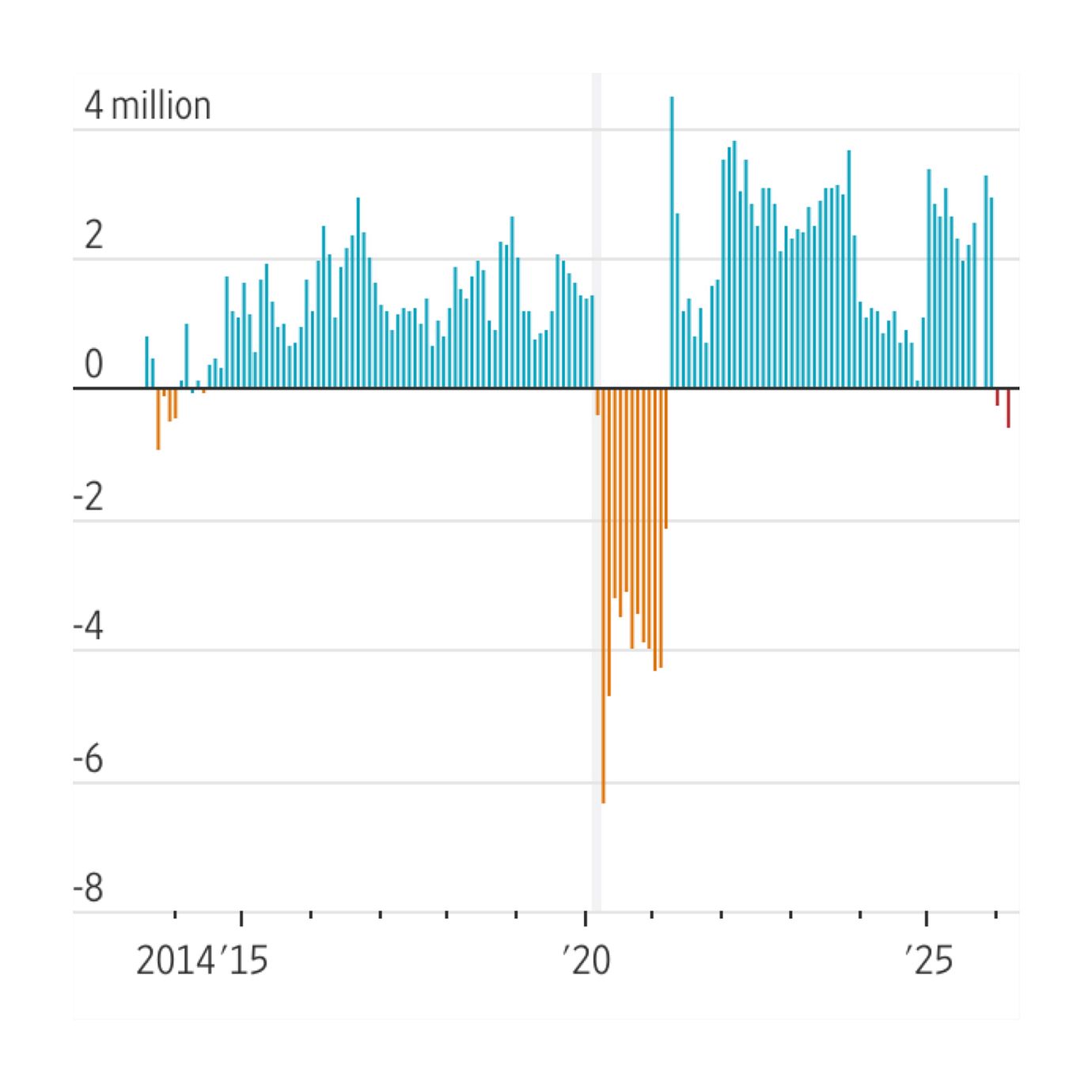
With fewer new entrants to the labor force, the number of new jobs needed to keep the unemployment rate stable, called the breakeven rate, has also fallen, which helps explain why the jobless rate hasn’t risen much over the past year even as job creation flatlined at just under 22,000 a month on average, the lowest outside a recession since the year through March 2003.
The monthly breakeven rate was much higher in the 1970s at 185,000 jobs, as women and baby boomers poured into the labor force. It dropped to just 50,000 in late 2020 during the pandemic. This year, slower immigration means “the breakeven pace could fall to nearly zero, requiring less than 10,000 new jobs per month in 2026,” according to a recent paper from the Federal Reserve. It estimated there might not be any growth in the labor force at all this year because of slower immigration and worker retirements.
“Any growth in potential GDP this year would then need to come from productivity growth,” the paper said. “This would represent a significant departure in the composition of economic growth from recent history.”
These are uncharted waters.
“Zero job growth just doesn’t map into any kind of stability in terms of employment and whatnot,” Federal Reserve governor Christopher Waller said at an economics conference in late February. “This would be the first time in my career, my life, that I saw an economy growing like this and zero job growth. I don’t even know quite how to think about this because I’ve never seen it before.”
Ordinarily, a stagnant labor force would be devastating for economic growth. Japan, for example, has grown just 0.7% a year since 2000, in great part because of a shrinking population and flat labor force.
The U.S. could risk the same fate absent faster productivity growth. Worker productivity is regarded by economists as one of the most important drivers of long-term standards of living. It is essentially economic output per hour worked, reflecting the contribution of technology and capital. At 1% annual productivity growth, standards of living double every 70 years. At 2%, it takes just 35 years.
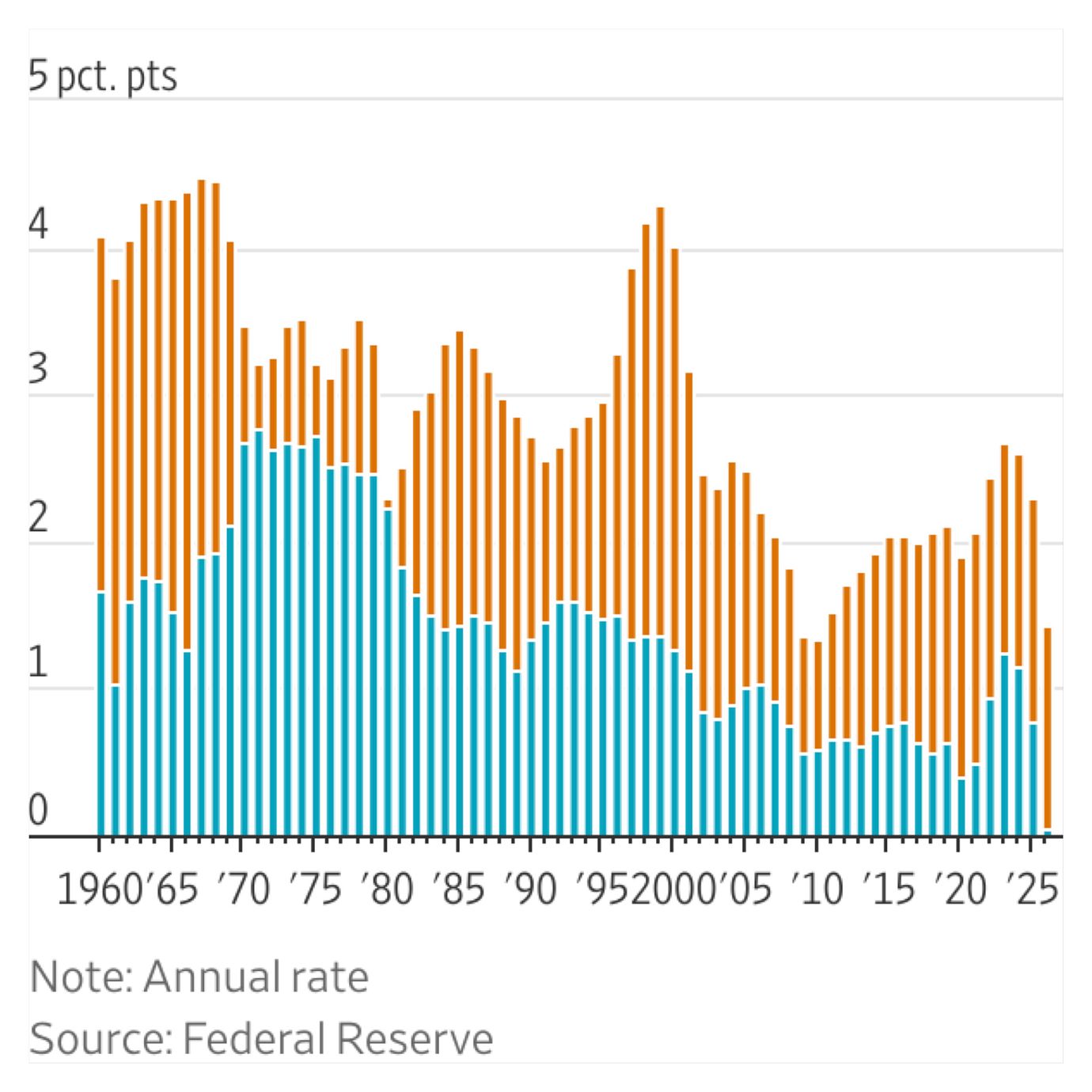
Productivity growth is volatile and often driven by short-lived cyclical factors. The recent acceleration, though, might be durable. Economists say the Covid lockdowns and worker shortages that followed forced many companies to speed up automation. A hot labor market and shift to remote-work policies allowed greater numbers of workers to move into jobs they performed more productively. The number of workers quitting jobs each month has fallen to a six-year low, and the longer workers stay in jobs, the more productive they tend to become.
“Coming out of Covid, the labor force saw a spate of dynamism that it hadn’t seen in a long time,” said Chad Syverson, professor of economics at the University of Chicago Booth School of Business. “People shuffled themselves into jobs that were better for them,” he said.
Then, of course, there is artificial intelligence. It has been around for decades but was turbocharged by the 2022 release of ChatGPT, OpenAI ’s chatbot.
Economists caution that it is still too early to determine AI’s impact on productivity. “If you squint, you could tell yourself that story in the data,” said Syverson.
Job Creation Lags Behind
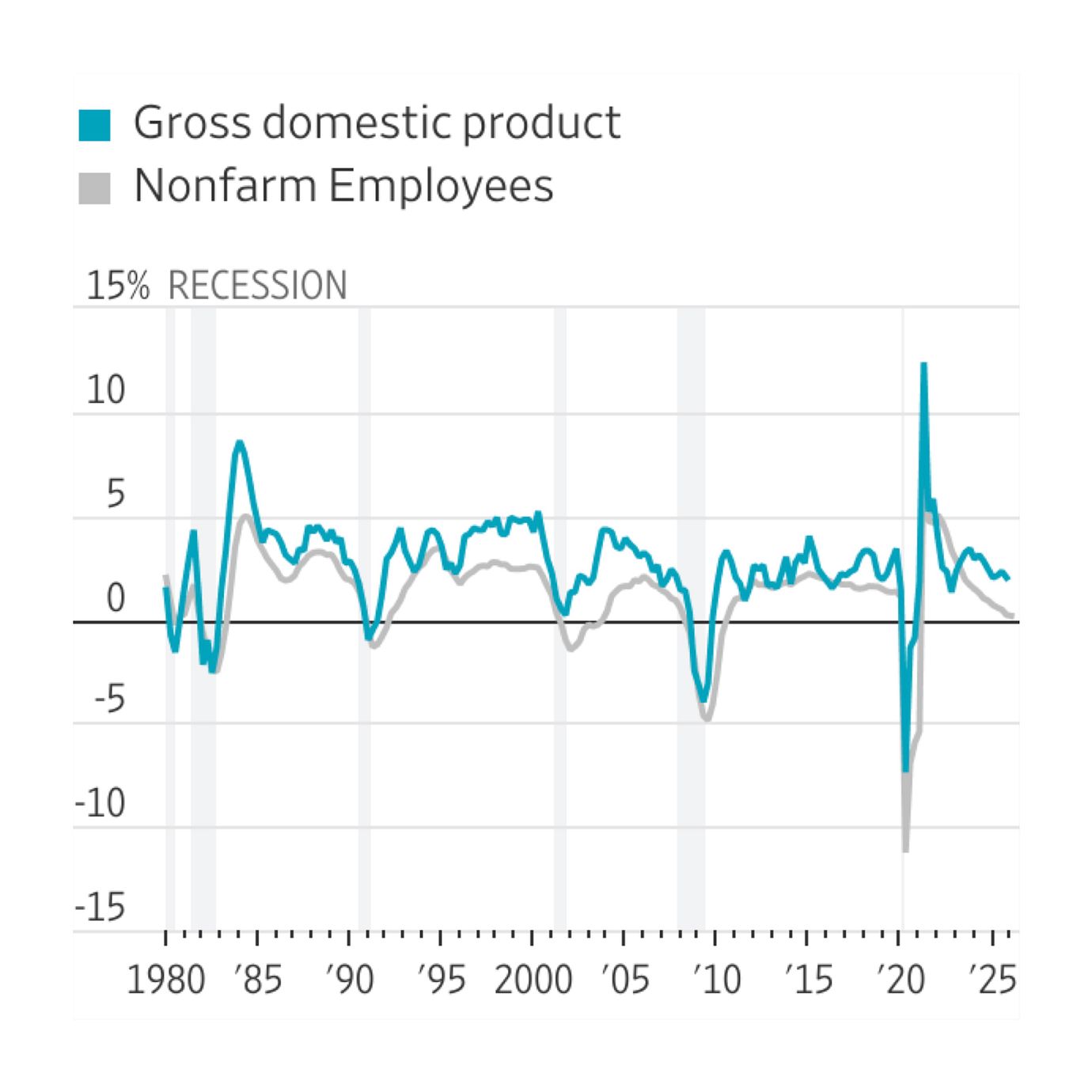
Nonetheless, some forecasters are building higher productivity into long-term growth expectations. In March, Federal Reserve officials raised their long-term growth-rate estimate to 2% from 1.8%. Kevin Warsh, nominated by Trump to be the next Fed chair, has argued that faster productivity growth thanks to AI will hold down cost pressures, enabling the Fed to lower interest rates.
Stanford’s Brynjolfsson expects the gains from AI will be meaningful, but not necessarily simple or immediate. “The biggest gains from a powerful general-purpose technology usually arrive only after firms invest in the complements: reorganizing workflows, retraining workers, redesigning processes and building the intangible capital needed to use the technology effectively,” he said.
A growing body of evidence does point to productivity gains thanks to AI. Another plus, analysts say, is that the tools are much easier to use than transformative, productivity-enhancing technologies in the past.
Personal computers, which economists credit for a productivity boom starting in the mid-1990s, were initially clunky and took years to become more user-friendly, said Martin Neil Baily, an economist at the Brookings Institution.
“Now with Gen AI, it’s conversational, so anybody can use it,” he said, “but that will be a process—maybe a little quicker than some of the other technological changes—but it certainly won’t be an overnight change.”