Svensk AI-raket i täten när Europas techsektor vaknar
Efter många år i skuggan av Silicon Valley börjar Europas techscen ta ny fart, skriver The Economist. Riskkapitalets investeringar i sektorn har växt till 85 miljarder dollar, och allt fler startuper väljer att bygga vidare hemma i Europa i stället för att sälja tidigt.
USA ger dessutom oväntad medvind. Donald Trumps politik och nedskärningar i amerikansk tech bidrar till att både talanger och kapital i större utsträckning söker sig till Europa.
– Tankesättet håller på att förändras, säger Anton Osika, medgrundare av svenska AI-bolaget Lovable.
 The Economist
At last, reasons to be cheerful about European tech
One of which is Donald Trump.
At Lovable’s headquarters in Stockholm the decor suits the startup’s cosy name. The firm, which specialises in “vibe-coding”—prompting an artificial-intelligence system to make software—has a shoes-off policy. The smell of Swedish coffee fills the office. Heart-shaped cushions bearing Lovable’s logo rest atop sumptuous sofas.
Yet the firm is less soft and cuddly than nimble and competitive. And though still small, it is growing fast: in November its annualised recurring revenue hit $200m, up from $1m a year earlier. Anton Osika, Lovable’s co-founder, argues that building a world-beating AI company in Europe is now possible. “The mindset change is happening,” he says.
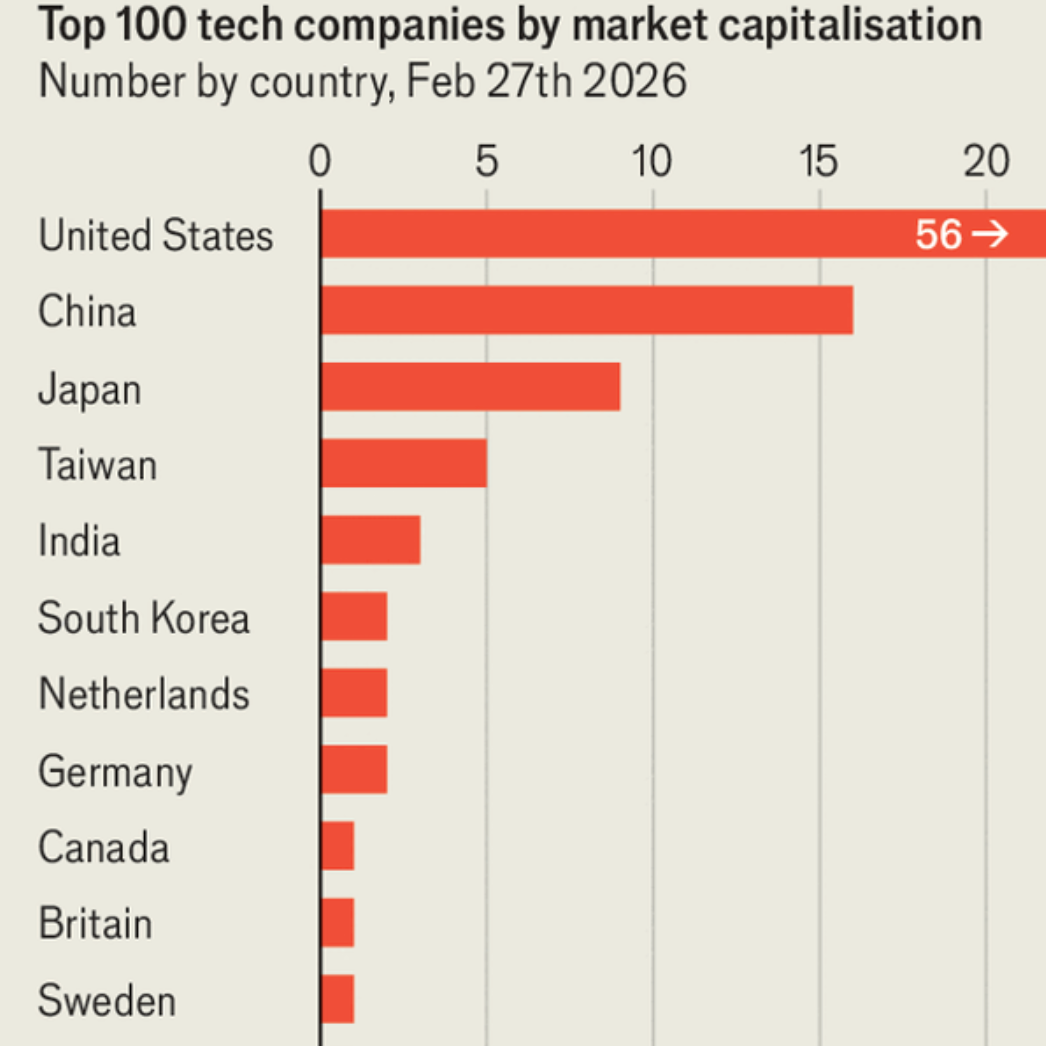
When it comes to creating tech giants, Europe has long been a laggard. Today Europe (meaning the European Union, Britain and Norway) is home to just six of the world’s 100 most valuable tech companies. America has 56 and China 16 (see chart 1). The continent’s drawbacks are well known. Its 520m-strong consumer market is divided by language and regulation. Europe has plenty of talent, thanks to its world-class research labs and universities. But its entrepreneurs have had trouble raising capital to expand their companies quickly.
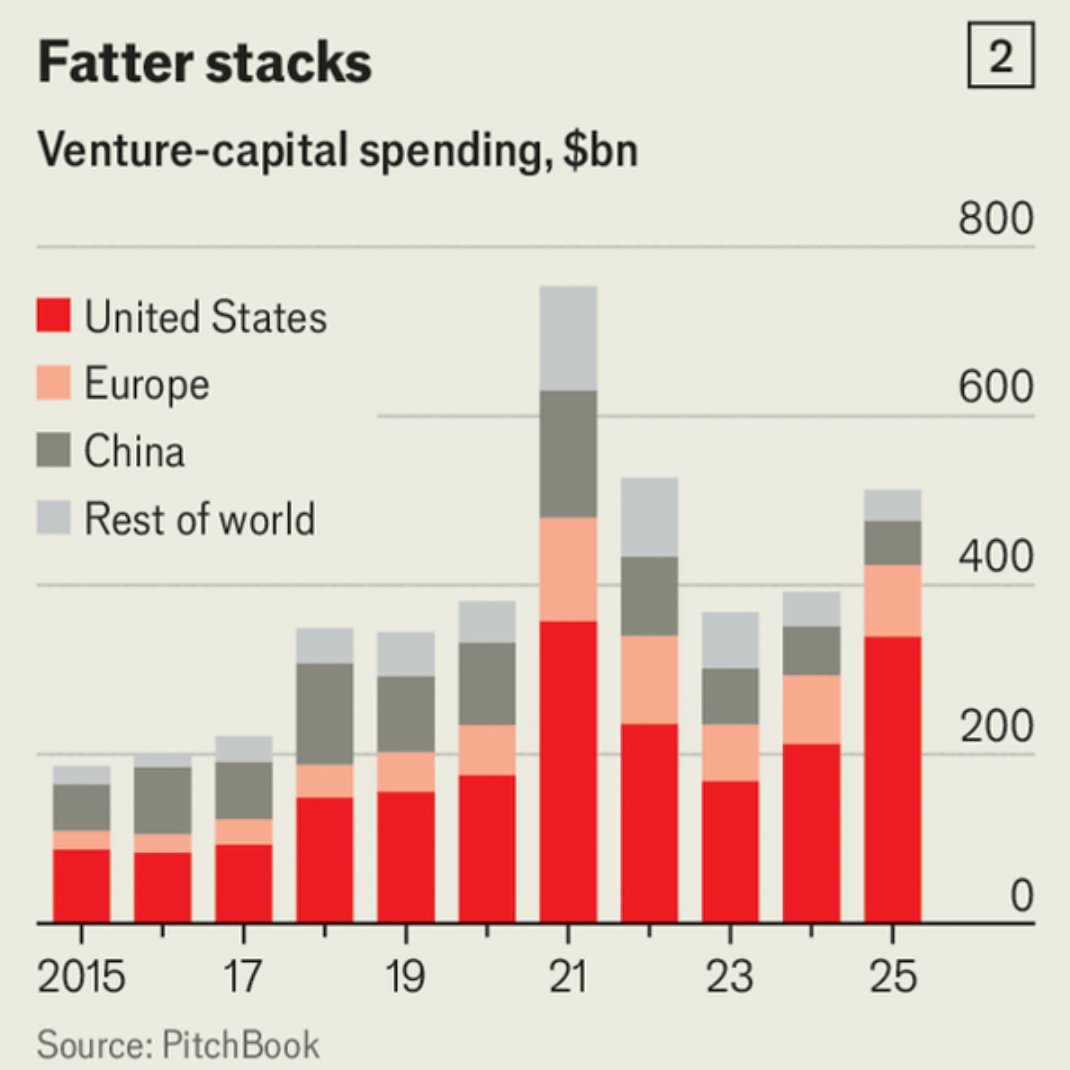
Yet there is new hope for the old continent. Jolted by the deterioration of Europe’s relationship with America, policymakers are redoubling efforts to strengthen its technology ecosystem. At the same time, America and China have made decisions that make Europe relatively more attractive to tech workers and investors. The continent’s established tech companies, though few in number, are now nurturing a new generation of startups. Last year venture-capital (VC) investments in European startups rose to $85bn, from $22bn a decade earlier (see chart 2). Although AI-mad America is still far ahead, with $339bn invested last year, China now lags behind, with $53bn.
In an attention-grabbing report in 2024 Mario Draghi, a former Italian prime minister, bashed Europe for its sagging competitiveness. But it is Donald Trump, with his animus towards the region, who has really galvanised policymakers. They now see Europe’s techno-failings as a geopolitical risk as well as a commercial one.
Henna Virkkunen, the European Commission’s tech czar, says the commission is looking into ways to encourage EU governments to buy more technology from home-grown startups, for instance. European enterprises are also “realising that they can’t afford to entirely depend on foreign providers”, says Arthur Mensch, the boss of Mistral, a French maker of AI models.
Perhaps more importantly, policymakers are taking steps to help entrepreneurs expand their businesses. In March the commission will publish a plan to unify Europe’s segmented capital markets, which will help startups raise money. That will not happen quickly, as it will require difficult decisions about how to harmonise national tax regimes. It helps that member states are also upgrading their capital markets. Britain, France and Germany are tweaking rules to encourage pension funds to invest more in risky assets, such as young tech firms.
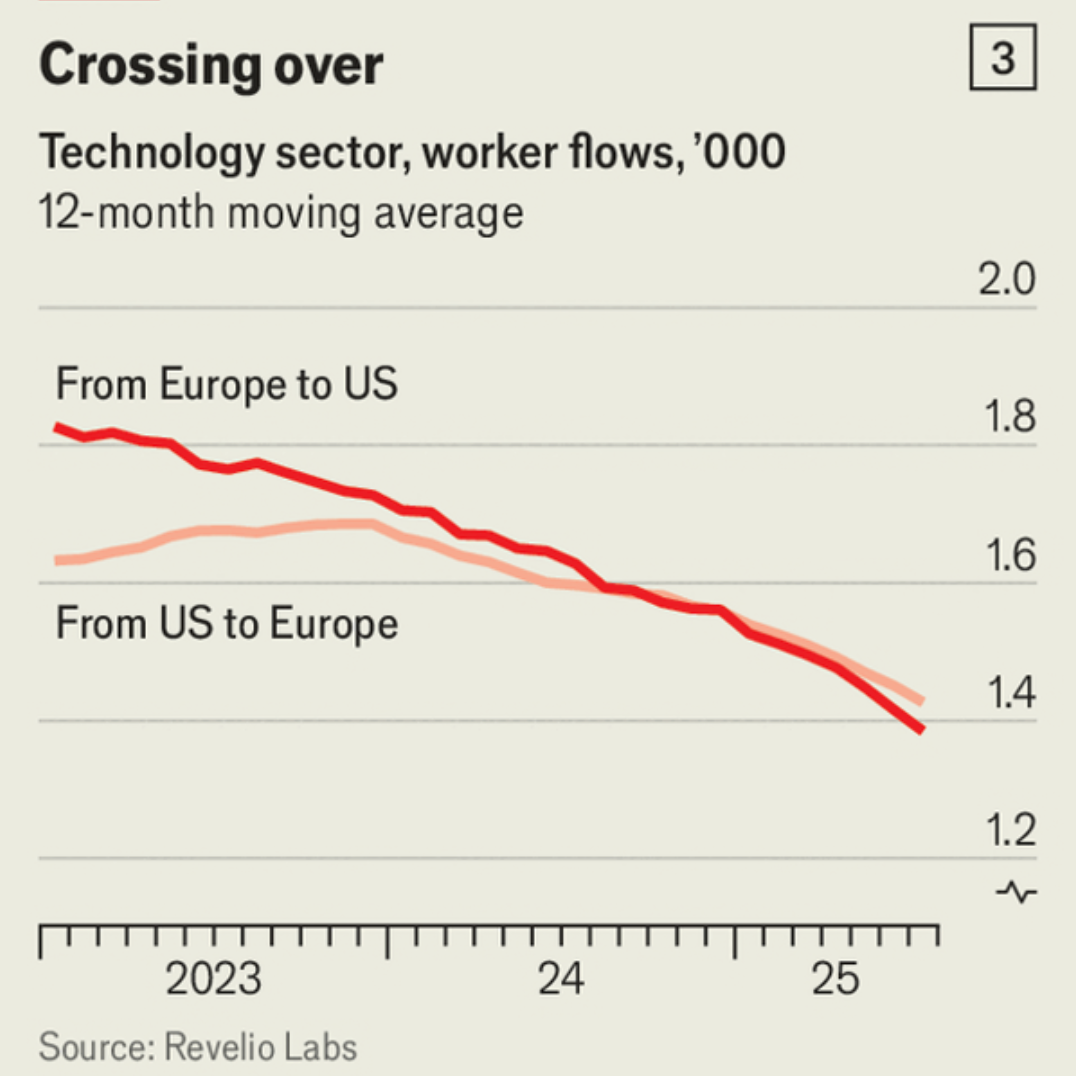
Meanwhile, Mr Trump’s foul treatment of foreigners, and recent lay-offs by American tech giants, are driving talent to Europe. Data from Revelio Labs, a workplace-data firm, show that the brain drain has reversed direction (see chart 3). Lovable, for example, has recruited executives from American software companies such as Notion and Gusto. What is more, fewer European tech firms are selling themselves to American ones. According to Dealogic, a data provider, from 2011 to 2013 American companies accounted for 12% of the acquisitions of European tech firms by number and 35% by value. In 2023-25 that dropped to 9% and 17% respectively.
China, too, is helping inadvertently. Its model of state-directed innovation has crowded out private investment and shrunk VC spending, pushing some towards Europe. Between 2015 and 2025 China’s share of global VC spending fell from 30% to 10%. Europe’s grew from 12% to 16%.
To get rich is glorious
Europe is also getting over its reluctance to let techies make lots of money. In “The New Geography of Innovation”, a book published last year, Mehran Gul, of the World Economic Forum, notes that Skype, a European startup, created just 11 millionaires in the early 2000s. PayPal, an American one, gave many more stock options to its employees, creating over 100. They, in turn, invested in newer Silicon Valley startups.
Now European tech companies are giving out more options, and the region’s established tech tycoons are helping youngsters make fortunes. Nikolay Storonsky, founder of Revolut, a fintech company, has backed firms such as Spiko, a French startup in the same sector, and Biorce, a Spanish medical-technology firm. Daniel Ek, Spotify’s founder, is a big investor in Helsing, a German defence-tech company. Former staff of Klarna, a Swedish fintech star, have created more than 60 startups, according to figures from Dealroom, another data provider, and Accel, a VC fund.
None of this means that Europe will supplant America as the leading techno-power. Last year it launched just two of the world’s 94 new cutting-edge large language models, according to Epoch AI, a think-tank. The idea that the EU will manufacture a fifth of the world’s computer chips by 2030, an objective of the commission, is fanciful. But in some areas Europe is becoming more competitive. Three sectors—all of them helped by Mr Trump’s actions—stand out.

Even before he started his second term last year, Europe’s climate-technology sector was catching up to America’s. From 2015 to 2016 VC spending on Europe’s green startups was 24% of America’s. That share grew to 55% by 2024-25. Mr Trump’s gutting of environmental regulation in America will no doubt encourage the trend. Last year the number of American climate-tech startups raising VC funds dropped to its lowest since 2019.
There is no sign of demoralisation among European green-tech firms. In December Octopus Energy, a British provider of green power, spun off Kraken, which sells smart-grid software, at an estimated valuation of $9bn. Sweden is a hotspot for green-tech startups. Stegra aims to make carbon-free steel there. Einride is electrifying freight transport. In Switzerland Climeworks builds machines that suck carbon dioxide from the air.
Mr Trump’s demand that Europe (including Ukraine) do more to defend itself is also spurring high-tech arms-making in a region that had little of it. In 2015-17 VC investment in European defence tech was barely 1% of North America’s. By 2023-25 that had risen to 6%. The International Institute for Strategic Studies, a think-tank, says that Europe’s defence spending rose by 42% from 2023 to 2025; America’s defence budget, though much bigger, was unchanged. Whereas long-established contractors account for much of defence spending in America, in Europe there is more scope for young defence-tech firms.
When Ukraine’s innovative drone-makers are done fighting Russia, many will presumably found or join European defence-tech firms
Munich has emerged as a hub for them. Behind a metal-panelled door marked “Confidential” at Helsing’s headquarters in the city is a “demo room”, where its newest weapons are illuminated with red light. The HX-2, a drone with wings in the shape of an X and a range of 100km, has AI systems that help it attack targets, such as tanks, even if they are protected by communications-jamming technology. Helsing is defiantly European. It calls the autonomous fighter it is building “Europa”. Much of the capital comes from Mr Ek, leaving the firm less reliant on American VCs. Helsing does not want to be “the little brother of some bigger thing in America”, says Niklas Köhler, a co-founder. Its neighbours include Quantum Systems, a maker of surveillance drones that is valued at $4bn, and Isar Aerospace, which builds vehicles that launch small satellites. When Ukraine’s innovative drone-makers are done fighting Russia, many will presumably found or join European defence-tech firms.
“Deep-tech” firms investing in unproven technologies may benefit as well from Mr Trump’s hostility to scientific research. Proxima Fusion, spun off from the Max Planck Institute for Plasma Physics in Munich, has raised over €200m ($236m) for nuclear-fusion reactors. Nearby are quantum-computing startups, such as Planqc, also a Max Planck spinoff, and firms specialising in nanotechnology, photonics and laser communications.
The share of European VC investment that went to deep-tech companies rose from 19% in 2021 to 36% last year, according to Atomico, a VC fund. In some niches European startups are raising more than American ones. Since 2023 European hydrogen startups (whose technology is both deep and green) have secured more capital than young American firms. In quantum technologies, European and American startups are almost on a par.
It is possible, of course, that Europe’s tech dawn will be a false one. One worry, especially for defence companies, is that European governments are short of cash. On February 25th the budget committee of Germany’s legislature called for “moderation” in defence spending and cut the expenditure on contracts with Helsing and Stark Defence, a rival. Few think that the world’s next trillion-dollar tech company will be European. But, perhaps for the first time, that does not seem a silly idea.
© 2026 The Economist Newspaper Limited. All rights reserved.