Sydafrikas miljardreform ses som bromskloss för rättvisa
Sydafrikas omtalade politik för ekonomisk upprättelse, Black Economic Empowerment (BEE), kritiseras allt mer för att ha skapat en elit på bekostnad av tillväxt och social rättvisa.
Sedan starten har motsvarande 56 miljarder dollar i tillgångar överförts till färre än hundra individer, enligt forskaren William Gumede.
– Det är en av de mest slösaktiga och ineffektiva omfördelningsstrategier som någonsin skapats i ett postkolonialt samhälle, säger han.
Opinionsundersökningar visar i sin tur att en majoritet vill se en mer meritokratisk modell, skriver The Economist.
 The Economist
Race, power and money in South Africa
The staggering costs of Black Economic Empowerment.
After the end of apartheid South Africa embarked upon one of the world’s most extensive attempt to redress racial inequality. At the centre of this effort is Black Economic Empowerment (BEE), a set of policies that, in effect, mandate firms to sell discounted assets to black investors, hire more black managers and procure more from black suppliers. But the flagship scheme of the African National Congress (ANC), the party in charge since 1994, is being questioned like never before.
The Trump administration cites BEE as a reason it is imposing 30% tariffs on the country. Inside South Africa there is growing concern that these policies, while perhaps necessary at first, are no longer fit for purpose. BEE has mostly benefited a tiny black elite while restraining economic growth, undermining the social stability it was meant to underpin.
The Trump administration cites BEE as a reason it is imposing 30% tariffs on the country.
BEE was conceived by South Africa’s largest conglomerates, six of which in the early 1990s accounted for 86% of the value of the Johannesburg Stock Exchange (JSE). To convince the ANC, hitherto committed to nationalising the economy, of the merits of capitalism, they needed black capitalists. So they sold cheap shares or units to ANC bigwigs such as Cyril Ramaphosa, now South Africa’s president. The ANC’s response to criticism of the policy as an elite stitch-up was the Broad Based Black Economic Empowerment Act, passed in 2003. The law turned ad hoc corporate atonement into a vast regulatory system.
Today BEE is a form of gamified affirmative action. Firms are awarded points based on five aspects. These are ownership (having black shareholders), management (having senior black staff), skills development, socio-economic development (charity) and enterprise and supplier development (buying from black-owned firms). Firms with a low score will struggle to get state contracts and licences or to attract commercial partners. “Your BEE rating will determine your success in business in 90% of cases,” says Deirdre Mitchell of Honeycomb, a BEE ratings firm.
To supporters BEE is a source of harmony. “If we had kept the pre-democratic status quo then South Africa would have imploded at some point,” says Tshediso Matona, who heads the BEE regulator. He argues that the policy has also grown the black middle class.
The first claim is based on an unproveable counter-factual. South Africa, with one of the highest murder rates in the world and periodic unrest, is hardly tranquil. Inequality, measured by the benchmark Gini coefficient, is higher today than in 1994, partly because of rising inequality among black South Africans. One study suggests the gross income of the top 10% of black earners tripled between 1993 and 2019, while that of the bottom 50% fell. This reflects persistently high joblessness—less than 40% of black South Africans of working age are in formal employment—caused by slow economic growth.
The main beneficiaries were a mostly politically connected elite and the (mostly white) facilitators who took large cuts
“Very, very conservative” estimates by William Gumede, an academic who in the 2000s worked on a review of BEE, are that more than 1trn rand ($56bn) in assets may have been transferred to fewer than 100 people since BEE began. The main beneficiaries were a mostly politically connected elite and the (mostly white) facilitators who took large cuts. One banker says that a “paper transfer” of 25% of a firm’s equity typically ends up being worth 8%, after transaction costs and loans to buy the assets are paid off. Mr Gumede calls BEE “one of the most wasteful, costly and ineffective redistribution strategies devised in any post-colonial society”.
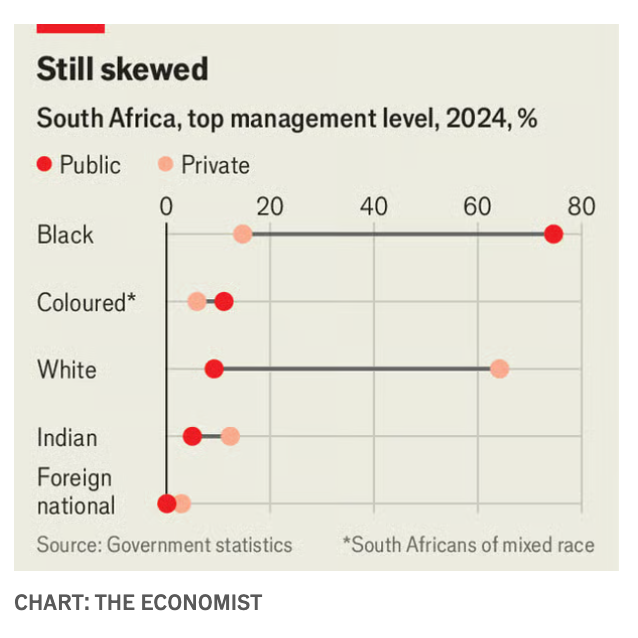
Has BEE fostered a black middle class? The number of black-owned firms doubled between 2002 and 2019, but that might have happened anyway. The growth of black employment in the public sector has been more important. Today 75% of senior managers in state employment are black (roughly akin to the 82% of the population that is black), versus 15% in the private sector. The latter could be proof of enduring racism or the lingering effects of apartheid-era schooling on the skill levels of black South Africans.
In June the Free Market Foundation, a think-tank, estimated that the annual cost for firms to comply with BEE was 145-290bn rand, equivalent to 2% to 4% of GDP. Though there are reasons to quibble with the methodology, BEE certainly adds costs to firms and creates perverse incentives.
Firms maximise points by buying from businesses owned by black South Africans, with extra points if they are women-owned. That often means “three people in the supply chain rather than two,” says Ms Mitchell. The state can spend 25% above cost if a good or service is from a black supplier, according to the Institute of Race Relations, a think-tank. These “BEE premiums” add to already soaring public debts. Procurement rules provide a pretext for giving contracts to cronies.
BEE is plagued by “inputitis”, where points are given for spending, not results. Firms can get points by paying for courses that are never completed. This has led to a mini-industry of people enrolling in but never completing multiple vocational schemes known as “learnerships”. Only firms with at least 50 employees have to adhere to racial quotas. So companies forgo growth or split into smaller units.
Some firms try to get around BEE by “fronting”. In its crudest form this is when a firm dupes a black South African—the company driver, say—to be their “BEE partner” on paper, while receiving little of the benefits. Mr Matona says his commission has received more than 1,300 complaints about fronting since 2017.
A recent poll by Ipsos found that 44% of South Africans want BEE to continue. Some 36% say it should end; 20% are unsure
Foreign firms can win exemptions from the ownership requirements of BEE through “equity equivalence” schemes. Microsoft, for example, funded local start-ups. Starlink, Elon Musk’s satellite-internet firm, may be able to strike a similar deal. But these are still extra costs for firms that could invest elsewhere, adding to South Africa’s lack of dynamism. The rate at which firms enter and exit the economy is a third of that in other middle-income countries. The IMF has placed it last in a list of 49 states for ease of doing business.
Moeletsi Mbeki, a commentator, says that BEE has created a “parasitic club” of black South Africans, who (with exceptions) are content with taking their share of existing firms rather than building their own. Combined with high salaries in the public sector—the state wage bill accounts for 15% of GDP versus the OECD average of 10%—this leads to low levels of black entrepreneurship, he argues.
Tshepo Mahloele, one of South Africa’s richest men, supports transformation but worries about the way BEE can add an asterisk to black success. The 57-year-old, who has participated in BEE deals but has also invested successfully outside South Africa, says that in some eyes “when I walk into a room… I’m not first a business person; I’m a black business person.”

A recent poll by Ipsos found that 44% of South Africans want BEE to continue. Some 36% say it should end; 20% are unsure. Those who say it slows economic growth are twice as many as those who say it fosters it. A plurality agree it is “outdated and divisive”. Polling by the Social Research Foundation finds that about 80% believe governments should hire the best people and buy the cheapest goods, regardless of race.
The ANC remains wedded to BEE, despite pressure from the Trump administration and from its main coalition partner, the liberal Democratic Alliance. Indeed its solution to problems with the policy seems to be more state control. It wants to set up a state-led Transformation Fund paid for by firms. Tweaks passed this year have imposed more stringent quotas.
Mr Ramaphosa argues that BEE is “not just a policy choice but a constitutional imperative.” He says it is a “false notion that we must make a choice between growth and transformation”. But the truth is that, more than 30 years on from apartheid, his country has too little of either.
© 2025 The Economist Newspaper Limited. All rights reserved.