Utsläppsboven Kina ser sig själv som en klimaträddare
Kina har under nästan två årtionden stått för världens största utsläpp av koldioxid. Samtidigt satsar landet mer på ren energi än någon annan nation, och står för nästan 40 procent av de globala investeringarna i sektorn.
Kritiker i väst menar att mycket av den kinesiska produktionen dumpas utomlands. Men president Xi Jinping hävdar att dess gröna investeringar gör landet till en förkämpe i klimatkampen, skriver The Economist i samband med toppmötet COP29.
 The Economist
Mega-polluter China believes it is a climate saviour
It accounts for almost 40% of global investment in clean energy.
Which countries should spend more to save the planet? That is a question that diplomats and activists are sparring over at COP29, the UN’s climate summit in Azerbaijan from November 11th to 22nd. A common answer is China, which Westerners accuse of contributing too little to efforts aimed at helping poor countries cope with climate change. For nearly two decades China, the world’s second-largest economy, has been the biggest emitter of carbon dioxide.
Chinese officials push back, arguing that their country is still developing and that it is responsible for fewer historical emissions than America and Europe. But their strongest counterargument is that China is already spending more than any other country on the green transition. It is driving global investment into clean-energy technologies, which, as a result, are being rolled out around the world at rates unimaginable just a decade ago.
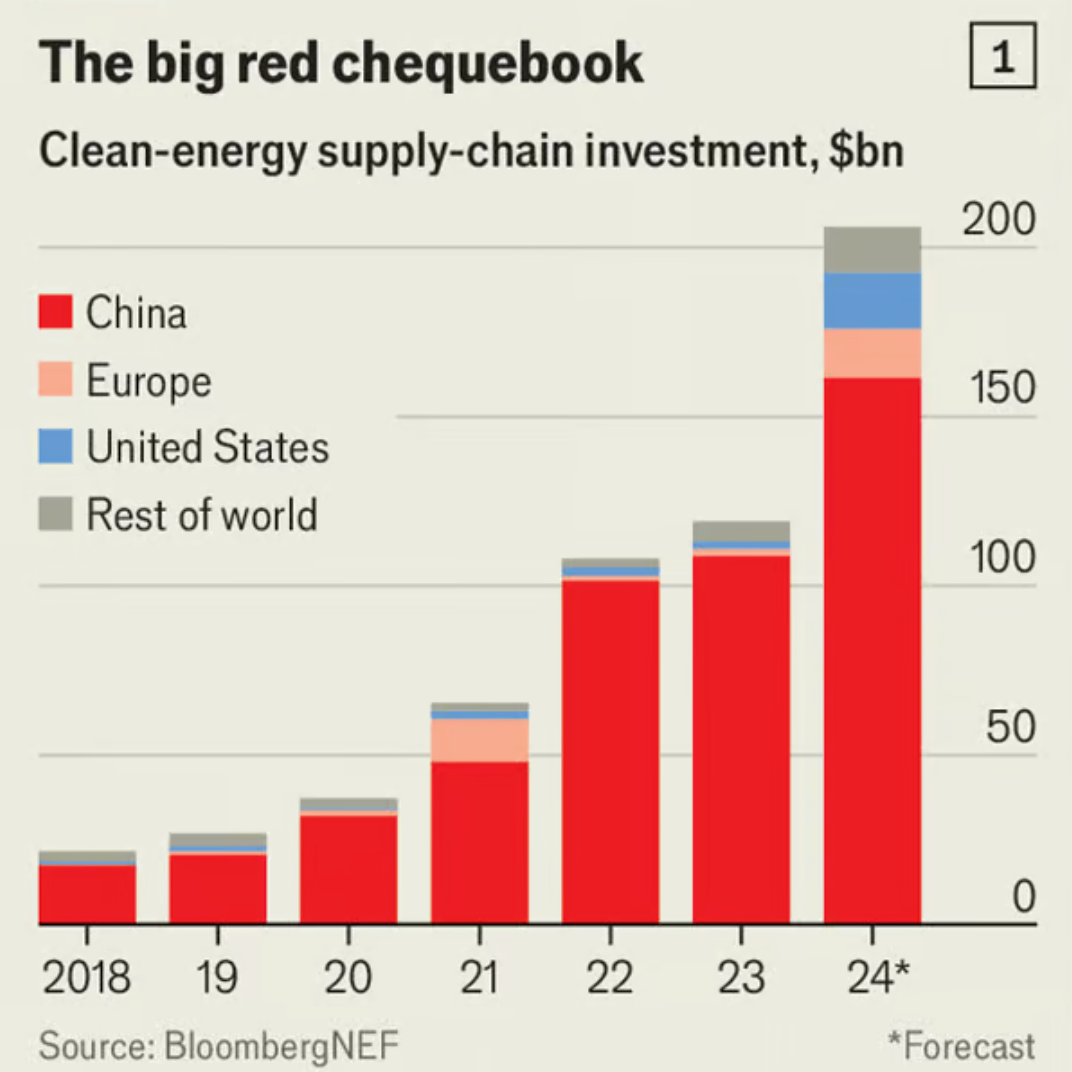
Chinese money props up every stage of the clean-energy supply chain. Between 2018 and 2023 global investment in the refineries and factories that turn raw materials into wind turbines, electric vehicles (EVs) and other green technologies came to $378bn, according to BloombergNEF, a research firm. Nearly 90% of that came from China (see chart 1). Europe and America have started to pony up more. Even so, China is expected to account for over three-quarters of the total in 2024.
Thanks to these investments, China produces far more clean-energy equipment than any other country. Its companies manufacture enough lithium-ion batteries (which are used to power EVs) to satisfy the whole of global demand. Eight in ten of the world’s solar panels are made in China, according to the International Energy Agency, an intergovernmental body. China has enough manufacturing capacity to produce them at twice today’s rate. By building whopping economies of scale and competing with each other fiercely, Chinese companies have slashed costs.
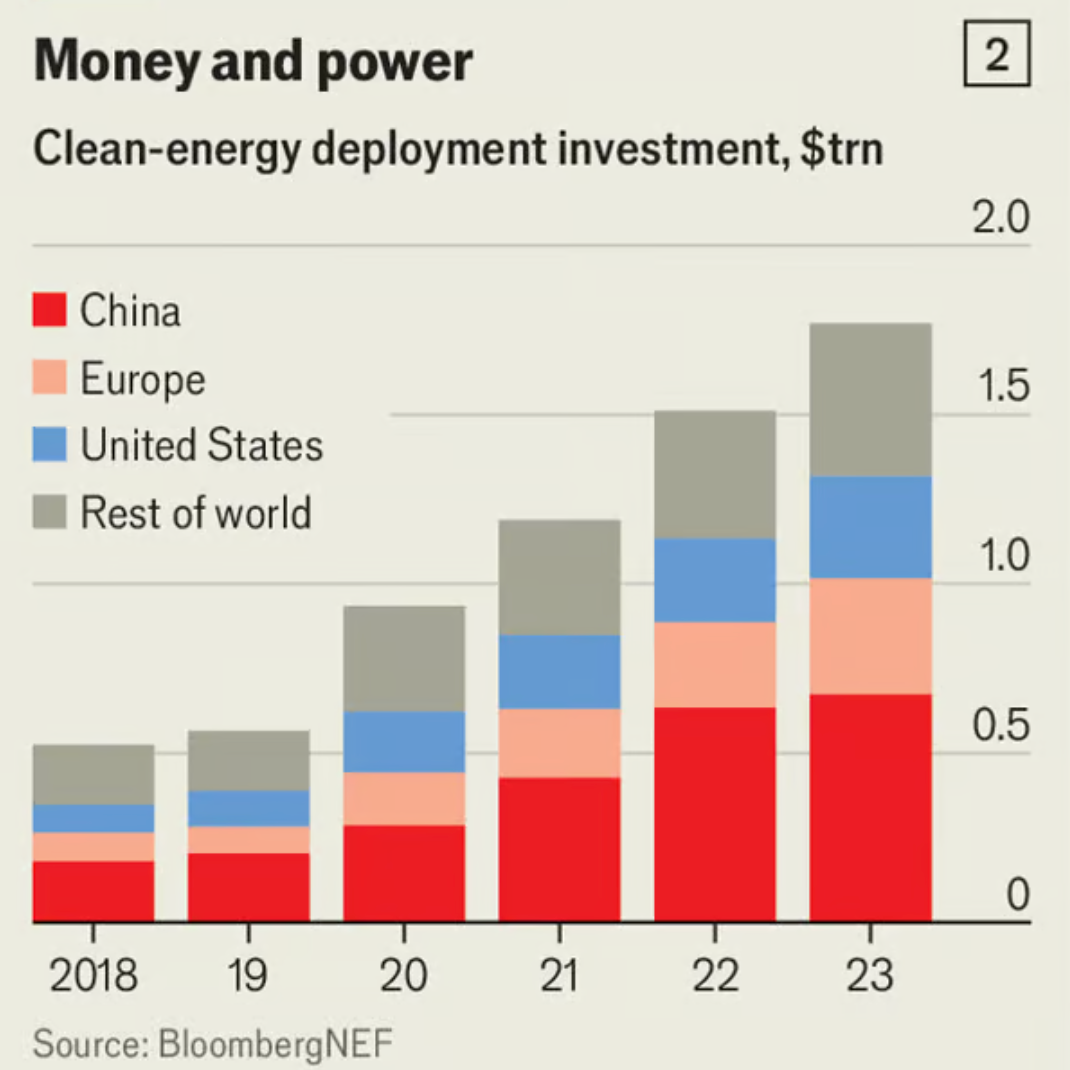
China is not only supplying these technologies, it is driving demand for them. More than half of its electricity is still generated by coal. But just last year Chinese companies plugged some 300 gigawatts of wind- and solar-power capacity into the grid, nearly two-thirds of the amount installed globally. (For comparison, Britain’s total power capacity is 100 gigawatts.) In June the world’s biggest solar farm came online in the western region of Xinjiang. It covers an area of desert twice the size of Manhattan. China is also building more nuclear-power plants than any other country. Last year global spending on the deployment of clean-energy technologies came to $1.8trn, according to BloombergNEF, of which 38% occurred in China (see chart 2).
When it comes to the size of such outlays, China has two big advantages over other countries. Thanks to a high savings rate, it has long relied on investment, rather than consumption, to drive economic growth. And its authoritarian government is capable of directing much of that investment to sectors it favours. For example, after the global financial crisis of 2007-09, officials channelled vast amounts of money to property, roads, and railways (China now has lots of all three). Over the past decade the state has increasingly targeted clean energy.
Some of what China is doing to mobilise investment would be familiar elsewhere. Like Germany and Japan, it has incentivised the generation of renewable power by guaranteeing an above-market price for it (what is known as a feed-in tariff). China has also encouraged its companies to issue green bonds, financial instruments that channel funds towards environmentally friendly projects. China is the world’s largest market for them.
China’s ruler, Xi Jinping, has dubbed clean energy one of the “new productive forces”—a term he uses to describe the industries of tomorrow
But it is in other forms of state support for the clean-energy sector that China stands most apart. So-called “government guidance funds” have taken stakes in privately owned businesses to support research and development. State-run banks have handed out lots of cheap loans. And local governments have competed to offer firms generous subsidies in the form of inexpensive land and lower taxes. China’s EV-makers, for example, received a total of $231bn in subsidies between 2009 and 2023, according to a report by the Centre for Strategic and International Studies (CSIS), a think-tank in Washington.
Waste is a big problem. Investments are often replicated, as different regions of China vie to create local champions. By offering up so many subsidies, provincial, county and city governments have added to their already unmanageable debt loads. And because production has outpaced domestic demand, clean-energy industries are suffering from overcapacity. As a result, China’s battery and solar manufacturers are undergoing a wave of painful consolidation.
Innovation and aggravation
Western governments point to these handouts when accusing China of unfair competition. But China’s clean-energy success is down to a number of factors, says Lauri Myllyvirta of the Centre for Research on Energy and Clean Air (CREA), a think-tank in Finland. It has long been a manufacturing powerhouse and its companies have access to a deep pool of engineering graduates. China’s demand for power is still growing fast, creating a reliable market for new generating capacity. (Many Western countries, by contrast, saw power demand stagnate or fall in the 2010s.) And Chinese firms—such as CATL, the world’s largest maker of lithium-ion batteries, and BYD, an EV giant—have proven to be agile and innovative.
Still, China’s sending of green technologies abroad has provoked a backlash in some parts of the world. America and the European Union have accused it of trying to export away its overcapacity problem and of flooding international markets with artificially cheap goods, making it impossible for their own firms to compete. Both have imposed steep tariffs on things like Chinese EVs. America’s president-elect, Donald Trump, is now threatening a full-on trade war.
In the face of all this, China’s policies are evolving. As clean-energy industries have matured, the state has reduced its support. Feed-in tariffs for renewable power were rolled back in 2021, after solar and wind became cost-competitive with fossil fuels. Schemes to subsidise purchases of EVs are being wound down.
This does not foreshadow a collapse. China still needs lots of power, and even if it did not have a long-range target of reaching net zero emissions by 2060 the fact that renewables are now cheap guarantees that a lot will be used. Chinese leaders, anxious about relying on imported oil and gas, like the increasing diversity of their energy mix. They also see clean energy as a central part of the country’s economic blueprint. Last year investments in the field accounted for 40% of China’s GDP growth, according to calculations by CREA.
China’s ruler, Xi Jinping, has dubbed clean energy one of the “new productive forces”—a term he uses to describe the industries of tomorrow which China must dominate to succeed on the world stage. All this means the success of China’s clean-energy sector is now linked to Mr Xi himself, says Ilaria Mazzocco of CSIS. “These have become priority industries, no matter how tough the times get.” Put another way: China will continue to make the world’s transition to clean energy easier—if the world lets it.
© 2024 The Economist Newspaper Limited. All rights reserved.