Danskar slutar leverera brev efter 400 år: ”Inte lönsamt”

Efter 400 år avslutar Danmark sin tradition av att samla in och leverera brev. Den sista december blir Postnord först i Europa med att skrota brevtjänsten helt, som en följd av digitalisering och fallande efterfrågan.
– Brevmarknaden är inte längre lönsam, säger Kim Pedersen, vd för danska Postnord.
Bara i fjol minskade brevvolymen med 30 procent, och julkorten lyser med sin frånvaro. Från 2026 flyttar de ikoniska röda postlådorna in på museum, skriver The Economist.
 The Economist
Denmark gets ready to cancel Christmas cards
The Danish post is the first to end letter collection, but others will follow.
When Peter Kurrild-Klitgaard and his family moved to Frederiksberg, a leafy neighbourhood of Copenhagen, 17 years ago, they had five or six post boxes within a few minutes’ walking distance. Today there are none. They have been progressively removed by PostNord, the state-owned mail service. On December 30th PostNord will take things further: after 400 years, it will end its collection and delivery of letters entirely.
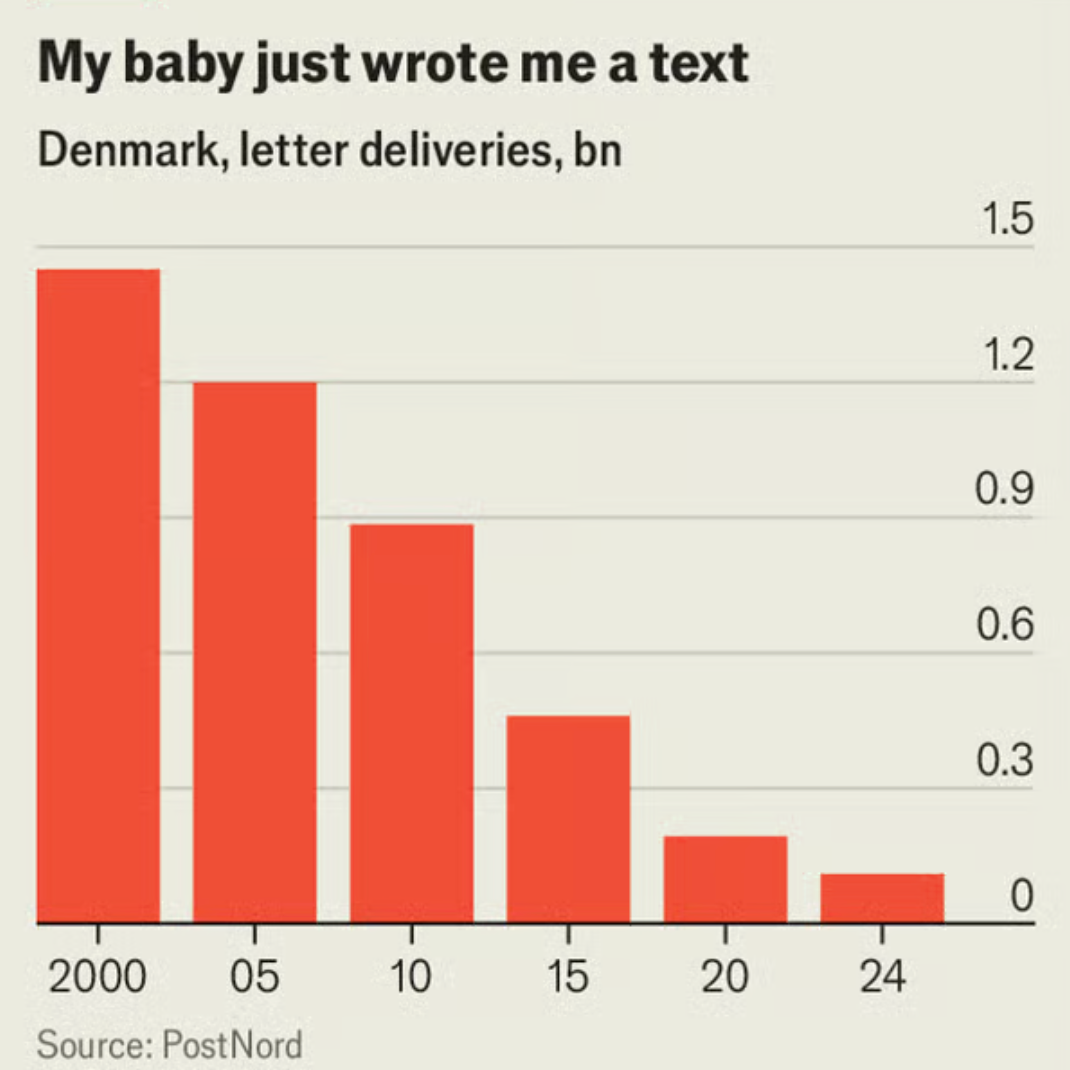
Denmark will be the first European country to do so. The step is demand-driven: over the past 25 years the volume of letters has declined by 90% (see chart). In 2024 alone it fell 30%, the result of a new law that ended Denmark’s universal service obligation (which required postal companies to make service accessible to everyone at an affordable price) and opened the market to rivals. It also scrapped the postal service’s exemption from value-added tax. Postage for a standard domestic letter shot up to DKr29 ($4.50), and DKr39 for next-day delivery. That sealed the letter’s fate. “In 2023 we still received 50 Christmas cards by post,” says Mr Kurrild-Klitgaard. Last year the family received one.
Post offices all over the world have seen the volume of letters collapse over the past two decades, as email, text messages and social-networking sites replace paper. The covid-19 pandemic exacerbated the trend: housebound people communicated online more than ever. Meanwhile e-commerce took off, and the number of parcels continues to grow fast. In 2022 the number of packages shipped was 161bn worldwide; it is projected to reach 256bn by 2027.
Some post offices have reinvented themselves. Privatised services, such as those of Malta and Portugal, are generally in better shape than state-run ones. Italy’s partly privatised Poste Italiane has had a good run under Matteo Del Fante, an ex-banker. The profitable firm provides banking and insurance services as well as delivering letters and parcels. Postepay, its pre-paid debit cards, introduced in 2003, are a great success with around 7.2m in use.
“The rate of decline of the volume of letters differs according to the level of digitisation of a country”
Germany’s Deutsche Post DHL group, a listed company whose biggest shareholder is Germany’s state-owned development bank, is also profitable, and was voted the world’s best postal service alongside Switzerland in 2024. After privatisation in 1995, Deutsche Post reinvented itself as a logistics company that also provides freight and supply-chain management services (warehousing and distribution). Britain’s Royal Mail, though partly privatised—its majority owner is Daniel Kretinsky, a Czech entrepreneur—has not done as well. In August it reported an operating profit for the first time in three years; after including the cost of voluntary redundancies, it still made a loss.
Many state-owned carriers, meanwhile, are suffering. On November 3rd the loss-making Greek post office closed 204 of its 456 branches. That caused a nationwide outcry, with opposition politicians arguing that it is vital for social cohesion and for reaching elderly Greeks in remote areas. Workers at Canada’s state-owned post have been striking, on and off, since September, in a dispute over wages, benefits and job security. The United States Postal Service (USPS) serves the world’s largest single market: North America accounts for 37% of global postal revenue. It reported a $9bn annual loss on November 14th, and its cumulative losses since 2007 come to more than $100bn. Donald Trump has called the service “a joke” and is reportedly considering folding its 635,000 workers into the Department of Commerce.
Letters are not dead yet. “The rate of decline of the volume of letters differs according to the level of digitisation of a country,” says Armen Ghalumyan of Cullen International, a research firm. They still account for a substantial portion of postal revenue. Until recently India and Brazil still had rising volumes of letters because of their growing middle classes, according to the Universal Postal Union (UPU).
Denmark, however, is among the most online of countries. In 2024 the United Nations ranked the digitisation of its public sector best in the world, for the fourth consecutive year. “The letters market is no longer profitable,” according to Kim Pedersen, PostNord’s chief executive. The fewer sent, the higher the unit cost of handling them.
Others will follow Denmark, predicts Henrik Ballebye Okholm of Copenhagen Economics, a consultancy—not immediately, but perhaps in a decade. Danes will still be able to send letters (or get them from abroad) via DAO, a private company, but they will have to go to a DAO branch. Bright red post boxes with a post horn and the Danish crown have adorned the country’s streets since the mid-1800s. From next year, they will be adorning its museums.
© 2025 The Economist Newspaper Limited. All rights reserved.