Musks AI-startup lockar talanger med rekordlöner
Elon Musks startup X AI har framgångsrikt samlat in 6 miljarder dollar och nått en värdering på 24 miljarder dollar. Företaget har rekryterat experter från Google och Microsoft, och erbjuder generösa lönepaket för att locka de bästa talangerna i branschen.
Musk planerar nu att bygga en massiv superdator för att konkurrera med Open AI och andra stora aktörer. Men utmaningarna är många, skriver The Economist. Det kan tvinga X AI att följa andra startupföretags exempel och utveckla modeller som är mindre och billigare.
 The Economist
Can Elon Musk’s xAI take on OpenAI?
It has some advantages. But it is entering a crowded field.
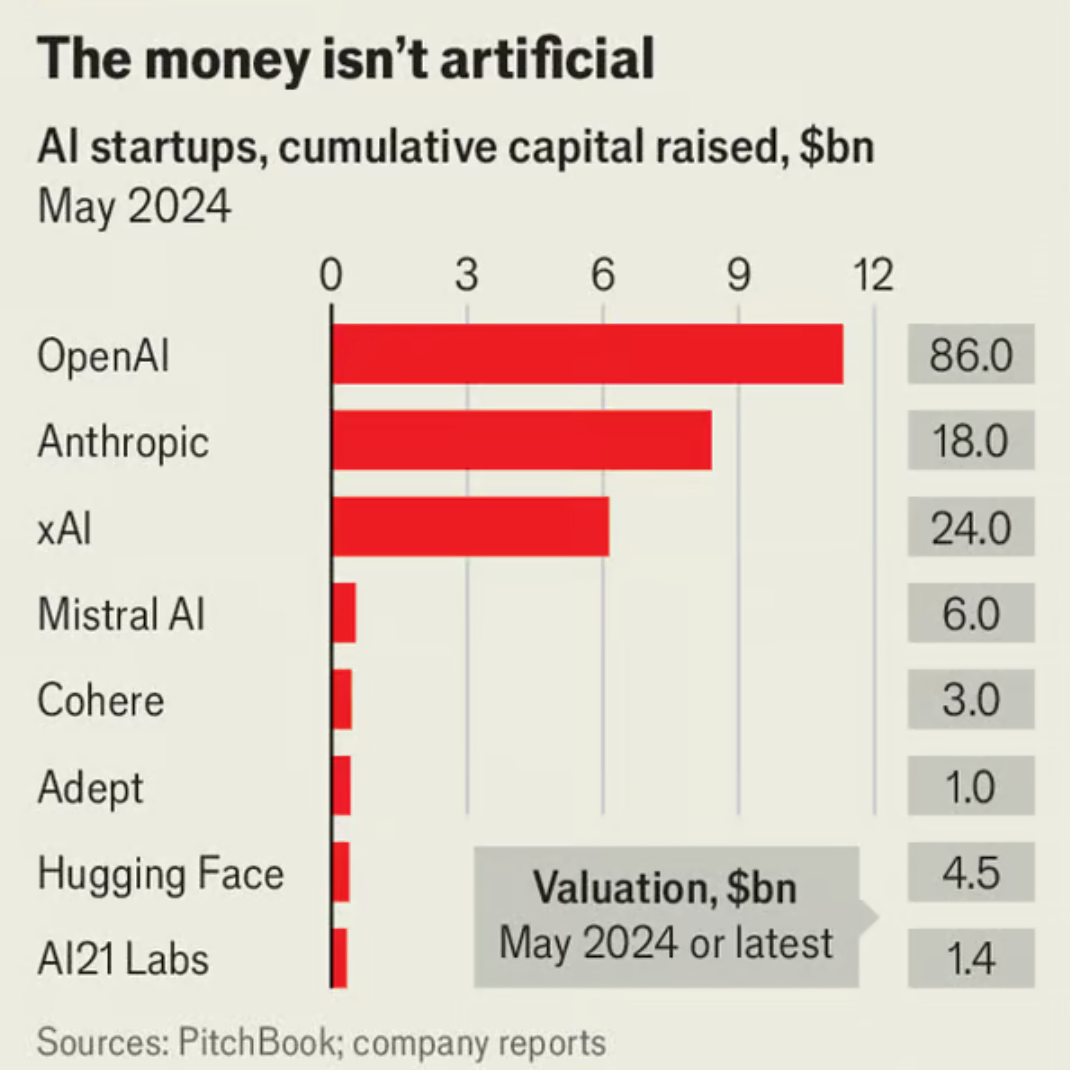
Every day seems to bring fresh bets on artificial intelligence (AI). In the past few weeks CoreWeave, an AI cloud-computing company, and H, a French AI startup, have raised hefty sums of money. On May 26th it was Elon Musk’s turn. The tech billionaire’s startup, christened XAI, said it had raised $6bn at a valuation of $24bn. Investors include Silicon Valley stalwarts such as Sequoia Capital and Andreessen Horowitz, two venture-capital (VC) giants, and an investment fund with ties to the Saudi royal family. Their backing puts XAI’s firepower in the big leagues, alongside model-builders such as OpenAI, the creator of ChatGPT, and Anthropic (see chart). Can Mr Musk compete with the AI superstars?
This is not his first foray into AI. Mr Musk co-founded OpenAI, then left after falling out with Sam Altman, its boss. In April he told investors that Tesla, his electric-vehicle maker, should be viewed as an AI firm. Never one for modest ambitions, Mr Musk wants his latest venture, which he launched last July, to “advance our collective understanding of the universe”.
That is tech speak for building large AI systems that are as good as humans at many intellectual tasks, or better. In this pursuit, XAI has many of the necessary strengths. Through Mr Musk’s purchase in 2022 of Twitter, a social-media site now called X, it enjoys access to reams of human-generated data. That is ideal for teaching an AI system how to interact with people. Footage from Teslas, which are equipped with plenty of cameras and other sensors, could in time feed xai’s models, too. Through an arrangement with Oracle, a business-software and cloud-computing behemoth, XAI is renting specialist AI servers that machine-learning algorithms need to crunch the data.
Mr Musk is also a magnet for talent: XAI has poached boffins from Google and Microsoft. Founders of other startups have complained that XAI prices them out of the market by offering astonishingly generous pay packages. It might also benefit from talent from elsewhere in Mr Musk’s empire. When he bought Twitter, some 50 software engineers from Tesla were reportedly called in to help with tasks such as code reviews. A handful of Tesla engineers have recently been hired by XAI.
There are, as ever with the mercurial Mr Musk, plenty of risks
All that has helped XAI “develop high performing models from a standing start”, notes Nathan Benaich of Air Street Capital, a VC firm. In November it released Grok, its answer to ChatGPT, which it sells to X users on a subscription basis. An update followed in the spring along with a preview of another version of Grok that can interpret images.
Mr Musk wants to go further. He has said that he needs 100,000 AI chips to build the next version of Grok. According to the Information, a tech-news outfit, he told XAI investors that he wants to build an enormous supercomputer that will come online in late 2025. This “gigafactory of compute” would rival a similarly ambitious project discussed by OpenAI and its big-tech partner, Microsoft.
There are, as ever with the mercurial Mr Musk, plenty of risks. One is his increasingly packed schedule. Along with Tesla, XAI and X (where he is not the CEO but does hold the post of executive chairman), he also runs SpaceX, a rocketry business, Neuralink, a brain-implant firm, and Boring Company, which builds tunnels. If that didn’t keep him busy enough, he is involved in numerous legal battles, including one to reinstate a $56bn pay package from Tesla that was struck down by a judge in Delaware, and another to move Tesla from that state to Texas.
A bigger problem is competition, which is white-hot in model-making. Startups are up against the titans of tech—including Alphabet, Amazon, Microsoft and Meta—which are building their own AIs. Many less titanic but still large companies, such as Adobe and Salesforce, are getting in on the AI action, too. Switching between rival models tends to be easy for users, and XAI’s Grok lacks distinctive selling points.
OpenAI in particular still has more money and better access to processing power than its rivals, including this latest one. That may force XAI to follow the lead of other startups and develop models that are smaller (and cheaper) than OpenAI’s, but not quite as powerful, argues Mr Benaich. Not quite the cosmic understanding that Mr Musk seeks.
© 2024 The Economist Newspaper Limited. All rights reserved.