Musks plan är fullt möjlig – frågan är om stödet finns
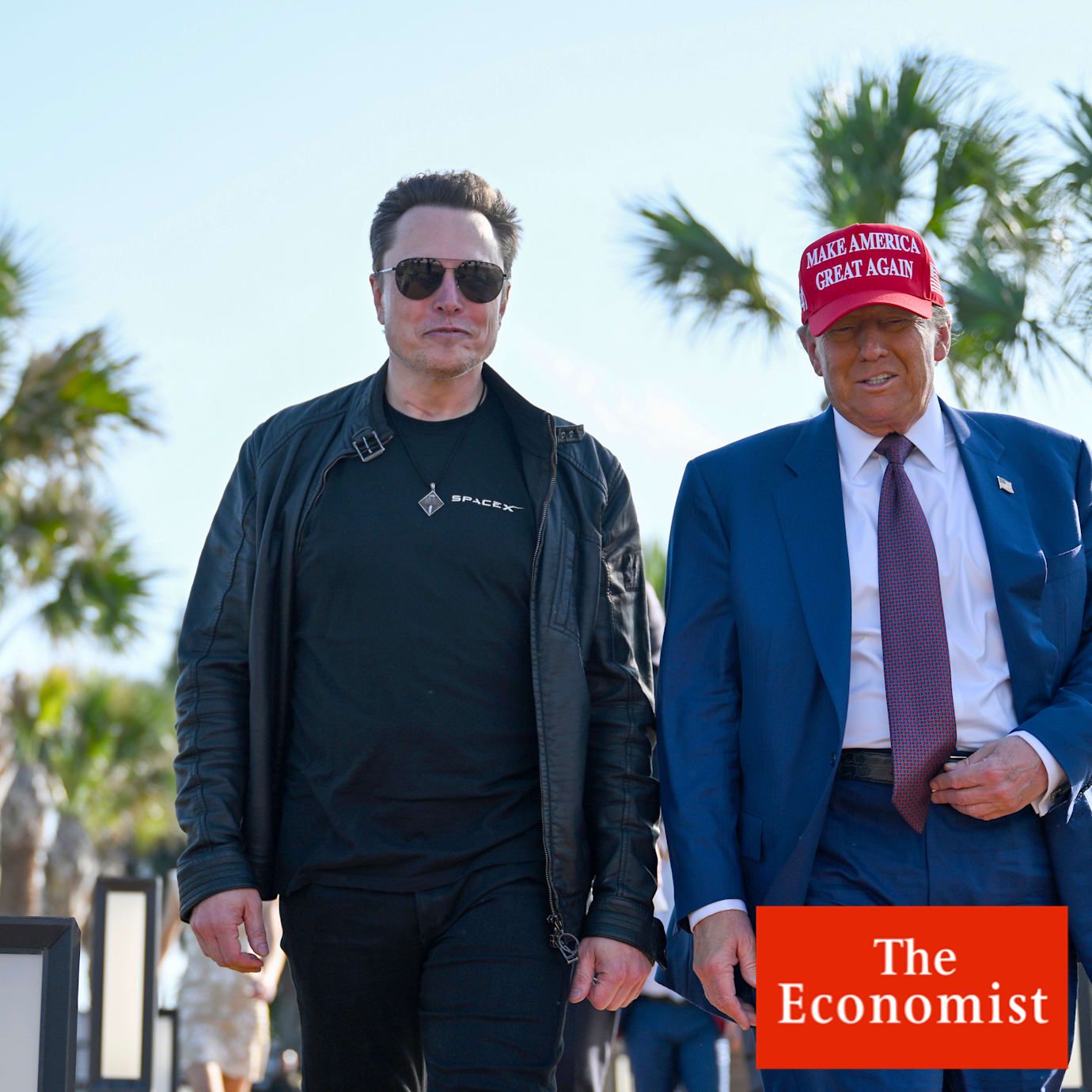
Elon Musk och Vivek Ramaswamy vill ”effektivisera” staten och karva bort 2 000 miljarder dollar från USA:s budget. Det kan låta absurt men det är faktiskt möjligt och dessutom nödvändigt, skriver The Economist.
Men först och främst räcker inte de två åren som Trump har gett dem att utföra jobbet – snarare tio. Sedan finns färdiga manualer för hur man kan gå tillväga, bland annat genom att reformera vård- och pensionssystemen. Problemet är inte att hitta lösningarna – utan att få politiskt stöd att genomföra dem, skriver tidningen.
 The Economist
How to make Elon Musk’s budget-slashing dreams come true
We offer some suggestions
ELON MUSK and Vivek Ramaswamy are keen to whip the American government into shape. On November 14th their newly created Department of Government Efficiency (DOGE) announced it wants to hire “super-high-IQ small-government revolutionaries” to get to work on cost-cutting. It is easy to ridicule the enterprise. Mr Musk has talked of ripping $2trn out of the federal budget, an amount that, if done in one year, would exceed the government’s entire discretionary spending. Moreover, Donald Trump has given DOGE less than two years to get the job done. And the entity is a small advisory body, not an actual department, with a name inspired by a joke cryptocurrency.
But it would be a mistake to make light of DOGE’s mission, because it does get at two essential truths. First, America’s fiscal trajectory is unsustainable. The national debt is approaching 100% of GDP, up from 35% in 2007.
Mr Musk has talked of ripping $2trn out of the federal budget, an amount that, if done in one year, would exceed the government’s entire discretionary spending
With the federal deficit running at 6% of GDP—a level once associated with wars and economic downturns—debts are bound only to climb higher, raising the risk of an eventual crisis. Second, the situation is not actually hopeless. There are plenty of ways that American officials can, in theory, put the country on a sounder fiscal footing (though getting budget cuts through Congress is another matter).
None of the small-government revolutionaries at The Economist has applied for a job at DOGE, as far as we know. But we do have a few suggestions. One general point is that time scale matters. Whereas cutting $2trn in a year is absurd—it would leave public offices incapable of performing many basic functions, and most likely involve slashing the defence budget—achieving those sorts of savings over the next decade is eminently doable. Moreover, DOGE would not be starting from scratch. There are already plenty of well-researched blueprints for sorting out America’s finances. It is useful to break them into four categories: conventional spending cuts; tweaks to entitlement eligibility; changes to health-care spending; and tax reform.
Across-the-board spending cuts appear to be what Mr Musk and Mr Ramaswamy have mainly in mind when they rail against government waste. Yet there is an obvious problem. Consider the $6.8trn spent by the federal government last fiscal year. After excluding interest on existing debt as well as mandatory allocations to pensions and health insurance, just about 25%—or $1.8trn—remains. These are the discretionary funds at the heart of the annual budget process. Almost half goes to defence, which Mr Trump is loth to cut. So that leaves roughly $900bn allocated annually by the federal government to transport, education, science, national parks and law enforcement.
Nevertheless, paring back discretionary spending ought to be part of the solution. It has grown by nearly a third since 2019, propelled by big increases during the covid-19 pandemic. Rather than making outright cuts, DOGE could call for strict caps on future discretionary allocations, a simple budgeting technique used on and off since the 1990s. If, for instance, discretionary-spending growth was capped at 2% per year (in line with expected inflation) until 2035, that would work out to a saving of about $500bn over the next decade relative to the forecast of the Congressional Budget Office (CBO), a non-partisan scorekeeper. That would be a good start.
Cutting $2trn in a year is absurd — achieving those sorts of savings over the next decade is eminently doable
Next is a recognition that America cannot fix its finances without tackling social security and Medicare, two giant programmes that together gobble up more than a third of the budget. Mr Trump vowed in his campaign platform that he would make no cuts to them. That should not stop DOGE from weighing the options. America is experiencing much the same demographic pressure as other rich countries: people are living longer, and assets meant to support them in their retirement are being stretched to cover more years. One response would be to raise the age of eligibility. To be sure, this would not be politically easy, as demonstrated by the backlash in France when Emmanuel Macron raised the retirement age there. But Mr Trump is no stranger to controversy.
The Penn Wharton Budget Model, a research group, examined the effects of delaying Medicare coverage to the age of 67 from 65. The change would be phased in by two months a year, so that it would take a dozen years to fully implement it. The savings would be about $50bn annually. Similarly, the Penn Wharton modellers looked at raising the age for full social-security benefits (in effect, a national pension) to 70 from 67. That would also reduce the government’s obligations by about $50bn annually. Over the next decade the combined savings from these two delays to when programmes start would be around $1trn.
DOGE could then get to work on the government’s broader health-care spending. States design and operate Medicaid—health insurance for lower-income Americans—but the federal government funds about two-thirds of it. This leads to a misalignment in incentives: the federal commitment is open-ended, so if spending at the state level rises, federal spending does, too. The CBO has examined potential tweaks. One would be to set a federal cap on payment per person enrolled. Were the cap to increase at the rate of inflation, it would reduce the federal deficit by almost $900bn over the next decade.
Much else can be done to reduce medical spending even more. There is ample evidence of waste in parts of America’s fiendishly complex Medicare system. DOGE would do well to get acquainted with MedPAC, an independent commission that advises Congress on how to manage the health-care system. Among its many recommendations, it has called for closer scrutiny of billing, for more competitive bidding between providers, and for mandating that the same medical service costs basically the same at every facility (currently, hospital outpatient departments charge more than clinics). The Committee for a Responsible Federal Budget, a non-partisan group, totted up several such ideas and concluded that they could save the federal government about $550bn over a decade. And if Mr Trump were to build on the Biden administration’s efforts to negotiate lower prices for prescription drugs, there would be another $200bn-worth of savings.
The main obstacle, therefore, is not intellectual firepower but political will
If DOGE were truly courageous, its final target would be America’s tax system. Given Mr Trump’s oft-professed desire to slash taxes, it is utterly unrealistic to expect him to raise them instead. But it would be irresponsible to look at America’s fiscal health today without considering whether, and how, to generate more revenue. The good news is that the government does have options short of outright tax increases. Reducing tax deductions for health-insurance plans bought through employers could lower the deficit by at least $500bn over a decade, according to the CBO. Covid-era tax credits for companies that retained employees are, shockingly, still being processed; ending these would save another $80bn. And arguably the best investment the government can make in terms of its potential return is to modernise and strengthen the Internal Revenue Service (IRS), in order to crack down on fraud and make filing tax returns less onerous. If Mr Trump sustains funding increases approved by Mr Biden, tax collectors could bring in about $850bn in extra revenue over the next decade, according to the Treasury department. Alas, many Republicans would rather shrink the IRS.
Implementing all the various proposals laid out above would save the government about $4.5trn over the next decade. And there is much more that can be done: in a report in 2022 the CBO offered 76 different policy options for reducing the deficit. The main obstacle, therefore, is not intellectual firepower but political will. Budget cuts are never popular. What’s more, the White House cannot act on any of this alone. Any serious fiscal policies must go through Congress. That may end up being the biggest test of DOGE and Mr Trump: not whether they can draw up cost-cutting proposals, but whether they can win the support of their fellow Republicans.
© 2024 The Economist Newspaper Limited. All rights reserved.