Tio år efter brexit: Britterna har blivit mer europeiska
Nästan tio år efter folkomröstningen om EU har Storbritannien i flera avseenden blivit mer likt de europeiska länderna i unionen man lämnade. Britterna dricker mer kaffe än te, födslotalen har fallit mot europeiska nivåer och fler unga vuxna bor kvar hemma på grund av höga bostadspriser. Ekonomin utvecklas ungefär i takt med eurozonens.
Till och med politiken har blivit mer europeiskt fragmenterad: med flera partier över tio procent och ett högerpopulistiskt parti i opinionsledning, skriver The Economist.
 The Economist
Ten years after the EU referendum, Britain has become more European
A nation of caffeinated populists.
Almost a decade ago Britons started buying more coffee than tea. And not just any coffee. The long-running Family Food Survey shows that shoppers used to favour instant coffee: in the mid-1970s they bought about five times as much of that revolting stuff, by weight, as coffee beans. The scales tipped to beans in 2019. “The UK has become a coffee-drinking nation,” says Dock No, a statistician at the International Coffee Organisation.
Britain has become more like a continental European country in that respect, and in many others. The birth rate has slumped and young people are living at home for longer. Its economy tracks that of the euro zone. Britain is about to acquire continental-style employment regulations and renters’ rights. Its politics looks decidedly European, with a fissile electorate and a populist party leading the polls. And even the Telegraph, a strongly pro-Brexit media brand, is being bought by Germany’s Axel Springer.
None of this seemed probable ten years ago, as campaigning began for the forthcoming referendum on membership of the European Union. Those who wanted to stay in the EU feared that Britain might throw out continental imports like parental leave and working-time restrictions, while some hot-headed Brexiteers argued that the country should align itself with the Commonwealth or what they called “the Anglosphere”. But the eventual vote for Brexit in June 2016 is a big reason why Britain has become more European.
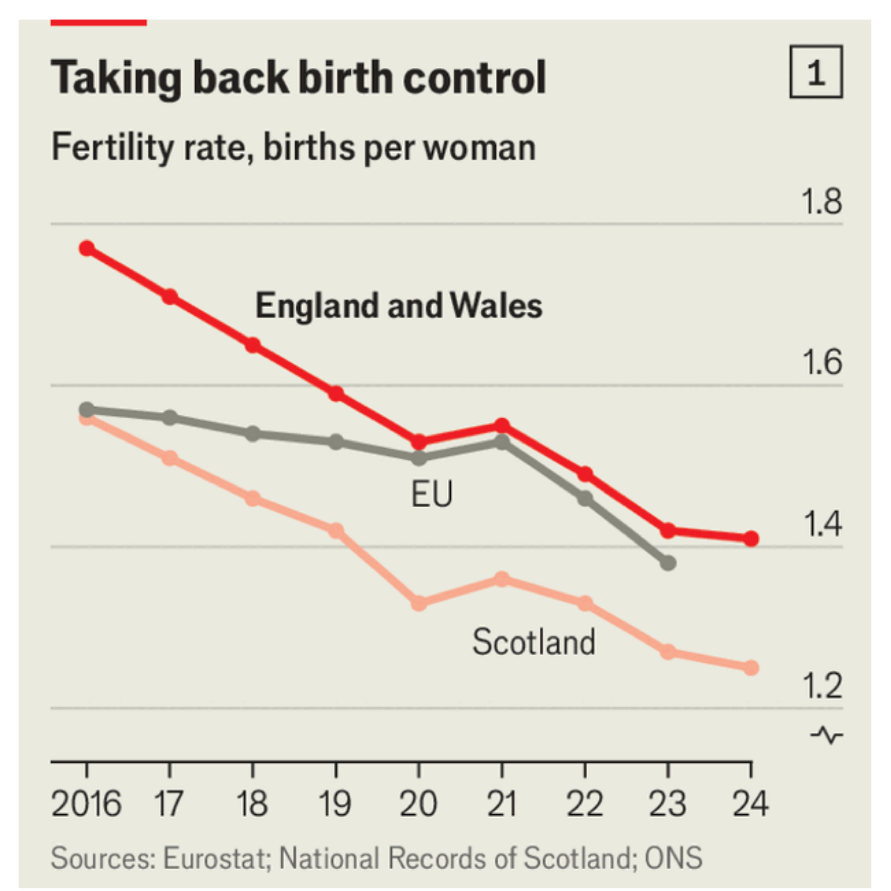
Start with reproduction. The fertility rate in England and Wales had been falling for a few years before the referendum. It stood at 1.8 in 2016. By 2024, the last year for which figures are available, it had dropped to 1.4 (see chart 1 ). The fall brings England and Wales close to the EU average. They have joined a central European medium-fertility clique that includes Austria, Germany and Hungary. Scotland has come to resemble the low-fertility countries of southern Europe.
In 2024 fully 49% of 24-year-olds were living in the family home, up from 36% a decade earlier. As with fertility, Britain has come to resemble a central European country. The Institute for Fiscal Studies, a think-tank, has shown that high house prices encourage young people to stick around, as does ethnic-minority heritage. In pricey, ethnically mixed London, one in five people in their 50s and 60s have a 25- to 34-year-old child living with them, a higher share than anywhere else.
Economically, Britain was something of an outlier ten years ago. Although its gdp growth was hardly spectacular, the country had sidestepped the euro crisis, which hobbled southern Europe. Many British politicians believed that a chasm had opened between their country and the rest of the continent. Douglas Carswell, a Eurosceptic, argued that Britain was “shackled to a corpse”. Even Sir Nicholas Soames, a Europhile Tory, described Europe as mired in “insecurity, lack of confidence and lack of optimism”.
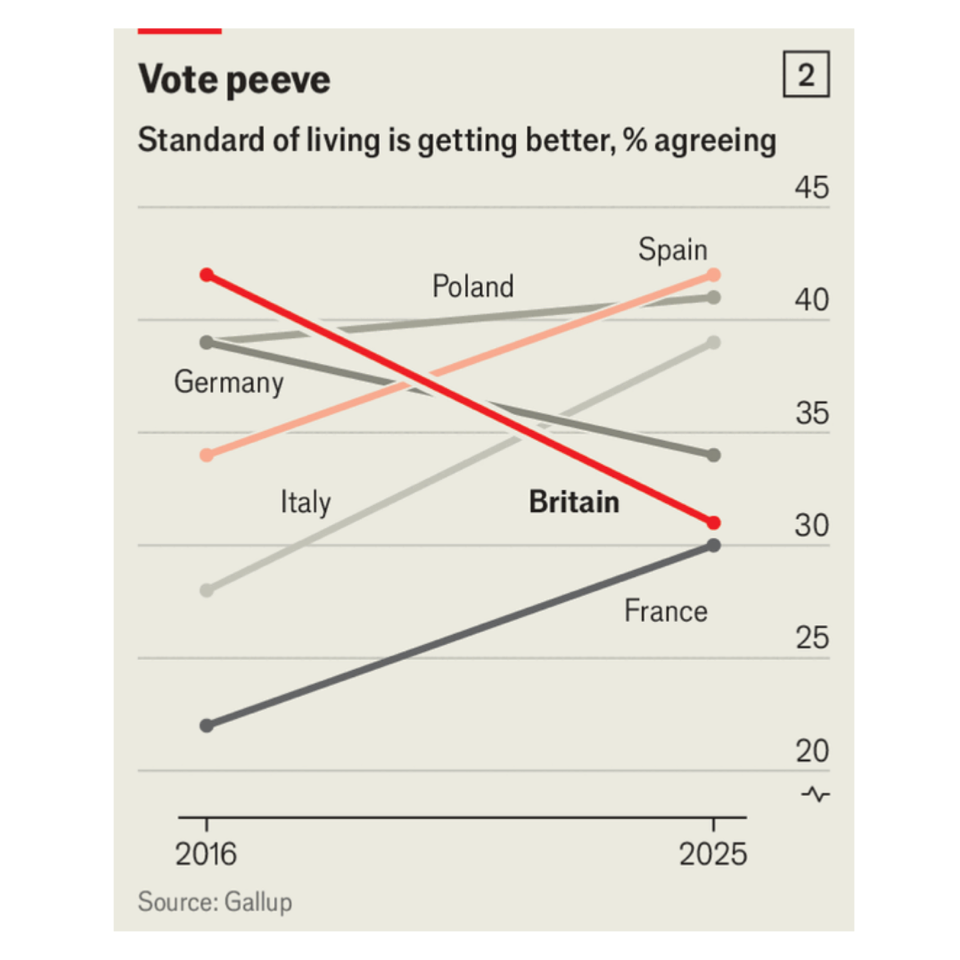
The gap was never as wide as politicians claimed, and it has since disappeared, partly because Brexit has crimped trade and investment in Britain. The imf projects gdp growth of 1.3% this year in both Britain and the euro zone. In 2016 the Gallup World Poll found that 42% of British people thought that their standards of living were getting better—higher than the proportion who said the same in France, Germany, Italy, Poland or Spain (see chart 2). By 2025 only 31% of Britons were similarly optimistic. They had become about as gloomy as the French, who make a national sport of pessimism.
In 2016 some Remainers worried that Britain might turn its back on the “social Europe” of workers’ rights. The opposite has happened. British governments have shored up entitlements by strengthening paternity-leave rules and, from next month, introducing tougher protections against redundancy. Labour politicians and trade unionists argue that the changes will make Britain more like the rest of Europe—as they will.
The same is true of the property market. Britain has long been a European outlier when it comes to residential lettings. Landlords were comparatively lightly regulated and tenants were more exposed to rent increases and the repossession of their homes. That is about to change. On May 1st, the “section 21” rule that allows many English landlords to reclaim their properties will be abolished and tenants will be able to appeal against rent rises.
Politically, Britain has become more European too
Emmanuelle Causse, secretary-general of the Brussels-based International Union of Property Owners, says that Britain is falling into line with other European countries. The Netherlands made indefinite tenancies the default in 2024. Ireland is severely restricting the ability of large landlords to recover their properties. With the partial exception of Scotland, Britain has avoided the extreme market meddling pursued in France and Germany, where rent increases have been capped. But some, including the mayor of London, want to do just that.
Politically, Britain has become more European too. On the eve of the referendum, two-thirds of voters favoured the Conservatives or Labour—the two parties that had dominated politics for almost a century. Only one other outfit, the United Kingdom Independence Party, scored more than 10% in the polls. Today five parties are polling above that threshold. Reform UK, a populist anti-immigration party, is in the lead; the other runners are Labour, the Conservatives, the Liberal Democrats and the Greens.
Britain has never seen such political fragmentation, nor has a populist right-wing party led the polls before. The country has come to resemble continental countries such as France and Switzerland, where National Rally and the Swiss People’s Party are in front. Again, Brexit is part of the reason. The 2016 plebiscite reorganised British politics along cultural lines: people increasingly vote not according to their class but according to their attitudes to issues such as immigration. Reform and the Green Party, specialists in cultural politics, have benefited.
Britain is highly unlikely to rejoin the EU in the next few years. But it finds itself aligned with continental Europe in many ways—including in its citizens’ feelings about the EU. Before the 2016 referendum, the World Values Survey showed that Britons trusted the institution much less than the citizens of other large European countries did. They now trust it almost as much as Germans do and slightly more than Italians, simply because Britons have warmed. Rejoining the club would be immensely difficult and fractious. It might, however, feel right.
© 2026 The Economist Newspaper Limited. All rights reserved.