Billig el, ökad invandring och stark börs lyfter Spanien
Medan många europeiska ekonomier kämpar, går Spanien oväntat starkt. Ekonomin växte med 3,2 procent i fjol och det spanska börsindexet Ibex 35 – som följer landets största börsbolag – steg med hela 14,8 procent, en av de bästa siffrorna i Europa.
Billig grön el och en rejält ökad invandring driver utvecklingen, skriver The Economist. Storföretag som Inditex och Santander går bra, men också mindre aktörer som ingenjörsfirman Sener.
– Efterfrågan i alla våra sektorer exploderar samtidigt, säger företagets ordförande Andrés Sendagorta.
 The Economist
Spanish business thrives while bigger European economies stall
Cheap energy and high immigration are the motors of success.
“The future is bright” is a phrase rarely uttered by European business leaders these days. But José Manuel Entrecanales, the chief executive of Acciona, is brimming with optimism for both Spanish business and his family’s company, which he has transformed from a construction firm to one focused on renewable-energy infrastructure. He reflects a mood in Madrid that is happy and enthusiastic—in contrast to the anxiety in Berlin or Paris.
Spain’s economy grew by 3.2% last year, nearly four times the euro-area average, while France’s expanded only tepidly and Germany’s shrank. The IBEX 35, tracking Spain’s biggest listed firms, was up by 14.8%, one of the best showings among Europe’s leading stockmarket indices. The tourism industry, which was hard-hit by the pandemic, welcomed a record 94m visitors to a country of 48m people. It expects 100m this year. Tourism contributes 13% of GDP directly and 20% indirectly, through spending on restaurants, transport and retailing. “It’s our oil,” jokes José García Cantera, the chief financial officer of Santander, a bank.

Plenty of Spain’s largest companies are thriving. Inditex, perhaps the principal corporate success, has long been one of the world’s biggest fashion retailers. Spain is also home to two of Europe’s top ten banks by market capitalisation (BBVA and Santander), as well as leading construction and infrastructure firms (Grupo ACS, Acciona, Ferrovial and Grupo FCC). Repsol is one of Europe’s oil majors and Iberdrola one of its biggest electric utilities.
Less known are the country’s smaller stars. One is Sener, an engineering firm with around 4,000 employees, which is based in Bilbao. “Ninety percent of our sales are abroad but we still feel very Spanish,” says Andrés Sendagorta, chairman of the family business. “Demand in all areas we are operating in is exploding at the same time.” One of his biggest headaches is finding qualified staff. Sener is building a gas terminal and a data centre in Germany. It is also helping build a high-speed railway from Abu Dhabi to Dubai and another in California. And in January it won the contract to refurbish five airports in Saudi Arabia.
In ten years some 90% of Spain’s electricity will come from renewable sources
Two big factors have been working in Spain‘s favour. The first is cheap electricity, with prices almost as low as those in America. Twenty years ago Spain imported 50% of its electricity. Today it has achieved a high degree of self-sufficiency by harnessing solar, wind and hydroelectric power. According to BBVA, the share of renewables in power generation increased from 45% in 2021 to 65% in 2024, which led to a 20% fall in electricity prices. Reaching the government’s target of 80% by 2030 would mean a further fall of around 20%, the bank says. In ten years some 90% of Spain’s electricity will come from renewable sources, predicts Mr Entrecanales.
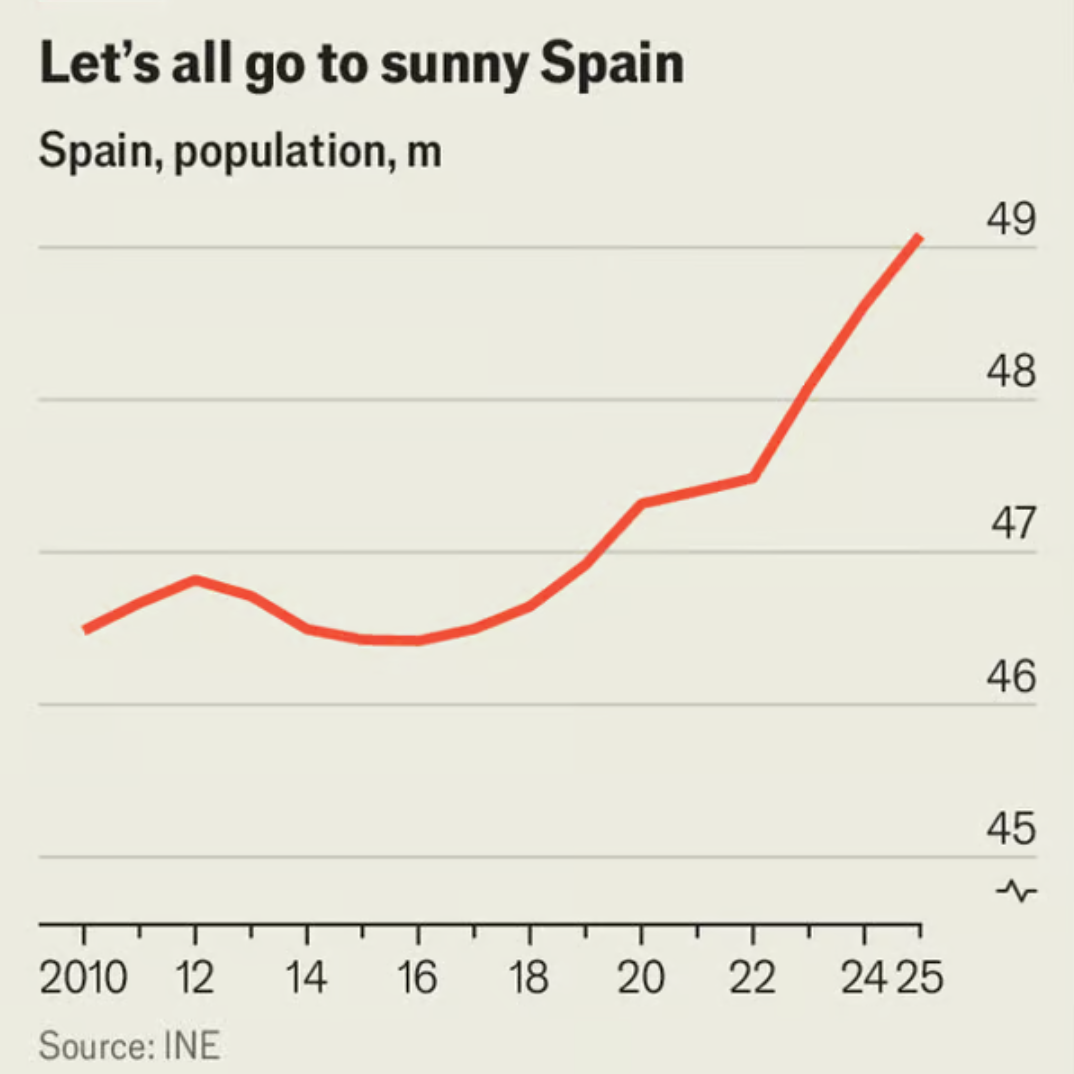
A second advantage, business leaders say, has been immigration. In the past 12 years Spain’s population has grown from around 46m to 49m (see chart); in the past six the foreign-born workforce has risen by 1.2m. Perhaps because most new arrivals speak Spanish and have a similar culture, immigration has not brought the same political tensions as in other countries. Vox, a hard-right party, campaigns on culture wars (eg, abortion) rather than on anti-immigrant sentiment.
High levels of immigration are expected to continue but that has fuelled demand for housing, which is already outstripping supply. Tens of thousands took to the streets of Madrid and 40 or so other cities at the beginning of April to demand affordable homes. A report by Spain’s central bank found that nearly 40% of families who rent spend more than 40% of their income on housing. Over the past ten years rents have doubled, while salaries have risen by just 20%.
Spanish business is not immune to other problems visible elsewhere on the continent. It needs to boost investment and productivity, says Rafael Doménech, chief economist of BBVA. Private-sector investment is still below the level of 2019. Low business investment affects productivity if firms don’t invest in, say, the latest technology. In the past ten years labour-productivity growth has averaged a measly 0.2%, well below the OECD average of 0.9%.
Uncertainty about new laws and regulations and excessive red tape from both regional and central governments are deterring investors, explains Juan María Nin of the Circulo de Empresarios, a business think-tank. At the centre, a fragile Socialist-led coalition has been unable or unwilling to pass business-friendly reforms. Last month the cabinet approved a bill to shorten the working week from 40 hours to 37.5 hours without loss of pay. Some regions, such as Madrid, are kind to businesses; others, such as Catalonia, are not. The enlargement of Barcelona’s airport has been stalled for 15 years.
The other government causing concern is across the Atlantic. Pedro Sánchez, the prime minister, is trying to promote alternative trade partnerships. On April 10th he was the first European leader to visit China since Donald Trump unveiled his “reciprocal” tariffs. It helps, too, that Spain exports less to America than many other countries, so will be less vulnerable to Mr Trump’s levies—another reason for Spanish bosses to be more cheerful than their peers elsewhere in Europe.
© 2025 The Economist Newspaper Limited. All rights reserved.